Scales efficient language processing with open-source accessibility.
357M visits/mo+1%#2 Coding & Development
Decentralized AI platform running models locally via WebGPU without data egress
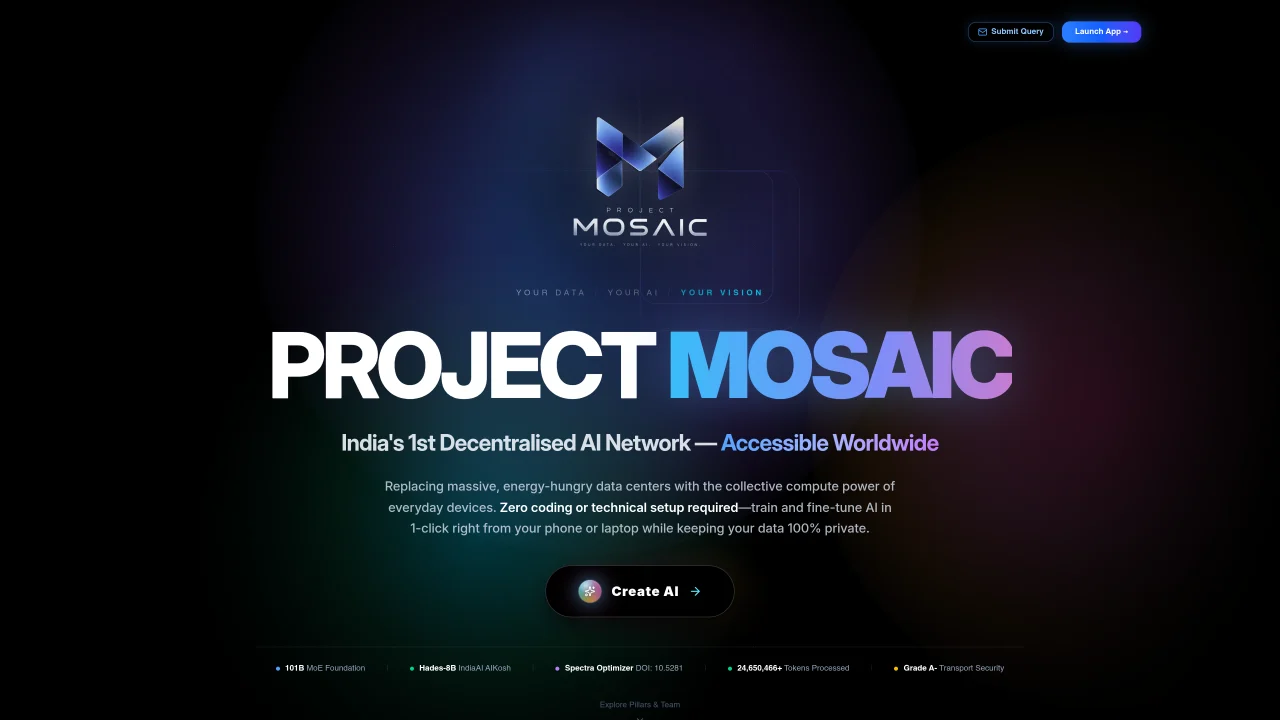
Project Mosaic is a decentralized AI network that replaces centralized data centers with a collective compute mesh using everyday devices. The platform enables users to train and fine-tune AI models in one click directly from personal devices such as phones or laptops without requiring technical setup or coding. All data processing occurs locally in the browser using WebGPU, ensuring zero data leaves the user’s device, which guarantees absolute data sovereignty. The system supports large-scale models through 101B parameter sharding, allowing edge devices to participate in distributed training and inference. Native WebGPU execution reduces VRAM overhead by 41% via the patented Spectra Optimizer, enabling efficient operation on consumer hardware. The platform integrates sovereign AI models like Hades-8B, which are cataloged under India’s official AIKosh repository and optimized for local execution. Ground-truth data streams from sources such as ISRO’s Resourcesat-2A and NASA’s MODIS satellites are ingested while maintaining cryptographic privacy and compliance with national policies.
Project Mosaic is a decentralized AI network that replaces centralized data centers with a collective compute mesh using everyday devices. It enables users to train and fine-tune AI models locally in the browser without requiring technical setup or coding.
The platform is designed for individuals and organizations seeking sovereign AI capabilities, particularly those prioritizing data privacy and compliance with national policies. It suits users who want to leverage local devices for AI training and inference.
All data processing occurs locally in the browser using WebGPU, ensuring zero data leaves the user’s device. This guarantees absolute data sovereignty and cryptographic privacy for sensitive information.
The platform supports consumer hardware, including phones and laptops, through native WebGPU execution and the patented Spectra Optimizer, which reduces VRAM overhead for efficient operation.
Yes, the platform integrates sovereign AI models like Hades-8B, which are cataloged under India’s official AIKosh repository and optimized for local execution.
Users can begin by accessing the platform directly from their browser, where they can train and fine-tune AI models in one click without requiring technical setup or coding.
We use essential cookies to run Aitoolnavio, and optional cookies to analyze traffic and measure our marketing. You choose what we use — optional cookies stay off unless you turn them on. See our Privacy Policy.
One short email a week: fresh tools worth trying, honest takes and the updates that actually matter. No spam, unsubscribe any time.
Scales efficient language processing with open-source accessibility.
Collaboration and version control platform for software development and AI model hosting.
xAI builds Grok frontier AI models for reasoning, coding, voice, images, video, enterprise workflows, and developer APIs.
Unified platform to access and switch between hundreds of AI models like ChatGPT, Claude, and Gemini via a single API.
Meta AI enhances machine learning, NLP, and computer vision capabilities.
Crowdsourced platform for blind, side-by-side AI model comparisons with a public leaderboard.
Customize, deploy, and control AI models securely.
AI-first electronic design automation for ICs, advanced packaging, and systems with hardware-assisted acceleration and elastic cloud delivery.
AI models that return typed decisions with calibrated confidence for software automation
Chat, build, and explore with open AI models.
Multimodal AI models for text, video, speech, music, and coding
Develop, run data jobs, transform datasets, leverage ML algorithms for actionable insights.
Matched on what this tool does — grouped by the job you would be replacing.
matches Zero-coding AI training and fine-tuning interface · 101B parameter model sharding for edge devices · Patented Spectra Optimizer for VRAM reduction
Train and fine-tune large language models faster with up to 70% less memory and twice the speed.
Open-source platform for training, downloading, and running LLMs locally on personal devices with enhanced privacy and customization.
Free Mac app that lets users build a small language model from scratch without coding or math experience.
matches WebGPU-based decentralized compute mesh · Z-Image-Turbo browser-based AI image generator running locally on the user’s GPU · Video2X browser-based AI video upscaler that converts 720p to 1440p locally without installation
matches Cryptographic privacy with DP-SGD and BFT consensus · Sovereign AI models cataloged under IndiaAI AIKosh · SovereignAI self-hosted AI platform running locally with user-owned data and models
Browser-based AI video upscaler that converts 720p to 1440p locally without installation
Browser-based AI image generator running locally on the user’s GPU
A privacy-first personal AI platform that connects scattered app data to on-device models and agents while protecting user privacy with TEEs and cryptographic proofs.
Self-hosted AI platform running locally with user-owned data and models
A hybrid AI agent platform that runs locally on Intel AI PCs, keeping data private while enabling agentic workflows.