GitHub hosts HunyuanVideo, Tencent's open-source framework for large-scale video generation models, enabling AI-driven video creation.

Switch Transformers by Google Brain
0Popularity
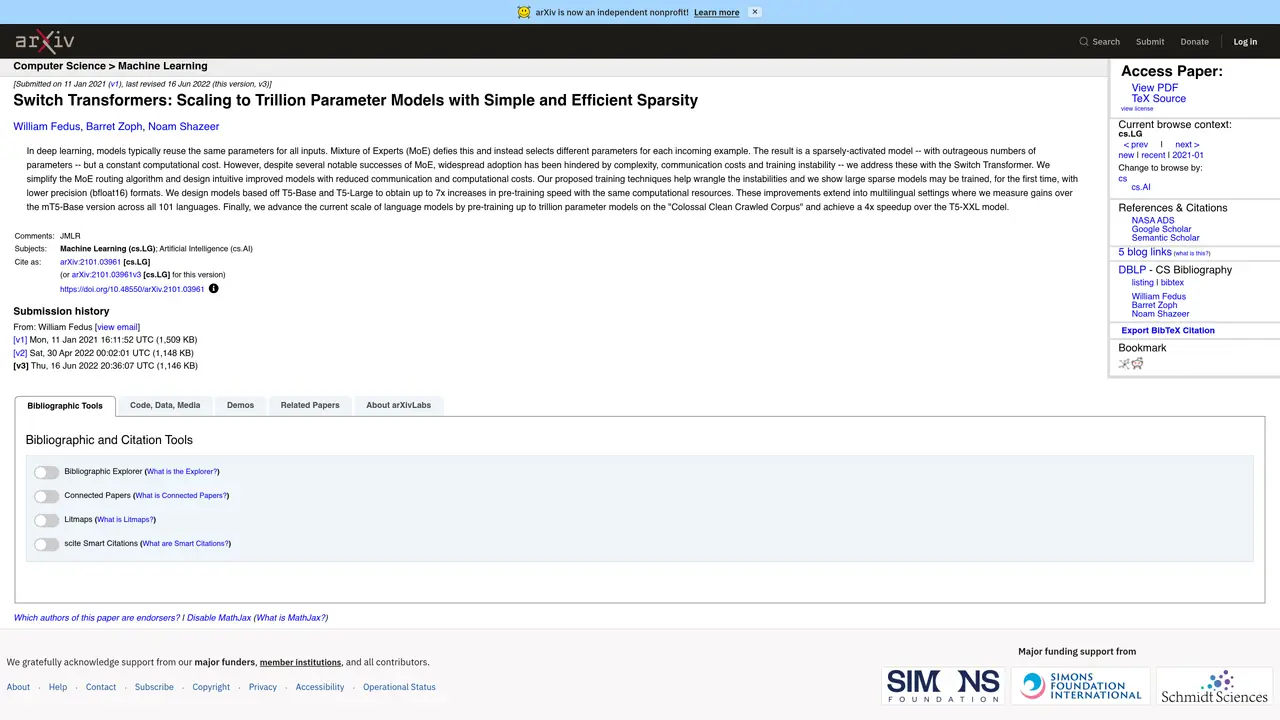
About Switch Transformers by Google Brain
Switch Transformers by Google Brain is an AI technology that enables natural language processing (NLP) and machine learning (ML) systems to process large amounts of data quickly and accurately. Switch Transformers make use of a unique architecture that consists of a set of layers called “switches” that can be used to quickly and accurately process inputs from a variety of sources. These switches are arranged in a hierarchical fashion, with each switch being responsible for processing a specific type of input. This allows the system to process data quickly and accurately, while also reducing the complexity of the system. The benefits of Switch Transformers are many. By using this technology, businesses and organizations can reduce the cost and complexity of their ML and NLP systems, enabling them to process large amounts of data with greater speed and accuracy. Additionally, the hierarchical architecture of the Switch Transformers makes them well-suited for a variety of applications, from language translation to image recognition.
Key features
- Automate large-scale data processing
- Reduce cost and complexity of ML and NLP systems
- Perform tasks like language translation and image recognition
- Hierarchical architecture for efficient processing
- Quick and accurate processing of inputs from various sources
Use cases
- Language translation
- Image recognition
- Automating large-scale data processing
Pros
- Enables training of extremely large sparse models with trillion parameters
- Simplifies Mixture of Experts routing to reduce complexity and communication costs
- Supports lower precision training (bfloat16) for improved efficiency
- Demonstrates up to 7x speed increases in pre-training with same computational resources
- Extends performance gains to multilingual settings across 101 languages
Cons
- Requires significant computational resources for training large-scale models
- Training instability may still pose challenges despite proposed techniques
- Complexity in implementation and deployment compared to dense models
Frequently asked questions about Switch Transformers by Google Brain
What is Switch Transformers?
Switch Transformers is a machine learning architecture that uses sparsely-activated models, where different parameters are selected for each input example. This approach, based on Mixture of Experts (MoE), enables scaling to extremely large models with constant computational cost.
Who should use Switch Transformers?
Researchers and organizations working on large-scale natural language processing or machine learning tasks that require high efficiency and scalability may benefit from Switch Transformers. It is particularly suited for applications demanding massive model sizes without proportional increases in computational resources.
How does Switch Transformers improve over traditional models?
Switch Transformers simplifies the routing algorithm used in MoE models, reducing communication and computational costs. It also introduces training techniques to improve stability and supports lower precision training formats like bfloat16, enabling faster pre-training speeds.
What are the key advantages of Switch Transformers?
The architecture allows for training models with up to trillion parameters while maintaining constant computational costs. It achieves significant speedups in pre-training compared to traditional dense models and demonstrates performance gains in multilingual settings.
Can Switch Transformers be used for multilingual tasks?
Yes, Switch Transformers have been shown to improve performance across multiple languages, including gains over the mT5-Base model in multilingual benchmarks involving 101 languages.
Is Switch Transformers available for public use?
Switch Transformers is described in a research paper and associated implementations are available through platforms like Hugging Face, enabling researchers to experiment with the architecture.