GitHub hosts HunyuanVideo, Tencent's open-source framework for large-scale video generation models, enabling AI-driven video creation.

Troxen
0Popularity
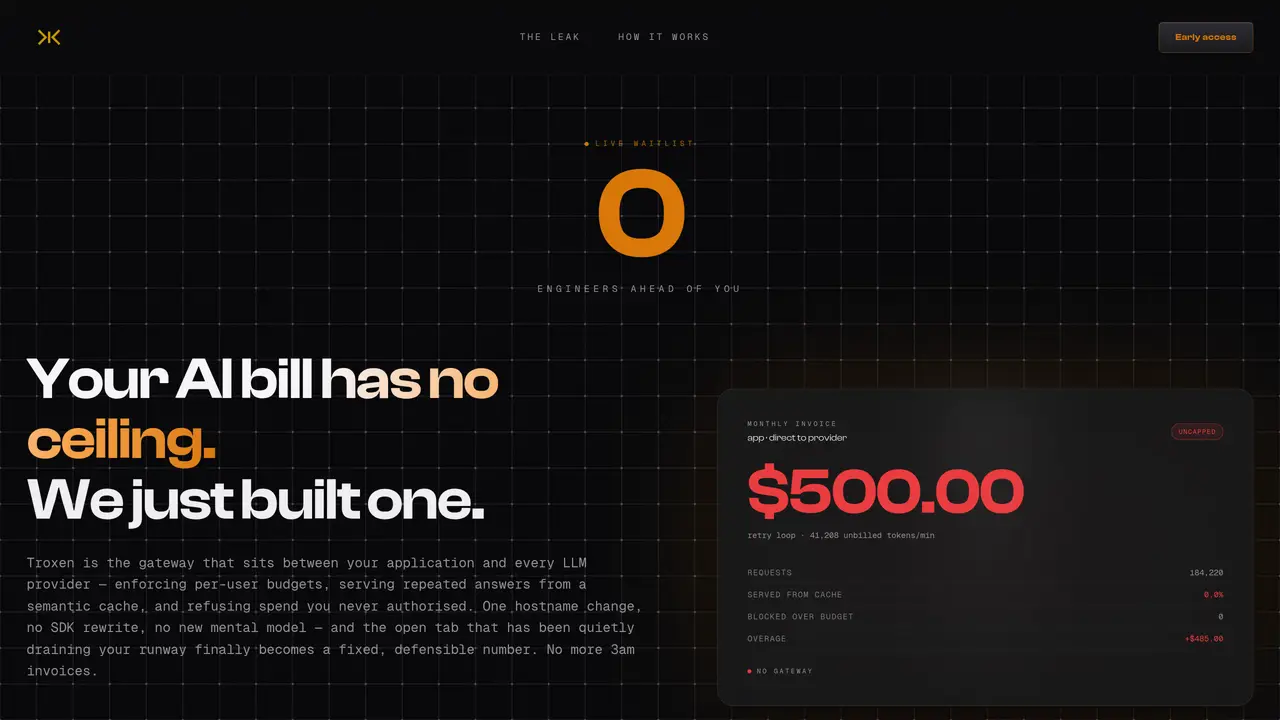
About Troxen
Troxen acts as a gateway positioned between applications and LLM providers to enforce strict per-user budget limits before any tokens are billed. It intercepts requests to evaluate whether a user has remaining budget or if the exact question has already been answered, serving cached responses when available or blocking unnecessary spend entirely. The system operates at the edge with single-digit millisecond latency for both budget checks and cache lookups, requiring only a hostname change in the application’s SDK configuration. It supports multiple providers including OpenAI, Anthropic, Google, and Mistral, and offers controls such as per-user caps, semantic caching, hard kill-switches, and provider-agnostic routing. By placing a hard ceiling on LLM spending, Troxen prevents unexpected cost overruns that often go unnoticed until invoices arrive, ensuring predictable infrastructure budgets for SaaS platforms, AI agents, and internal tools. The tool is designed to address the silent financial leaks in LLM usage, where retry loops, malicious users, or repeated questions can silently drain budgets without triggering traditional monitoring systems.
Key features
- Per-user budget caps enforced at the edge
- Semantic cache for identical and near-identical prompts
- Hard kill-switch to halt all outbound spend
- Provider-agnostic routing across major LLM providers
- Single hostname change for integration
- Account-wide panic control for immediate spend halt
- Metered request evaluation before billing
- Consistent enforcement regardless of provider
Use cases
- SaaS platforms managing AI-powered features for multiple tenants
- AI agents prone to retry loops or malformed tool calls
- Internal tools with shared LLM access across teams
Pros
- Enforces hard per-user budget caps before any tokens are billed
- Semantic caching reduces repeated spend on identical prompts
- Single hostname change required, no SDK rewrites
- Supports multiple LLM providers with consistent controls
- Edge-based enforcement with single-digit millisecond latency
Cons
- Requires early access waitlist
- No free tier or public pricing listed
Frequently asked questions about Troxen
What does Troxen do?
Troxen acts as a gateway between applications and LLM providers, enforcing per-user budget caps and semantic caching before any tokens are billed. It intercepts requests, checks budgets and caches, and either serves cached responses, forwards requests, or blocks spend entirely.
Who should use Troxen?
Troxen is designed for SaaS platforms, AI agents, and internal tools where controlling LLM costs is critical to maintaining predictable infrastructure budgets. It suits teams that need enforceable spending limits and cost predictability.
How does Troxen integrate with existing applications?
Integration requires only a hostname change in the application’s SDK configuration, pointing to Troxen’s gateway instead of the LLM provider. No SDK rewrites or new mental models are needed.
Does Troxen support multiple LLM providers?
Yes, Troxen supports multiple providers including OpenAI, Anthropic, Google, and Mistral, with provider-agnostic routing and unified budget enforcement across all providers.
What controls does Troxen provide for managing LLM spend?
Troxen offers per-user budget caps, semantic caching, hard kill-switches, and provider-agnostic routing. Each control enforces spending limits before tokens are billed.
How does Troxen handle repeated questions?
Troxen uses semantic caching to serve identical or near-identical prompts from cache in single-digit milliseconds, preventing duplicate billing for the same answers.