
Create cloud servers with ease, enjoy full control, automated backups, secure networking, and reliable support.

Nutanix
$1.60Starting price
830KMonthly visits
49Popularity
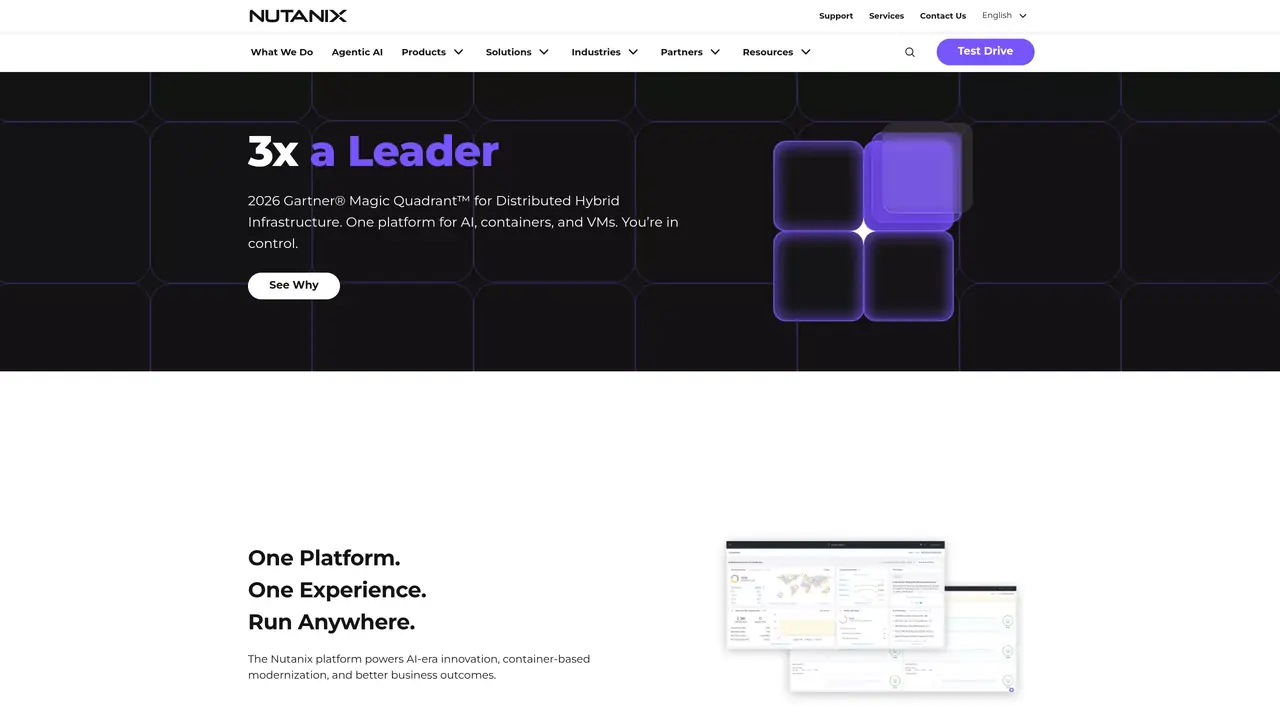
About Nutanix
Nutanix provides a unified cloud platform designed to operate virtual machines, containers, and AI workloads across datacenter, public cloud, and edge environments. It centralizes operations, storage, networking, governance, and cost controls into a single control plane, delivering consistent performance, resilience, and security for enterprise workloads. The platform supports running VMs and Kubernetes side-by-side, enabling platform engineering, SRE, and infrastructure teams to standardize operations while modernizing applications. Nutanix offers built-in hypervisor AHV for efficient enterprise workloads, a scale-out storage engine for resilient data protection, and tools like Prism and Nutanix Central for unified monitoring, policy management, and lifecycle automation. It extends clusters to public clouds via NC2 for elastic capacity and migration, while Agent Gateway enables governance for agentic AI workloads. The platform is particularly suited for regulated enterprises, hybrid multicloud adopters, VMware alternative evaluations, large VDI estates, and edge deployments requiring consistent operations across multiple sites, including global retail, healthcare, and public sector use cases. Teams can deploy Nutanix on existing hardware or cloud, use guided demos or Test Drive for exploration, and leverage Community Edition, Sizer, and X-Ray for validation and piloting before full deployment.
Nutanix
San Jose, United States · Founded 2009
- Founders
- Mohit Aron, Dheeraj Pandey
- Founded
- 2009
- Headquarters
- San Jose, United States
- Legal status
- Public company
Key features
- Unified control plane for VMs, Kubernetes, and AI workloads across on-prem, cloud, and edge
- Centralized governance, storage, networking, and cost controls
- Built-in hypervisor (AHV) for efficient enterprise workloads
- Scale-out storage engine with snapshots, replication, and policy controls
- Prism and Nutanix Central for unified monitoring, health, and cost dashboards
- Agent Gateway for governance of agentic AI workloads
- Lifecycle automation for upgrades and policy management
- NC2 for extending clusters to public clouds for elastic capacity
- Disaster recovery and data protection across sites
- Community Edition, Sizer, and X-Ray for validation and piloting
Use cases
- Modernizing applications with Kubernetes while maintaining VM workloads
- Standardizing operations for platform engineering and SRE teams
- Deploying consistent AI workloads across hybrid multicloud and edge environments
Pros
- Unified platform for running virtual machines, containers, and AI workloads across on-premises, cloud, and edge environments
- Built-in hypervisor (AHV) and Kubernetes support for running VMs and containers side-by-side
- Centralized operations, storage, networking, governance, and cost controls via a single control plane
- Strong disaster recovery and data protection capabilities with scale-out storage engine
- Supports regulated industries and hybrid multicloud environments with consistent operations
Cons
- May require significant initial setup and configuration for large-scale deployments
- Potential vendor lock-in due to proprietary technologies and integrations
- Complexity in managing lifecycle automation and policy governance across distributed environments
Frequently asked questions about Nutanix
What is Nutanix and what does it do?
Nutanix is a unified cloud platform that runs applications, data, and AI workloads across datacenter, public cloud, and edge environments. It centralizes operations, storage, networking, governance, and cost controls into a single control plane for consistent performance and security.
Who is Nutanix designed for?
Nutanix is designed for regulated enterprises, hybrid multicloud adopters, VMware alternative evaluations, large VDI estates, and edge deployments requiring consistent operations across multiple sites. It suits platform engineering, SRE, and infrastructure teams modernizing applications.
How does Nutanix support AI workloads?
Nutanix supports AI workloads through its Agent Gateway for governance of agentic AI, built-in Kubernetes for containerized AI applications, and unified storage for data management. It enables enterprises to build and operate AI factories efficiently.
What integrations does Nutanix offer?
Nutanix integrates with public clouds via NC2 for elastic capacity and migration, supports Kubernetes for containerized workloads, and provides tools like Prism and Nutanix Central for unified monitoring and policy management. It also offers disaster recovery and database services.
How can I get started with Nutanix?
Prospective users can explore Nutanix through guided demos, Test Drive for hands-on experience, or deploy using Community Edition for validation. The platform can be deployed on existing hardware or cloud, with support resources available for piloting and deployment.
What are the deployment options for Nutanix?
Nutanix can be deployed on-premises, in the cloud, or at the edge. It supports hardware platforms, software options, and cloud clusters (NC2) for extending capacity. Users can also leverage Community Edition for testing and validation before full deployment.
Nutanix Website Engagement
Last Update: 9 days ago
Total Monthly Visits
0
Bounce Rate
0%
Visit Duration (avg)
0.00s
Pages Per Visit
0
Country Rank
0
United States
Global Rank
0
Category Rank
#0
Computer Hardware
Monthly Traffic
Traffic Sources
Traffic Share By Country
- United States25.9%
- India20.4%
- Japan6.2%
- Germany5.8%
- South Korea4.4%