
OpenAI builds and deploys advanced AI models like GPT-4o for autonomous agents and workflows.

Foretop
FreeStarting price
0Popularity
About Foretop
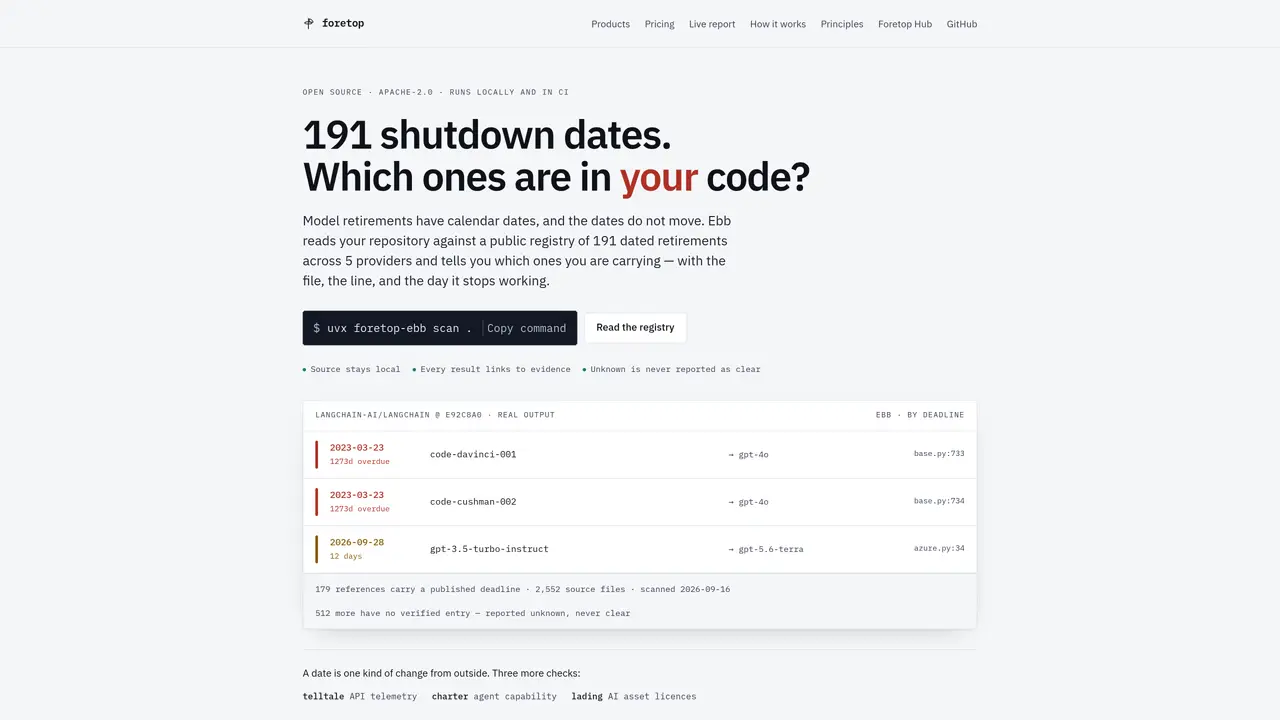
Foretop provides static analysis focused on AI-related dependencies and configuration. The tool scans repositories to identify references to deprecated AI models by comparing code against a registry of 191 dated retirements across five providers. It also checks for configuration drift by validating API telemetry, agent capabilities, and AI asset licenses against expected states. Each finding includes the file, line number, and evidence linking to the exact source revision. The output is reproducible, linking to pinned commits to ensure consistent results across re-runs. The tool operates locally and in CI, producing terminal, Markdown, JSON, and SARIF outputs. It supports GitHub Actions and pull-request annotations for integration into development workflows.
Key features
- Scans for deprecated AI model references with published deadlines
- Validates API telemetry configuration against expected signals
- Checks agent capability declarations in configuration files
- Verifies AI asset licenses for compliance
- Produces terminal, Markdown, JSON, and SARIF outputs
- Supports GitHub Actions and pull-request annotations
- Links findings to exact source lines and pinned commits
- Operates locally and in CI environments
Use cases
- Identifying outdated AI model references in codebases before they break
- Validating API telemetry configurations for compliance with expected signals
- Auditing AI asset licenses for attribution and redistribution requirements
Pros
- Open-source under Apache-2.0 license
- Runs locally and in CI without requiring an account
- Detects deprecated AI models with dated retirement schedules
- Checks for configuration drift in API telemetry and agent capabilities
- Produces reproducible results linked to exact source revisions
Cons
- No free tier for the hosted Hub service beyond three repositories
- Limited to AI-related checks (deprecated models, configuration drift)
- Requires local execution or CI integration for full functionality
Frequently asked questions about Foretop
What does Foretop do?
Foretop performs static analysis on AI-related dependencies and configurations in repositories. It scans code to identify references to deprecated AI models by comparing against a registry of 191 dated retirements across five providers, and checks for configuration drift by validating API telemetry, agent capabilities, and AI asset licenses.
Who is Foretop designed for?
Foretop is designed for developers, DevOps teams, and organizations working with AI models and configurations who need to ensure their code remains compliant with current and future model retirements and configuration standards.
How does Foretop ensure reproducible results?
Foretop links every finding to a pinned commit, ensuring that re-running the scan against the same commit produces identical results. This reproducibility is critical for consistent validation across development and CI environments.
What outputs does Foretop provide?
Foretop generates outputs in multiple formats including terminal, Markdown, JSON, and SARIF. It also supports GitHub Actions and pull-request annotations for seamless integration into development workflows.
Does Foretop report unknown or unverified entries?
Yes, Foretop explicitly reports unknown entries as 'unknown' rather than treating them as clear or problematic. This ensures transparency about unverified or undocumented AI model references.
Can Foretop be used in CI pipelines?
Yes, Foretop operates both locally and in CI environments, making it suitable for automated scanning as part of continuous integration and deployment workflows.