
OpenAI builds and deploys advanced AI models like GPT-4o for autonomous agents and workflows.

Graphify
FreeStarting price
29KMonthly visits
24Popularity
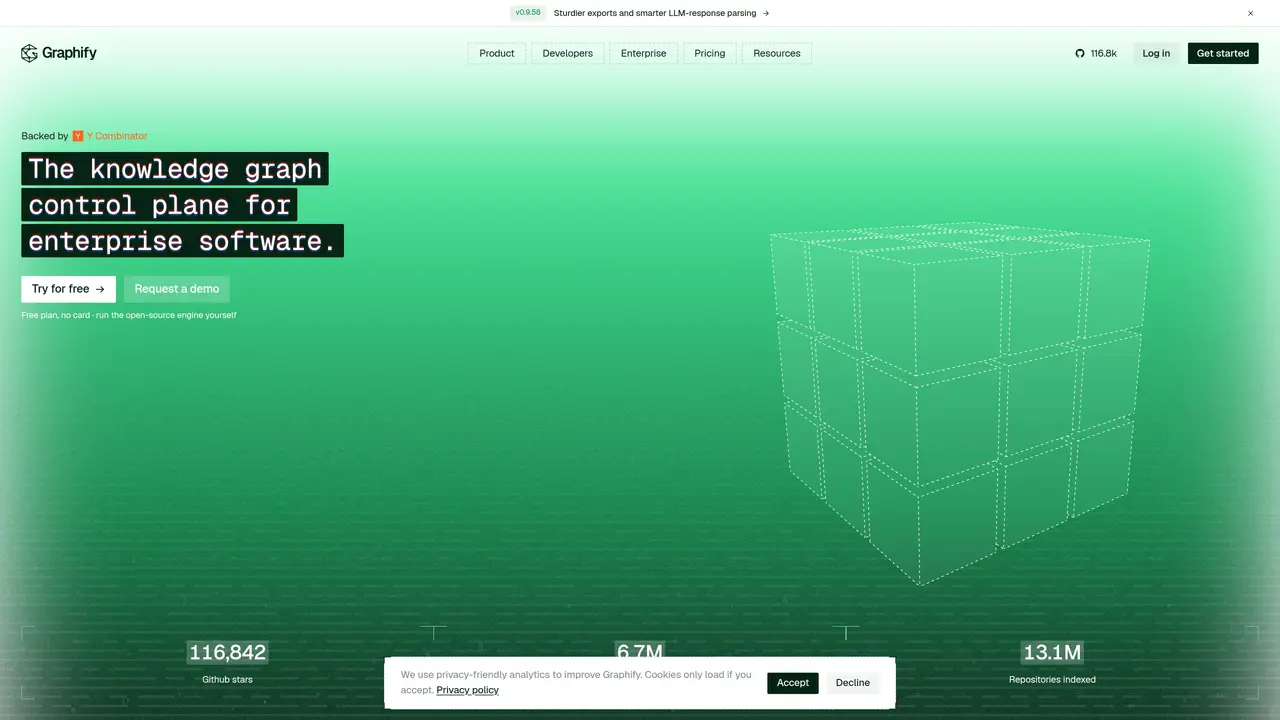
About Graphify
Graphify is an on-device knowledge graph engine designed to transform codebases, documents, meeting transcripts, and browsing history into a single, continuously updated graph. It maintains this graph incrementally by patching only the affected nodes and edges whenever files change, avoiding costly full re-indexing. The system delivers path-aware answers with sources and confidence scores, enabling users to trace dependencies, decisions, and authorship across code, specifications, meetings, and browser activity in seconds. Graphify preserves privacy with zero telemetry and supports fully local operation, while enterprise deployments offer team graphs, role-based access, SSO, audit logging, and air-gapped or managed configurations for large-scale repositories. The CLI watcher monitors changes, rebuilds only what’s necessary, and outputs graph diffs with Leiden clustering and high-betweenness nodes to highlight coupling, ownership, and change risk before refactoring or policy updates. It exports evidence in HTML and JSON for review, making it suitable for regulated environments and teams requiring auditable decision trails. The tool is built for engineers onboarding to large codebases, product and platform teams tracing architectural choices, researchers mapping literature and notes, and operators connecting meetings, drafts, and decisions without relying on brittle indexing jobs or colleague interruptions. Graphify’s architecture centers on an AST-native knowledge graph that unifies polyglot code, documents, images, and transcripts into a single traversable structure. Users can query relationships to uncover hidden communities, identify critical nodes, and reconstruct the rationale behind shipped changes, all while maintaining persistent memory for AI coding assistants. The system is deployed via a simple CLI—install with uv or pip, initialize the corpus with graphify ., start the watcher with graphify watch, and run queries with graphify query—with open-source and enterprise editions available to scale from local development to million-file corpora.
Key features
- Builds AST-native knowledge graphs from polyglot code, documents, images, and transcripts
- Incrementally patches only affected nodes and edges on file changes
- Delivers path-aware answers with sources, confidence scores, and explanations
- Supports fully on-device operation with zero telemetry
- Includes Leiden clustering to surface hidden communities and high-betweenness nodes
- Exports evidence in HTML and JSON for audits and reviews
- Provides team graphs, role-based access, SSO, and audit logging in enterprise mode
- Runs CLI watcher to show changed files, graph diffs, and rebuilt nodes
- Supports air-gapped or managed deployments for large-scale repositories
- Tracks dependencies, decisions, and authorship across code, specs, meetings, and browser activity
Use cases
- Onboard engineers by querying architectural decisions and blast radius instead of grepping stale docs
- Give AI coding assistants persistent memory of the codebase by linking commits, specs, and conversations to current changes
- Prepare board or client reviews with auditable paths from decisions back to meetings, drafts, and evidence
Pros
- Fully on-device operation with zero telemetry, ensuring code and data remain private
- Incremental graph updates avoid costly full re-indexing, keeping the knowledge graph current with minimal overhead
- Provides path-aware answers with traceable evidence and confidence scores for auditable decision-making
- Supports cross-repository graphs and integrates with multiple AI coding assistants via MCP
- Offers enterprise-grade features like role-based access, SSO, audit logging, and air-gapped deployments
Cons
- Requires local setup and maintenance, which may pose challenges for teams without technical infrastructure
- Limited to codebases and documents supported by its 36 tree-sitter grammars, potentially excluding niche languages or formats
Frequently asked questions about Graphify
What does Graphify do?
Graphify transforms codebases, documents, meeting transcripts, and browsing history into a continuously updated knowledge graph that tracks dependencies, decisions, and authorship across repositories and teams.
Who is Graphify designed for?
It is built for engineers onboarding to large codebases, product and platform teams tracing architectural choices, researchers mapping literature, and operators connecting meetings and decisions without manual indexing.
How does Graphify handle privacy?
The tool operates fully on-device with no telemetry, ensuring code and data are processed locally without uploads or third-party access.
Can Graphify integrate with AI coding assistants?
Yes, Graphify supports integration with 17 AI coding assistants via the MCP protocol, including Claude Code, Cursor, and Copilot.
What deployment options are available?
Graphify offers an open-source CLI for local use, as well as enterprise deployments with team graphs, SSO, audit logging, and air-gapped configurations.
How do I get started with Graphify?
Install the CLI using uv or pip, initialize the corpus with `graphify .`, start the watcher with `graphify watch`, and run queries with `graphify query`.
Graphify Website Engagement
Last Update: 9 days ago
Total Monthly Visits
0
Bounce Rate
0%
Visit Duration (avg)
0.00s
Pages Per Visit
0
Country Rank
0
Canada
Global Rank
0
Category Rank
#0
Programming & Developer Software
Monthly Traffic
Traffic Sources
Traffic Share By Country
- Brazil8.5%
- Mexico6.9%
- Ukraine6.5%
- Czechia6.1%
- France5.8%