
OpenAI builds and deploys advanced AI models like GPT-4o for autonomous agents and workflows.
Kornia
1.2KMonthly visits
1Popularity
About Kornia
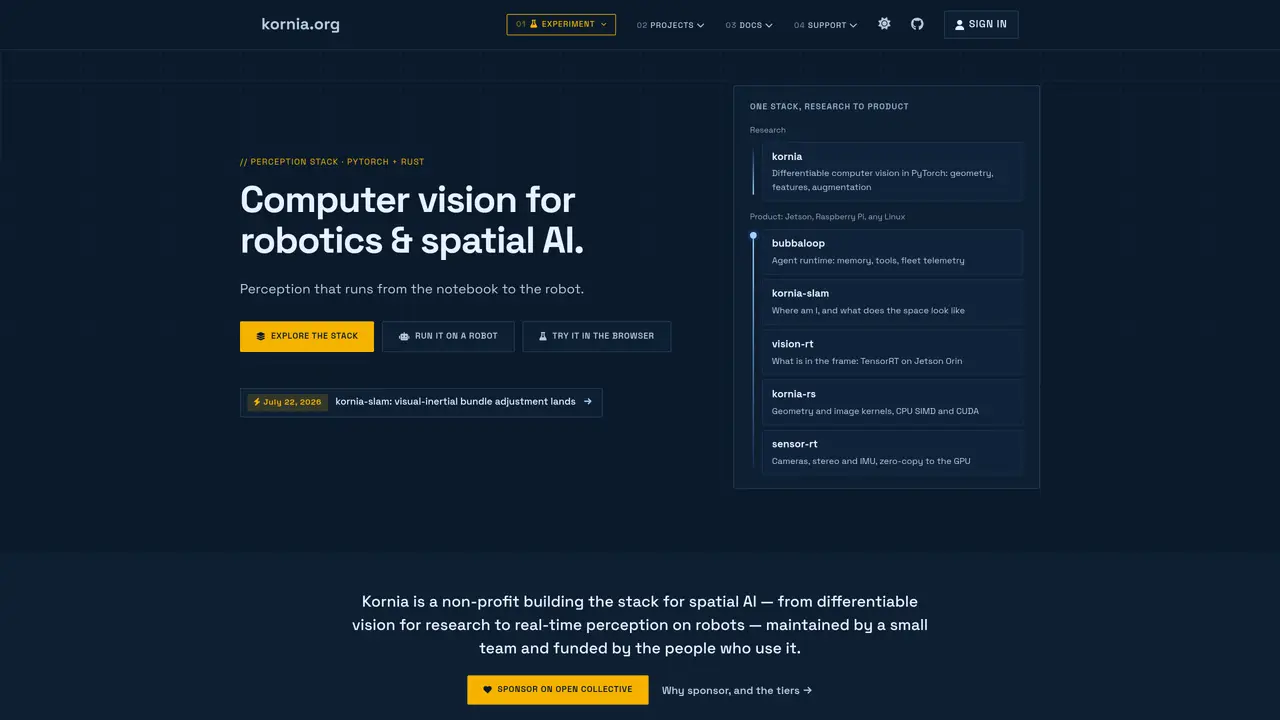
Kornia is an open-source computer vision and Spatial AI ecosystem built around a PyTorch-based differentiable vision library, complemented by Rust infrastructure and deployment tooling for multimodal vision systems. It provides reusable, production-aware building blocks for geometric vision, image processing, and model deployment, making it suitable for researchers and engineering teams. A typical Kornia workflow integrates differentiable computer vision operations directly into PyTorch projects, eliminating the need for separate preprocessing layers. This approach is particularly valuable for geometric vision, spatial transformations, and pipelines where gradients, tensor compatibility, and repeatable experimentation are critical. Teams can prototype algorithms in Python, inspect and modify open-source implementations, and transition to performance-focused Rust components or deployment layers like Bubbaloop when needed. Kornia supports academic research, robotics, physical AI, and product teams building camera-based monitoring or vision-language applications by offering a transparent foundation for transparent and extensible vision engineering. The ecosystem includes Jetson-based Kornia Box bundles for edge vision prototypes, Rust-backed performance components for low-level 3D workloads, and deployment services for vision-language inference on edge hardware. Open-source contributors benefit from inspectable, modifiable libraries, avoiding reliance on opaque vendor tooling.
Key features
- PyTorch-native differentiable computer vision operations
- Geometric vision and spatial transformation support
- Rust-backed performance components for low-level workloads
- Deployment tooling for multimodal vision systems
- Jetson-based edge vision prototype bundles
- Integration with Bubbaloop for vision-language inference
- Open-source and transparent library implementations
- Tensor-compatible image processing pipelines
- Reusable building blocks for production-aware vision systems
- Compatibility with robotics and physical AI frameworks
Use cases
- Prototyping camera perception pipelines for neural network training
- Building edge vision prototypes with preconfigured hardware bundles
- Developing transparent and extensible vision-language applications
Pros
- Provides differentiable computer vision operators compatible with PyTorch, enabling seamless integration into deep learning pipelines.
- Offers a unified stack from research to production, supporting prototyping in Python and deployment on edge devices via Rust components.
- Includes open-source, inspectable implementations for transparency and extensibility, avoiding reliance on opaque vendor tooling.
- Supports real-time vision applications with components like TensorRT inference and low-level 3D workloads via Rust kernels.
- Facilitates robotics and spatial AI development with tools for pose estimation, mapping, and agent-based interactions.
Cons
- Requires familiarity with PyTorch and Rust for full utilization, which may pose a learning curve for some users.
- The ecosystem's breadth may introduce complexity for teams seeking a single-purpose solution.
- Deployment on edge hardware depends on compatible drivers and runtime environments, limiting plug-and-play usability.
Frequently asked questions about Kornia
What is Kornia and what does it do?
Kornia is an open-source computer vision and Spatial AI ecosystem built around a PyTorch-based differentiable vision library. It provides reusable building blocks for geometric vision, image processing, and model deployment, enabling end-to-end vision pipelines from research to production.
Who is Kornia suitable for?
Kornia is designed for researchers, engineering teams, and product developers working in robotics, physical AI, and camera-based monitoring or vision-language applications. It supports both academic and commercial use cases.
How does Kornia support deployment on edge devices?
Kornia offers Rust-based components like kornia-rs for performance-critical workloads and Bubbaloop as a runtime for deploying vision pipelines on edge hardware such as Jetson and Raspberry Pi devices.
Does Kornia integrate with other tools or frameworks?
Yes, Kornia integrates with PyTorch for differentiable operations and supports exporting pipelines as ONNX graphs. It also works with AI agents via Bubbaloop and can interface with models like those from Ollama or Gemini.
What are the key limitations of Kornia?
Kornia requires knowledge of PyTorch and Rust for full utilization, and its broad ecosystem may introduce complexity. Deployment on edge hardware depends on specific drivers and runtime environments, which can limit flexibility.
How can I get started with Kornia?
Users can start by exploring Kornia's PyTorch-based operators and models in a browser-based playground or by following the provided tutorials. For deployment, components like Bubbaloop can be installed on supported edge devices.
Kornia Website Engagement
Last Update: 10 days ago
Total Monthly Visits
0
Bounce Rate
0%
Visit Duration (avg)
0.00s
Pages Per Visit
0
Country Rank
—
Unknown
Global Rank
0