GitHub hosts HunyuanVideo, Tencent's open-source framework for large-scale video generation models, enabling AI-driven video creation.

Transformers
$0.07Starting price
0Popularity
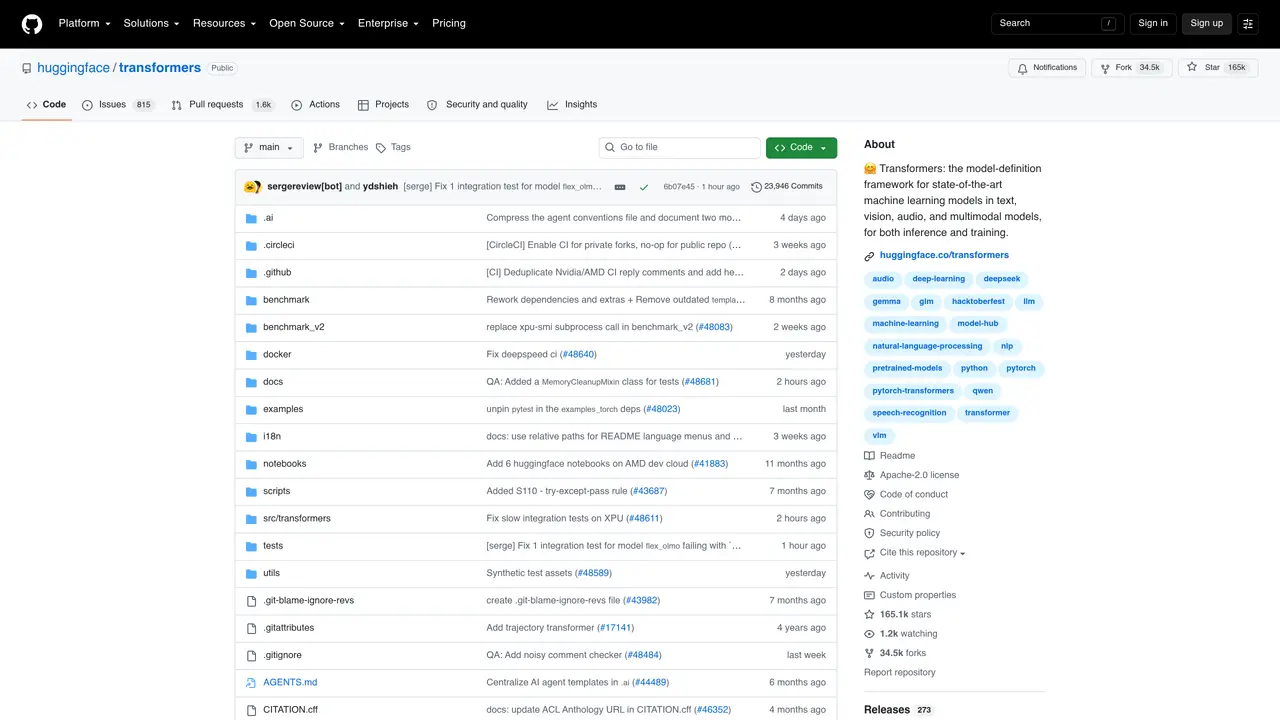
About Transformers
Transformers is Hugging Face’s open-source framework for defining, training, and running advanced AI models across text, vision, audio, video, and multimodal tasks. It provides a unified Python API that standardizes preprocessing, inference, and output formatting while exposing lower-level model internals for customization. The library integrates deeply with the Hugging Face Hub, enabling direct access to thousands of pretrained checkpoints without manual model recreation. It supports rapid prototyping for machine learning engineers, applied researchers, AI product teams, and technical founders who need reproducible architectures and fine-grained control over model behavior. Teams use Transformers to standardize model definitions before fine-tuning, evaluation, or production deployment, reducing duplicated engineering across research and production workflows. The framework also includes utilities for fine-tuning PyTorch-based models, example scripts for common tasks, and training workflows that shorten experimental setup time. While the library simplifies common inference tasks through high-level pipelines, it remains flexible enough for advanced users to inspect, adapt, or extend model internals for research or specialized applications. Installation is straightforward via package managers, with support for modern Python environments and PyTorch-based workflows. Teams are advised to validate examples against their own data, hardware, and deployment constraints, as sample scripts serve as starting points rather than guaranteed production-ready systems.
GitHub, Inc.
San Francisco, California, US · Founded 2008
- Founders
- Tom Preston-Werner, Chris Wanstrath, PJ Hyett, Scott Chacon
- Founded
- 2008
- Headquarters
- San Francisco, California, US
- Legal status
- Subsidiary of Microsoft (NASDAQ: MSFT)
Key features
- Unified Python API for text, vision, audio, video, and multimodal models
- Deep integration with the Hugging Face Hub for pretrained checkpoints
- High-level pipelines for standardized preprocessing and inference
- Utilities for fine-tuning PyTorch-based models
- Exposed model internals for customization and research workflows
- Example scripts and training utilities for rapid prototyping
- Support for modern Python environments and PyTorch workflows
- Shared architecture definitions for reproducible model behavior
- Access to task-specific patterns for common AI workloads
Use cases
- Prototyping text generation, chat, summarization, translation, and classification workflows
- Testing vision models for classification, segmentation, detection, and visual question answering
- Building speech and audio workflows including transcription, keyword spotting, and speech generation
Pros
- Unified model definition framework supporting text, vision, audio, video, and multimodal tasks
- Deep integration with the Hugging Face Hub for access to over 1M+ pretrained model checkpoints
- Compatibility with major training frameworks (e.g., Axolotl, Unsloth, DeepSpeed) and inference engines (e.g., vLLM, SGLang, TGI)
- High-level Pipeline API for simplified inference across multiple modalities
- Open-source and actively maintained with community contributions
Cons
- Requires familiarity with Python and PyTorch for advanced customization
- Sample scripts serve as starting points and may need adaptation for production use
- Installation and setup may involve dependency management challenges
Frequently asked questions about Transformers
What is Transformers and what does it do?
Transformers is an open-source framework for defining, training, and running state-of-the-art machine learning models across text, vision, audio, video, and multimodal tasks. It standardizes model definitions and integrates with the Hugging Face Hub for access to pretrained models.
Who should use Transformers?
The tool suits machine learning engineers, applied researchers, AI product teams, and technical founders who need reproducible architectures, fine-grained control, and standardized model definitions for research or production workflows.
How does Transformers integrate with other tools?
Transformers acts as a pivot across frameworks, ensuring model definitions are compatible with major training frameworks like PyTorch-Lightning and inference engines such as vLLM or TGI.
What are the system requirements for using Transformers?
Transformers requires Python 3.10+ and PyTorch 2.5+. Installation can be done via package managers like pip or uv, with support for virtual environments.
Can I use Transformers for both training and inference?
Yes, Transformers supports both training and inference for a wide range of models, including text, vision, audio, video, and multimodal architectures.
How do I get started with Transformers?
Users can start with the high-level Pipeline API for quick inference tasks or explore the library’s documentation and examples for more advanced use cases.