GitHub hosts HunyuanVideo, Tencent's open-source framework for large-scale video generation models, enabling AI-driven video creation.

Gemma
0Popularity
About Gemma
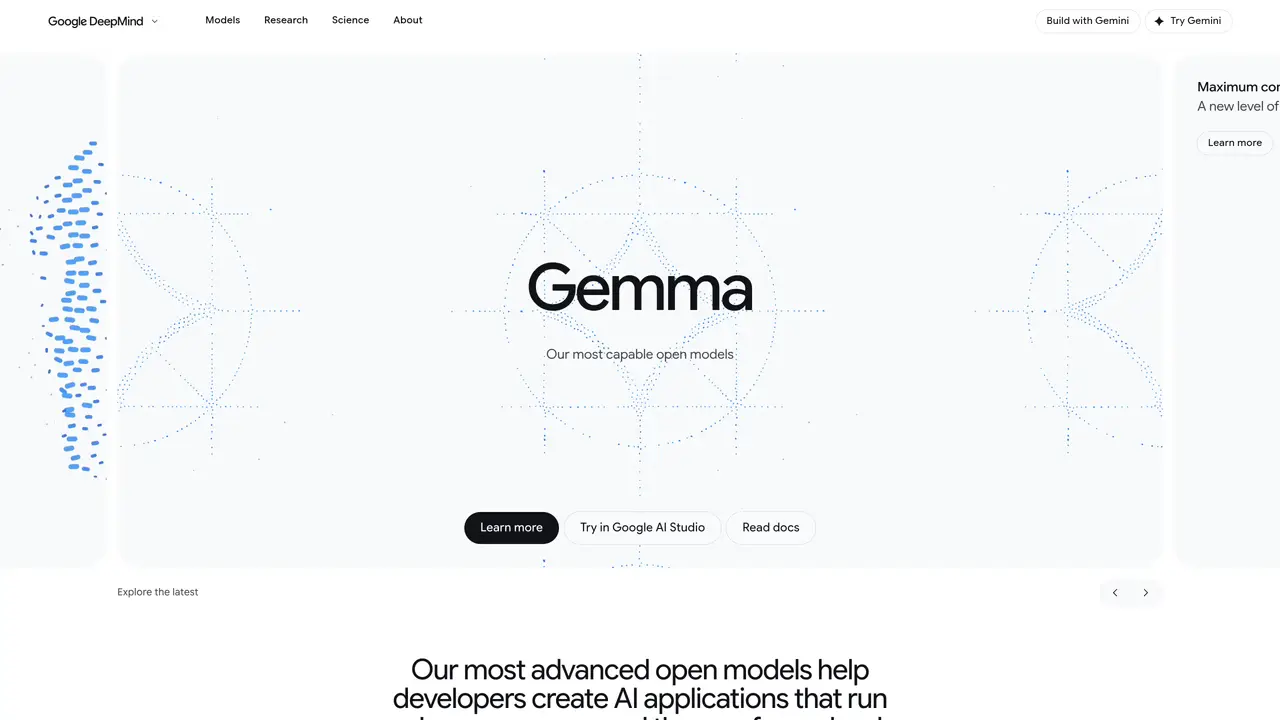
Gemma is Google DeepMind’s open-model family designed for intelligence-per-parameter and portability across devices. It enables running capable LLMs on mobile, edge, and PCs, with specialized variants for diffusion, embeddings, translation, medicine, and safety. The models integrate seamlessly with mainstream ML frameworks like PyTorch, Keras, JAX, Hugging Face, and deployment tools such as Ollama and Gemma.cpp. Developers can fine-tune or quantize models as needed, then deploy lightweight builds for Android, laptops, or edge devices without relying on proprietary endpoints. Gemma supports rapid prototyping on laptops, local assistants on Android, and efficient batch jobs on modest servers, making it practical for mobile engineers, edge builders, startups, researchers, and public-sector use cases where offline operation and predictable resource use are critical. It also offers task-specialized families like DiffusionGemma, TranslateGemma, and MedGemma, along with safety classifiers like ShieldGemma 2 for reducing harmful outputs. Integration paths include Google AI Studio, Hugging Face, and direct runtime support across multiple platforms, ensuring flexibility for diverse deployment needs.
Google DeepMind
London, United Kingdom · Founded 2010
- Founders
- Shane Legg, Demis Hassabis
- Founded
- 2010
- Headquarters
- London, United Kingdom
Key features
- Open-weight models optimized for edge, mobile, and cloud deployment
- Specialized variants for diffusion, embeddings, translation, medicine, and safety
- Integration with PyTorch, Keras, JAX, Hugging Face, Ollama, and Gemma.cpp
- Quantization-aware training and multi-token prediction for reduced latency and memory use
- Support for on-device inference on Android and lightweight CPU/GPU backends
- Safety tooling including ShieldGemma 2 classifiers for harmful content detection
- Portable runtimes enabling deployment to Android, laptops, edge devices, and cloud
- Fine-tuning and quantization capabilities for customization and efficiency
Use cases
- Building on-device AI assistants for Android and IoT devices
- Deploying local inference on laptops or workstations for offline use
- Running low-latency offline translation in multiple languages
Pros
- Designed for high compute and memory efficiency, enabling deployment on mobile and IoT devices
- Available in multiple specialized variants for tasks like diffusion, translation, and medical imaging
- Supports integration with mainstream ML frameworks such as PyTorch, Keras, JAX, and Hugging Face
- Offers task-specific models like MedGemma for medical imaging and TranslateGemma for multilingual translation
- Includes safety classifiers like ShieldGemma 2 to reduce harmful outputs
Cons
- May require technical expertise for fine-tuning and deployment optimization
- Specialized variants may have limited availability or documentation compared to core models
Gemma videos
Frequently asked questions about Gemma
What is Gemma?
Gemma is Google DeepMind’s open-model family designed for intelligence-per-parameter and portability across devices, enabling capable LLMs to run on mobile, edge, and PCs.
Who is Gemma suitable for?
Gemma is suitable for mobile engineers, edge builders, startups, researchers, and public-sector users who require offline operation and predictable resource use.
How does Gemma integrate with other tools?
Gemma integrates with mainstream ML frameworks like PyTorch, Keras, JAX, Hugging Face, and deployment tools such as Ollama and Gemma.cpp.
Can Gemma be fine-tuned or quantized?
Yes, developers can fine-tune or quantize Gemma models as needed for specific use cases.
What are some use cases for Gemma?
Gemma can be used for rapid prototyping on laptops, local assistants on Android, and efficient batch jobs on modest servers.
How do I get started with Gemma?
Users can start with Gemma by exploring the models in Google AI Studio or accessing documentation for integration and deployment.