GitHub hosts HunyuanVideo, Tencent's open-source framework for large-scale video generation models, enabling AI-driven video creation.

PlaidML
$0.07Starting price
0Popularity
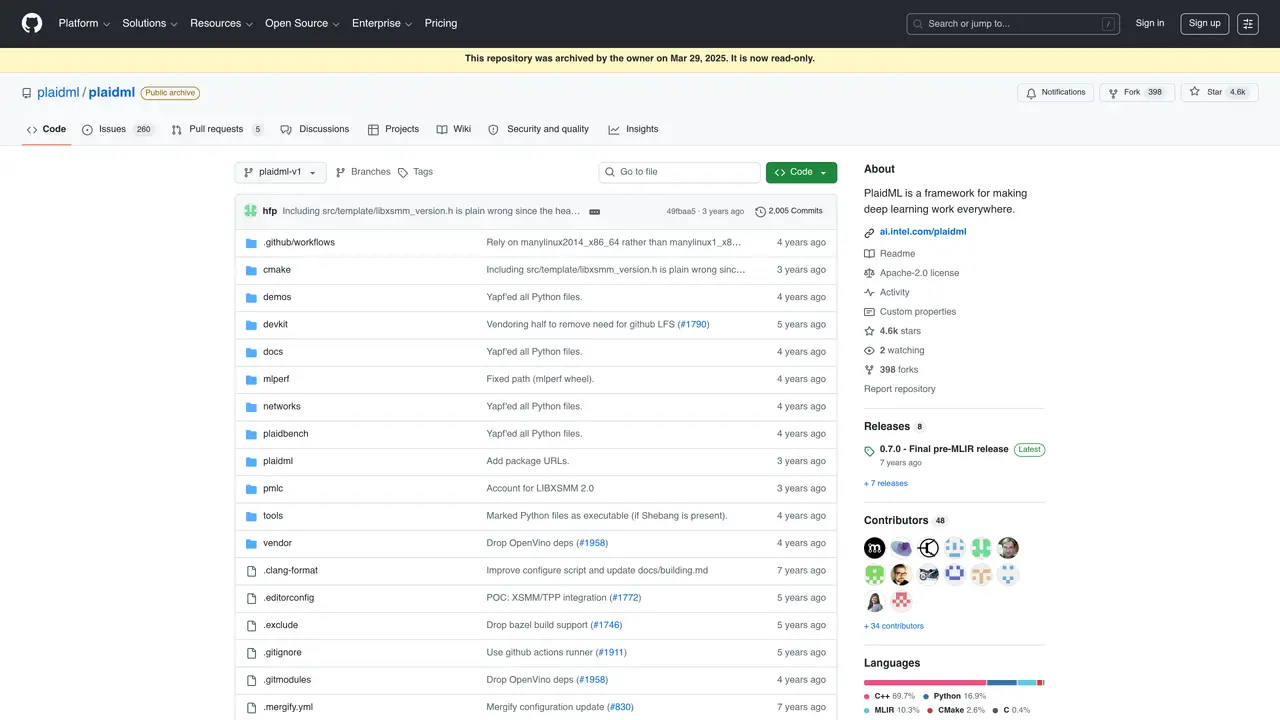
About PlaidML
PlaidML is a machine learning framework that allows developers to unlock high-performance hardware for their machine learning models. It is designed to be easy to use and highly efficient, offering developers a simple way to harness the power of GPUs, TPUs, and other specialized devices. PlaidML supports a wide range of popular frameworks, including TensorFlow, PyTorch, and Keras, so developers can quickly and easily develop and deploy their models across different hardware platforms. With PlaidML, developers can achieve higher performance on their machine learning models while also reducing their power consumption and cost. PlaidML also has a comprehensive set of tools and APIs to simplify development and deployment, making it easier for developers to bring their projects to life. With PlaidML, developers can unlock the potential of their hardware and create powerful, high-performance machine learning models.
GitHub, Inc.
San Francisco, California, US · Founded 2008
- Founders
- Tom Preston-Werner, Chris Wanstrath, PJ Hyett, Scott Chacon
- Founded
- 2008
- Headquarters
- San Francisco, California, US
- Legal status
- Subsidiary of Microsoft (NASDAQ: MSFT)
Key features
- Accelerate ML model performance using the power of GPUs and TPUs
- Reduce power consumption and cost of training
- Utilize a wide range of frameworks, including TensorFlow, PyTorch, and Keras
- Comprehensive set of tools and APIs for simplified development and deployment
- Highly efficient and easy to use
- Supports popular hardware platforms, including GPUs, TPUs, and others
Use cases
- Accelerate ML model performance in various applications
- Reduce power consumption and cost in machine learning training
- Develop and deploy models across different hardware platforms using popular frameworks
Pros
- Enables deep learning on diverse hardware including laptops and embedded devices with limited native support
- Supports multiple frameworks such as Keras, ONNX, and nGraph for broad compatibility
- Uses MLIR for extensible compiler infrastructure, improving integration with new software and hardware
- Offers a C++/Python embedded domain-specific language (EDSL) to enhance programmability
- Portable tensor compiler designed to work across different hardware platforms without restrictive licenses
Cons
- Development focus has shifted to the plaidml-v1 branch, which may lack stability or full feature parity with the master branch
- Limited hardware support in the current plaidml-v1 branch, restricted to Intel and AMD CPUs with AVX2 and AVX512 support
- Certain features, tests, and hardware targets may be broken in the plaidml-v1 research project branch
Frequently asked questions about PlaidML
What is PlaidML and what does it do?
PlaidML is an advanced and portable tensor compiler designed to enable deep learning on a wide range of hardware, including laptops and embedded devices. It acts as a layer beneath popular machine learning frameworks, allowing users to leverage hardware that may not be well-supported or has restrictive software licenses.
Who should use PlaidML?
PlaidML is suitable for developers and researchers who need to run deep learning models on diverse hardware platforms, particularly where standard frameworks offer limited support. It is ideal for those working with constrained or unconventional devices.
What machine learning frameworks does PlaidML support?
PlaidML supports Keras, ONNX, and nGraph, and it integrates with the nGraph Compiler stack to extend hardware compatibility. It is designed to work underneath these frameworks, enabling broader hardware support.
What hardware does PlaidML support?
PlaidML supports a variety of hardware, including Intel and AMD CPUs with AVX2 and AVX512 support. The plaidml-v1 branch focuses on these platforms, while the master branch and PyPI releases may offer broader compatibility.
How does PlaidML improve deep learning performance?
PlaidML uses MLIR, an extensible compiler infrastructure, and Stripe, a low-level intermediate representation, to optimize performance. These components enable better integration of new hardware and more efficient compiler optimizations.
How can I get started with PlaidML?
Users can access PlaidML through its GitHub repository, where they can find documentation, demos, and installation instructions. The master branch and PyPI releases provide stable versions, while the plaidml-v1 branch is a research-focused development version.