
OpenAI builds and deploys advanced AI models like GPT-4o for autonomous agents and workflows.

LLM Engineer Club
4Popularity
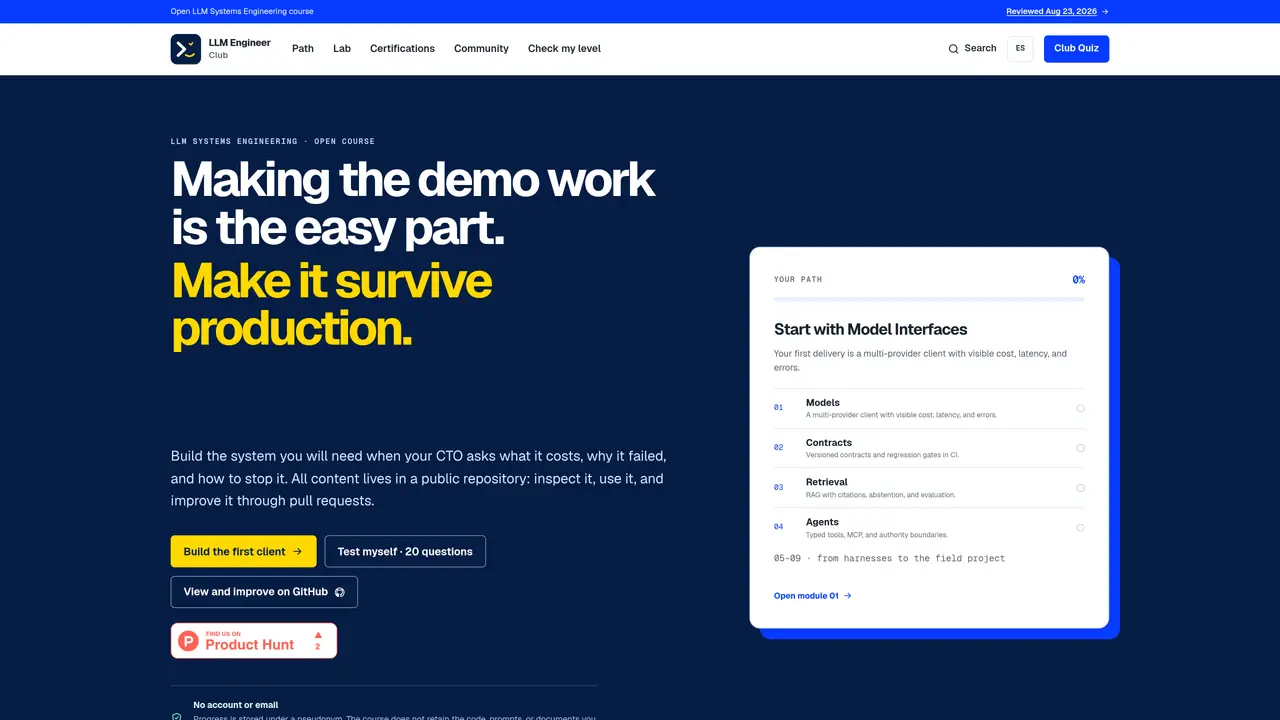
About LLM Engineer Club
LLM Engineer Club provides a structured path for engineers to learn how to design, build, and deploy reliable LLM systems in production environments. The course begins with model interfaces and progresses through contracts, retrieval, agents, harnesses, loops, graphs, and production engineering before culminating in a field project that another engineer can audit. Each module includes lessons and labs that focus on practical challenges such as managing multi-provider clients, versioned contracts, RAG with citations, typed tools, harness testing through failure injection, loop budgeting, and state management. The curriculum emphasizes observable metrics like cost, latency, and errors while teaching how to implement SLOs, security measures, and runbooks. Content is hosted in a public repository where progress is tracked pseudonymously and no user data is retained. The program also offers a verifiable challenge with private questions to test skills under pressure, as well as mock exams for AWS AI Practitioner and NVIDIA Generative AI LLMs certifications.
Key features
- Multi-provider client with visible cost, latency, and error tracking
- Versioned contracts and regression gates in CI
- RAG with citations, abstention, and evaluation
- Typed tools, MCP, and authority boundaries for agents
- Harness testing through injected failures
- Loop engineering with budgets, stopping, and resumption
- Graph engineering for state, knowledge, and provenance
- Production SLOs, cost control, security, and runbook creation
Use cases
- Building production-ready LLM systems for enterprise deployment
- Training engineers to design auditable and maintainable LLM applications
- Preparing for industry certifications in AI and generative technologies
Pros
- Public, traceable repository with versioned lessons and pull request history
- Hands-on labs and tools for testing retrieval pipelines and system behavior
- Pseudonymous progress tracking with no retention of user code or prompts
- Verifiable challenge and certificates for skill demonstration
- Preparation for industry certifications like AWS AI Practitioner and NVIDIA Generative AI LLMs
Cons
- No free tier or trial access mentioned
- Requires significant time investment (325–405 hours for full path)
- Limited to English-language content and tools
- No API or integration options described
Frequently asked questions about LLM Engineer Club
What is LLM Engineer Club and who is it designed for?
LLM Engineer Club is an open course designed for engineers who want to learn how to design, build, and deploy reliable LLM systems in production environments. It provides a structured path from foundational concepts to advanced topics like retrieval, agents, and production engineering.
How does the course structure work?
The course is divided into nine modules, starting with model interfaces and progressing through contracts, retrieval, agents, harnesses, loops, graphs, and production engineering. Each module includes lessons and hands-on labs, culminating in a field project that another engineer can audit.
What kind of practical challenges does the course cover?
The course focuses on practical challenges such as managing multi-provider clients, versioned contracts, RAG with citations, typed tools, harness testing through failure injection, loop budgeting, and state management. It also emphasizes observable metrics like cost, latency, and errors.
Does the course offer any certifications or verifiable achievements?
Yes, the course offers a verifiable challenge with private questions to test skills under pressure, as well as mock exams for AWS AI Practitioner and NVIDIA Generative AI LLMs certifications. Completing the challenge provides a pseudonymous achievement certificate.
How is progress tracked in the course?
Progress is tracked pseudonymously in a public repository where users can inspect, use, and improve content through pull requests. No user data, code, prompts, or documents are retained by the course.
What tools or resources are included in the course?
The course includes 12 browser-based tools, such as a document chunking analyzer, a support assistant for policy retrieval, and modules for testing retrieval pipelines and system performance. All tools are designed to simulate real-world scenarios.