
OpenAI builds and deploys advanced AI models like GPT-4o for autonomous agents and workflows.

memory-pulse
$49/moStarting price
0Popularity
About memory-pulse
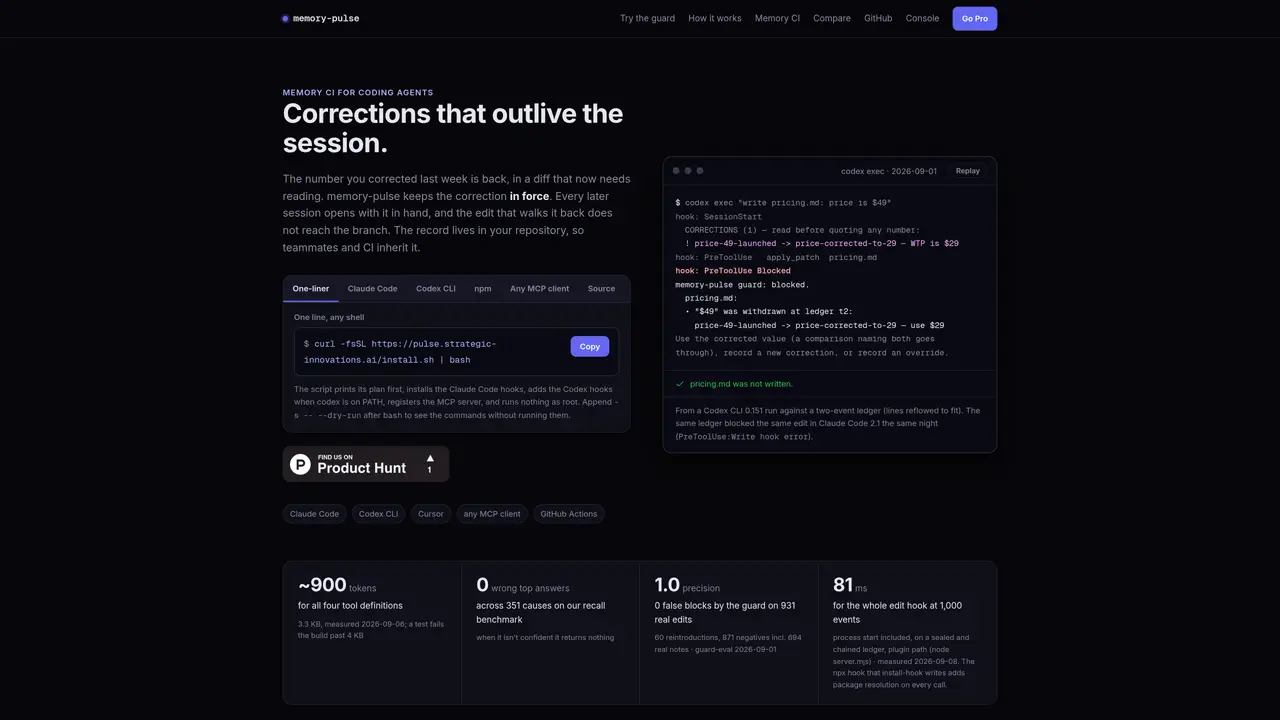
memory-pulse records corrections as entries in a repository’s .memory-pulse/events.jsonl file. Each correction specifies values that are now invalid and their replacements. At the start of every coding session, a brief lists active corrections so agents see them immediately. A guard hook blocks edits that reintroduce corrected values, returning the reason and the correction text. The system works offline and commits records to the repository, so teammates and CI inherit the constraints. It integrates with Claude Code, Codex CLI, npm, and any MCP client via a single executable. The ledger is a plain text file under version control, allowing inspection and audit without external dependencies.
Key features
- Records corrections in .memory-pulse/events.jsonl
- SessionStart brief lists active corrections
- PreToolUse guard blocks reintroduced corrections
- Offline operation with local ledger updates
- Integration with Claude Code, Codex CLI, npm, and MCP clients
- Repository-based ledger shared with teammates and CI
- Plain text ledger format for auditability
- Single executable for installation and execution
Use cases
- Preventing regression of previously corrected code values
- Enforcing policy decisions like pricing or configuration changes
- Maintaining consistency across team and CI environments
Pros
- Records corrections in a repository file for persistence and sharing
- Blocks edits that reintroduce corrected values using a guard hook
- Works offline and integrates with version control systems
- Supports multiple clients including Claude Code, Codex CLI, and MCP
- Ledger format allows inspection and audit without external services
Cons
- Requires repository access and version control setup
- Hooks run only in supported clients (Claude Code, Codex CLI)
- No free tier or open-source version mentioned
- Installation involves shell scripts and configuration steps
Frequently asked questions about memory-pulse
What does memory-pulse do?
memory-pulse records corrections as entries in a repository’s .memory-pulse/events.jsonl file, ensuring that invalid values are blocked in future edits. It provides a brief of active corrections at the start of each coding session and includes a guard hook that prevents reintroducing corrected values.
Who is memory-pulse designed for?
memory-pulse is designed for developers and coding agents who need to enforce corrections or rules across sessions without relying on model context. It is particularly useful for teams using tools like Claude Code, Codex CLI, or any MCP client.
How does memory-pulse integrate with coding tools?
memory-pulse integrates with Claude Code, Codex CLI, npm, and any MCP client via a single executable. It can be installed as a plugin, added as an MCP server, or run globally, with hooks that enforce corrections during editing.
Can memory-pulse work offline?
Yes, memory-pulse works offline and commits records directly to the repository, so teammates and CI inherit the constraints without requiring external dependencies or network calls.
How do I get started with memory-pulse?
Installation can be done via a one-liner shell script, npm, or directly from source. The tool provides commands to install hooks for Claude Code, Codex CLI, or other MCP clients, and it records corrections in a plain text ledger file under version control.
What happens if an agent tries to reintroduce a corrected value?
The guard hook blocks the edit and returns the reason along with the correction text. The agent must either use the corrected value, record a new correction, or record an override to proceed.