OpenAI builds and deploys advanced AI models like GPT-4o for autonomous agents and workflows.

minitok
$3.99/moStarting price
0Popularity
About minitok
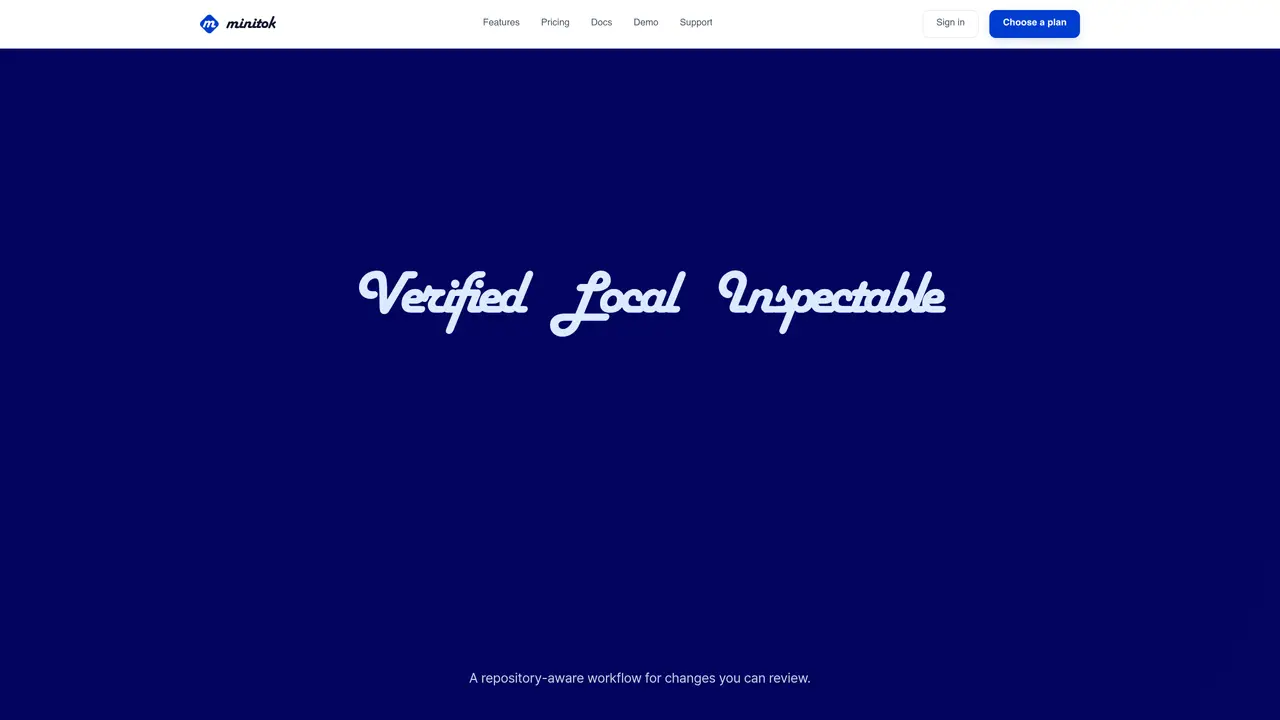
minitok provides a local-first workflow runtime that integrates with a user’s own LLM provider to perform repository-aware coding tasks. It researches the repository, plans and applies changes, runs configured checks, and records verifiable evidence of the process. The tool operates through a CLI and supports VS Code and MCP integrations, keeping all execution local by default. Users describe a task, and minitok generates an implementation plan grounded in the repository context before executing the change. After implementation, it runs deterministic checks such as linting, tests, and builds, and allows bounded retries when failures provide actionable feedback. The final output includes a record of checks passed and the evidence generated, though the tool explicitly states it does not guarantee correctness, security, or production readiness. Access and billing are managed through an account system with different telemetry boundaries available at varying price points.
Key features
- Repository context analysis
- Bounded change execution
- Configurable checks (lint, tests, build)
- Visual evidence recording
- Bounded repair with check feedback
- Provider-agnostic LLM integration
- VS Code and MCP support
- Telemetry boundary options
Use cases
- Automating repository-specific coding tasks
- Validating changes with project-specific checks
- Generating inspectable evidence for code reviews
Pros
- Repository-aware planning and execution
- Local-first operation with user-controlled LLM provider
- Configurable checks and bounded repair cycles
- Visual surface for inspecting workflow results
- Provider-agnostic with support for major LLM vendors
Cons
- No free tier available
- Requires separate LLM provider billing
- Telemetry boundaries vary by plan
- Limited to CLI and supported editor integrations
Frequently asked questions about minitok
What is minitok?
minitok is a local-first workflow runtime that integrates with a user’s own LLM provider to perform repository-aware coding tasks. It researches the repository, plans and applies changes, runs configured checks, and records verifiable evidence of the process without claiming production correctness.
Does minitok replace an LLM?
No, minitok does not replace an LLM. Users must bring their own credentials for providers like Anthropic, OpenAI, Google, or a compatible endpoint, and pay the provider separately for model usage.
Where does minitok run?
The CLI runs locally within the user’s repository, and VS Code and MCP integrations use the same local runtime. All execution is local by default, with telemetry boundaries managed through account-based plans.
What telemetry boundaries are available?
minitok offers three telemetry boundaries: Open (consent-required per-run telemetry with 30-day retention), Select (consent-required aggregate-only telemetry with 14-day retention), and Private (no telemetry upload or storage, with telemetry staying local).
How does minitok handle failed checks?
Failed checks can guide bounded retries within set limits. If the limits are reached, the process stops for review, preventing hidden drift and ensuring the user can inspect the outcome before proceeding.
What does 'verified' mean in minitok?
'Verified' indicates that the configured checks (such as linting, tests, and builds) passed during the workflow run. It does not guarantee correctness, security, or production readiness of the changes made.