
OpenAI builds and deploys advanced AI models like GPT-4o for autonomous agents and workflows.

ObjectStack
364Monthly visits
0Popularity
About ObjectStack
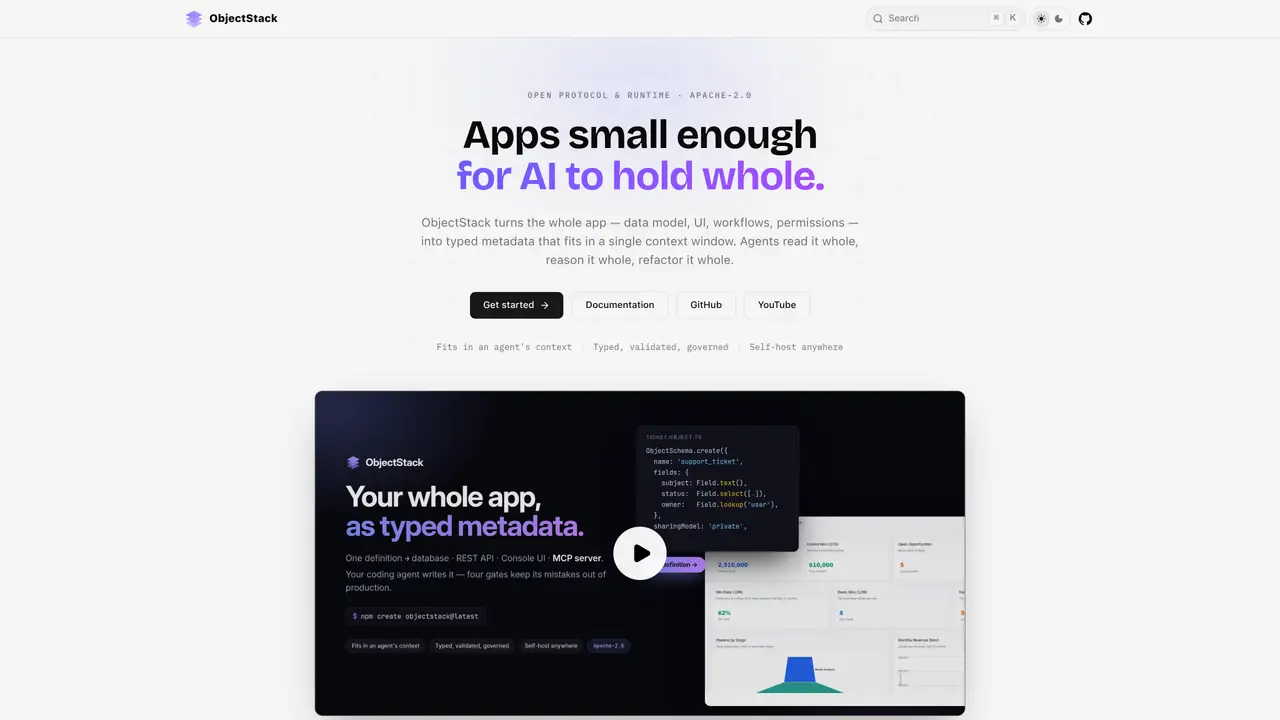
ObjectStack converts entire applications—data models, user interfaces, workflows, and permissions—into typed metadata that fits within a single AI context window. The framework uses strict TypeScript and Zod schemas to validate metadata at authoring time, preventing silent runtime failures. A runtime layer then derives the database, REST API, UI, and MCP server directly from this metadata, enforcing permissions and audit trails on every operation. Developers describe business requirements in natural language, which an AI agent translates into compact typed metadata. The Console provides live previews of the application, allowing iterative refinement through a loop of description, validation, and preview. Changes to requirements are handled by repeating this process, ensuring the application evolves alongside business needs. The framework supports enterprise-grade primitives such as objects with relations, RBAC permissions, multi-step approval flows, and dashboards with live data bindings.
Key features
- Typed metadata for data models, UI, workflows, and permissions
- Strict TypeScript and Zod validation at authoring time
- Live preview and iterative refinement via Console
- Automatic derivation of database, REST API, and MCP server
- RBAC and row-level security enforcement
- Multi-step approval flows with audit trails
- Dashboards with live data bindings and KPIs
- Support for multiple datasources including Postgres and MySQL
Use cases
- Building internal tools from natural language requirements
- Developing enterprise applications with complex permissions
- Creating data-driven dashboards and reporting systems
Pros
- Converts full applications into typed metadata for AI agents
- Validates metadata at authoring time to prevent runtime errors
- Derives database, API, UI, and MCP server from a single definition
- Enforces permissions and audit trails on every operation
- Supports enterprise primitives like RBAC, approvals, and dashboards
Cons
- Requires use of Claude Code for natural language to metadata conversion
- No explicit support for mobile or non-web platforms mentioned
- Limited to applications small enough to fit in an AI context window
Frequently asked questions about ObjectStack
What is ObjectStack and what does it do?
ObjectStack is a metadata framework that converts entire applications—including data models, user interfaces, workflows, and permissions—into typed metadata that fits within a single AI context window. It enables AI agents to read, reason, and refactor the entire application definition as a single unit.
Who should use ObjectStack?
ObjectStack is designed for developers and teams building enterprise-grade applications who want to leverage AI for rapid development while maintaining strict validation, governance, and control over the application's behavior and permissions.
How does ObjectStack work with AI agents?
Developers describe business requirements in natural language, which an AI agent translates into compact typed metadata. The agent composes the definition using ObjectStack's vocabulary of primitives, and the runtime derives the database, REST API, UI, and MCP server directly from this metadata.
Can I preview and iterate on my application before deploying it?
Yes, ObjectStack provides a Console that renders the application live, allowing developers to preview changes in real time. The iterative loop of describing requirements, validating metadata, and previewing results enables continuous refinement before deployment.
What kind of applications can be built with ObjectStack?
ObjectStack supports building enterprise-grade applications with features such as objects with relations, RBAC permissions, multi-step approval flows, dashboards with live data bindings, automation workflows, and APIs with typed SDKs.
How does ObjectStack ensure the correctness and security of applications?
ObjectStack uses strict TypeScript and Zod schemas to validate metadata at authoring time, preventing silent runtime failures. The runtime enforces permissions and audit trails on every operation, ensuring that even incorrect applications remain within defined boundaries.
ObjectStack Website Engagement
Last Update: 18 hours ago
Total Monthly Visits
0
Bounce Rate
0%
Visit Duration (avg)
—
Pages Per Visit
0
Country Rank
—
Unknown
Global Rank
0