
OpenAI builds and deploys advanced AI models like GPT-4o for autonomous agents and workflows.

Taste Skill
FreeStarting price
529KMonthly visits
45Popularity
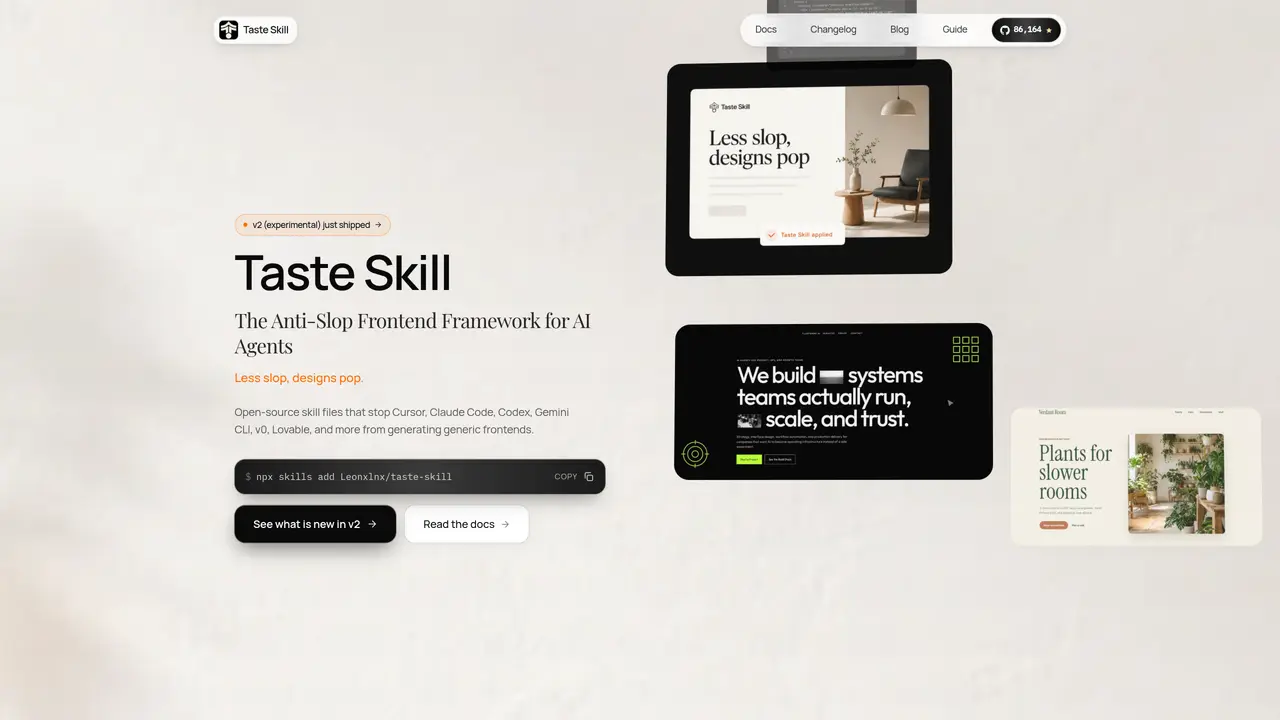
About Taste Skill
Taste Skill is an open-source framework that provides SKILL.md rule files to guide AI coding agents toward producing deliberate, non-templated frontends. The tool reads project briefs to infer audience, layout family, and design direction, then maps requirements to established design systems such as Material, Fluent, Carbon, Polaris, Primer, or native CSS. It enforces strict dark-mode parity, ensuring consistent contrast, hierarchy, rhythm, and tokens across both themes. A hard pre-flight check prevents agents from shipping placeholders, skipped sections, or mismatched components, guaranteeing coherent outputs. Taste Skill v2 integrates with popular agent environments like Cursor, Claude Code, Codex, Gemini CLI, v0, and Lovable, offering skills for style guidance, execution, image-first flows, Stitch exports, and redesign audits. The framework is designed for engineers and agent owners who need non-cookie-cutter UIs without hiring a dedicated design team, making it ideal for full-stack developers, frontend leads, AI agent integrators, and product engineers. It also supports auditors modernizing legacy applications by providing coherent tokens, components, and dark-mode parity without requiring a heavy framework adoption.
Key features
- Reads project briefs to infer design direction and audience
- Maps requirements to production-grade design systems (Material, Fluent, Carbon, etc.)
- Enforces strict dark-mode parity with consistent contrast and hierarchy
- Runs hard pre-flight checks to block placeholders and incomplete sections
- Offers style, execution, image-first, Stitch export, and redesign audit skills
- Integrates with Cursor, Claude Code, Codex, Gemini CLI, v0, and Lovable
- Provides dual-theme UI with coherent tokens and component rules
- Supports legacy modernization with minimal framework overhead
- Delivers non-templated, coherent UI outputs without hard-coding a single stack
Use cases
- Generating production-ready frontends from concise briefs using AI coding agents
- Modernizing legacy applications with coherent design tokens and dark-mode parity
- Auditing and redesigning existing UIs to enforce consistency and accessibility
Pros
- Prevents templated or generic AI-generated frontends by enforcing strict design rules and pre-flight checks
- Supports multiple established design systems (Material, Fluent, Carbon, Polaris, Primer, etc.) and ensures dark-mode parity
- Integrates with popular AI agent environments like Cursor, Claude Code, Codex, and v0 with a single install command
- Offers specialized skills for different use cases, including image-first flows, redesign audits, and brand kits
- Open-source framework with active development and community support
Cons
- v2 is labeled as experimental, which may introduce instability or rule changes before a stable release
- Requires familiarity with SKILL.md files and agent-based workflows to fully leverage its capabilities
- Limited to frontend development and does not address backend or full-stack architecture decisions
Frequently asked questions about Taste Skill
What is Taste Skill and what problem does it solve?
Taste Skill is an open-source framework that provides SKILL.md rule files to guide AI coding agents toward producing deliberate, non-templated frontends. It prevents generic or sloppy outputs by enforcing strict design rules, dark-mode parity, and pre-flight checks.
Who is Taste Skill designed for?
The tool is designed for engineers, frontend leads, AI agent integrators, and product engineers who need non-cookie-cutter UIs without hiring a dedicated design team. It also supports auditors modernizing legacy applications.
How does Taste Skill integrate with AI agents?
Taste Skill plugs into any agent that supports SKILL.md files, including Cursor, Claude Code, Codex, Gemini CLI, v0, and Lovable. It is installed via a single command and enforces design rules during the agent's workflow.
Does Taste Skill support dark mode and design system consistency?
Yes, Taste Skill enforces strict dark-mode parity, ensuring consistent contrast, hierarchy, rhythm, and tokens across both light and dark themes. It also maps requirements to established design systems like Material or Fluent.
What are the key differences between v1 and v2?
v2 is a substantial rewrite that infers design direction from project briefs and ships interfaces that do not look templated. It is stricter than v1 and is now the default, though still labeled as experimental.
Can Taste Skill be used for redesigning existing projects?
Yes, Taste Skill includes a redesign protocol that performs audit-first assessments and provides modernization levers for existing projects, ensuring coherent tokens, components, and dark-mode parity.
Taste Skill Website Engagement
Last Update: 9 days ago
Total Monthly Visits
0
Bounce Rate
0%
Visit Duration (avg)
0.00s
Pages Per Visit
0
Country Rank
0
United States
Global Rank
0
Category Rank
#0
Computers Electronics & Technology
Monthly Traffic
Traffic Sources
Traffic Share By Country
- United States17.5%
- India12.9%
- Indonesia8.1%
- China4.5%
- Brazil3.5%