
Frontier-grade Claude models with agentic workflows, strong coding, and enterprise guardrails delivered via developer console, web app, and cloud partners.

Halo
FreeStarting price
0Popularity
About Halo
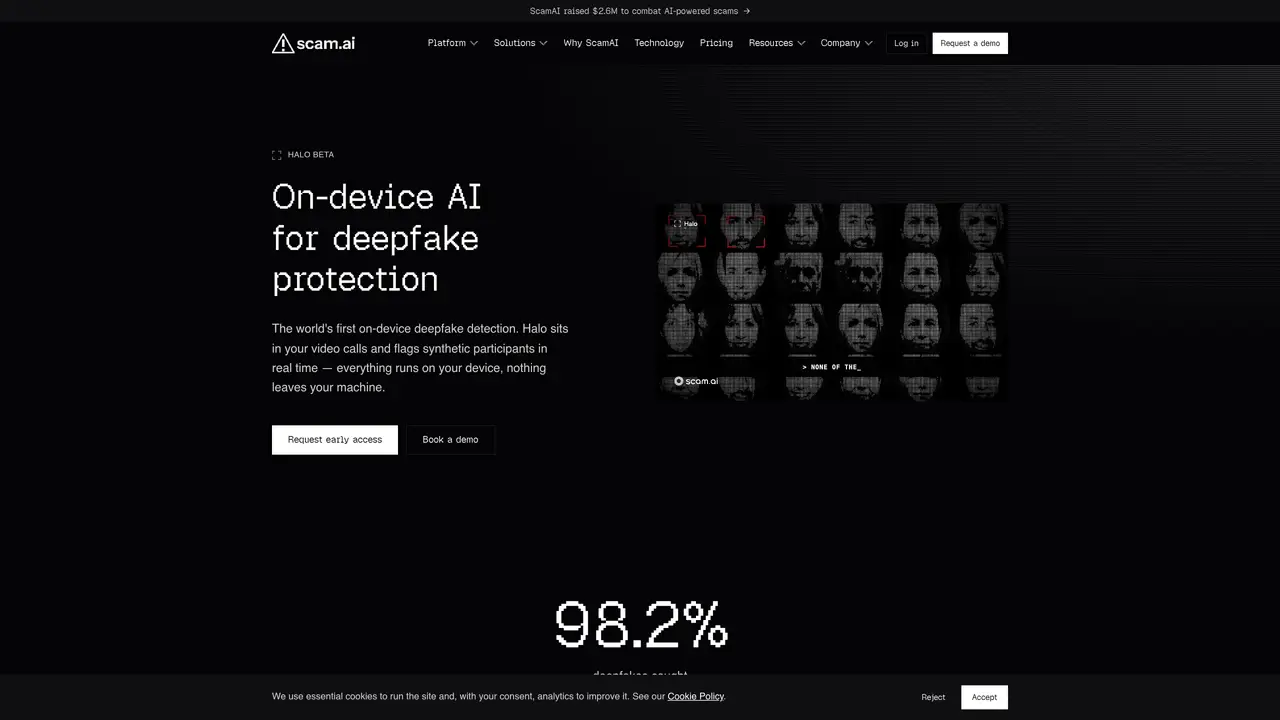
Halo is a lightweight application that integrates with video call clients to detect synthetic participants in real time. It operates entirely on the user’s device, analyzing video streams locally without uploading data to external servers. The tool flags deepfakes by evaluating multiple signals such as swapped faces, looped backgrounds, and fake camera feeds using the Eva V1.6 Detection Model. Halo is designed for fraud, risk, and trust & safety teams in sectors like banking, fintech, insurance, and marketplaces where verifying participant authenticity is critical. Installation involves running the app alongside existing meeting software, after which it monitors calls and provides immediate risk signals when synthetic content is detected. The detection process is private by default, ensuring no call data leaves the user’s machine. Halo is currently available as a beta version for Windows.
Key features
- Local video stream analysis
- Real-time risk signal generation
- Multi-signal detection (faces, backgrounds, camera feeds)
- Eva V1.6 Detection Model integration
- Private by default with no data upload
- Lightweight app installation
- Immediate evidence for detected deepfakes
- Enterprise-focused deployment
Use cases
- KYC/IDV verification in financial services
- Meeting security for fraud prevention teams
- HR/hiring processes to detect synthetic candidates
Pros
- On-device processing for privacy
- Real-time deepfake detection during calls
- Supports multiple signal types (faces, backgrounds, camera feeds)
- Lightweight integration with existing video call clients
- Designed for enterprise teams in high-risk industries
Cons
- Beta version only
- Windows platform only
- Requires manual installation and activation
- No free tier or self-service pricing
Frequently asked questions about Halo
What is Halo and what does it do?
Halo is an on-device AI tool designed to detect deepfake participants in real time during video calls. It runs locally on the user's machine, analyzing video streams without uploading data to external servers, and flags synthetic content by evaluating multiple signals such as swapped faces or looped backgrounds.
Who should use Halo?
Halo is primarily suited for fraud, risk, and trust & safety teams in sectors like banking, fintech, insurance, and marketplaces where verifying participant authenticity is critical. It is also relevant for organizations handling KYC, ID verification, or meeting security.
How does Halo work during a video call?
Halo operates as a lightweight app alongside existing meeting software. It monitors the video stream locally, analyzes it in real time using the Eva V1.6 Detection Model, and provides immediate risk signals when synthetic content is detected, including supporting evidence.
Is Halo available for all operating systems?
Halo is currently available as a beta version for Windows. The tool runs entirely on the user’s device, ensuring no call data leaves the machine.
How can I get access to Halo?
Access to Halo is available through an early access program. Users can request the installer and activation code by submitting their details via the ScamAI website, or book a demo for a guided onboarding experience.
Does Halo integrate with other tools or platforms?
Halo is designed to work alongside existing video call clients as a standalone application. It does not require integration with other platforms but functions as an additional layer of security during meetings.