Tesla’s AI stack powers Full Self-Driving, Optimus humanoid robots, and real-world autonomy with neural networks, custom hardware, and Dojo-scale training.
31M visits/mo+5.5%#8 Coding & Development

Runtime security service that inspects AI support workflows for untrusted content and actions
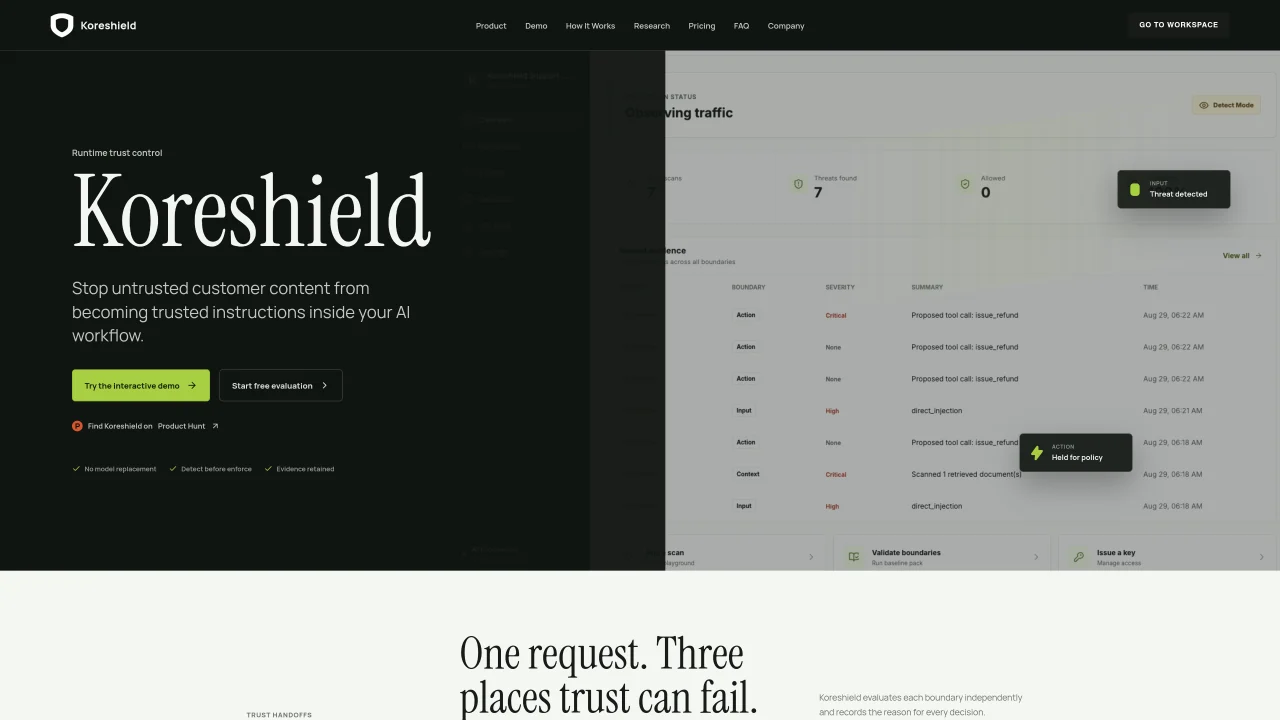
Koreshield provides runtime security controls for AI-powered support workflows by inspecting customer inputs, retrieved context, and proposed actions before model execution. It evaluates trust boundaries at three points—input messages, RAG documents, and tool calls—and records the rationale for each decision. The service operates in detect mode by default, logging threats without interrupting traffic, allowing teams to review evidence and false positives before enabling enforcement mode. Once validated, enforcement mode blocks requests that violate policy while maintaining detailed logs of decisions and severity levels. Integration involves running a FastAPI security service with PostgreSQL alongside existing support infrastructure, with decisions accessible via a hosted console or custom deployment. The tool is designed to prevent untrusted customer content from becoming trusted instructions within AI workflows.
Koreshield provides runtime security controls for AI-powered support workflows by inspecting customer inputs, retrieved context, and proposed actions before model execution. It evaluates trust boundaries at three points—input messages, RAG documents, and tool calls—and records the rationale for each decision.
Koreshield is designed for teams operating AI support workflows, particularly those transitioning from internal testing to production environments. It suits organizations that need to prevent untrusted customer content from becoming trusted instructions within their AI systems.
Integration involves running a FastAPI security service with PostgreSQL alongside existing support infrastructure. Decisions can be accessed via a hosted console or custom deployment, allowing teams to review evidence and false positives before enabling enforcement mode.
Koreshield offers hosted plans and a custom Enterprise path. Hosted options include Starter and Growth tiers, while the Enterprise plan supports regulated, high-volume, or privately deployed workflows with custom topologies like VPC, self-hosted, or air-gapped deployments.
No, Koreshield does not replace authorization systems. It focuses on security boundaries within AI support workflows, evaluating trust levels and preventing untrusted content from becoming trusted instructions without assuming full attack coverage.
Koreshield begins with detect mode, which logs threats without interrupting traffic, allowing teams to review evidence and false positives before enabling enforcement mode. This ensures decisions are validated against actual workflow behavior.
We use essential cookies to run aitoolnavio™, and optional cookies to analyze traffic and measure our marketing. You choose what we use — optional cookies stay off unless you turn them on. See our Privacy Policy.
One short email a week: fresh tools worth trying, honest takes and the updates that actually matter. No spam, unsubscribe any time.
Tesla’s AI stack powers Full Self-Driving, Optimus humanoid robots, and real-world autonomy with neural networks, custom hardware, and Dojo-scale training.
Customize, deploy, and control AI models securely.
Standardize application packaging and execution with portable containers for consistent local and cloud workflows.
AI-first electronic design automation for ICs, advanced packaging, and systems with hardware-assisted acceleration and elastic cloud delivery.
Unified AI-powered platform for real-time monitoring, analytics, and security across cloud infrastructure, applications, and services.
Prevention-first, AI-powered cybersecurity platform protecting networks, clouds, and endpoints with unified controls and autonomous response.
Automate tasks, analyze data, and ensure data security with advanced measures.
Cloud communications platform that lets developers embed SMS, voice, WhatsApp, email, video, verification, and conversational AI via APIs.
AI-powered endpoint security with XDR, cloud or on-prem control, and low system impact for ransomware, email threats, and account takeover prevention.
Automate error tracking, monitor application performance, and gain insights with advanced analytics.
Identify stolen identities, uncover copyright infringements, and find unauthorized use of images with precision.
Instant threat detection and response, AI-powered prevention, unified dashboard for full visibility and control.
Matched on what this tool does — grouped by the job you would be replacing.
matches Inspects customer input messages and attachments · Scans retrieved context from RAG documents and CRM notes · Evaluates proposed tool calls against policy limits
Kernel-level enforcement and audit for AI agents on Linux
Browser-native firewall and data loss prevention for AI agents calling tools via WebMCP
Runtime security and governance tool for LLM applications and agents
Policy engine that intercepts and validates AI agent actions before execution