
Tesla’s AI stack powers Full Self-Driving, Optimus humanoid robots, and real-world autonomy with neural networks, custom hardware, and Dojo-scale training.
31M visits/mo+5.5%#8 Coding & Development

Browser-native firewall and data loss prevention for AI agents calling tools via WebMCP
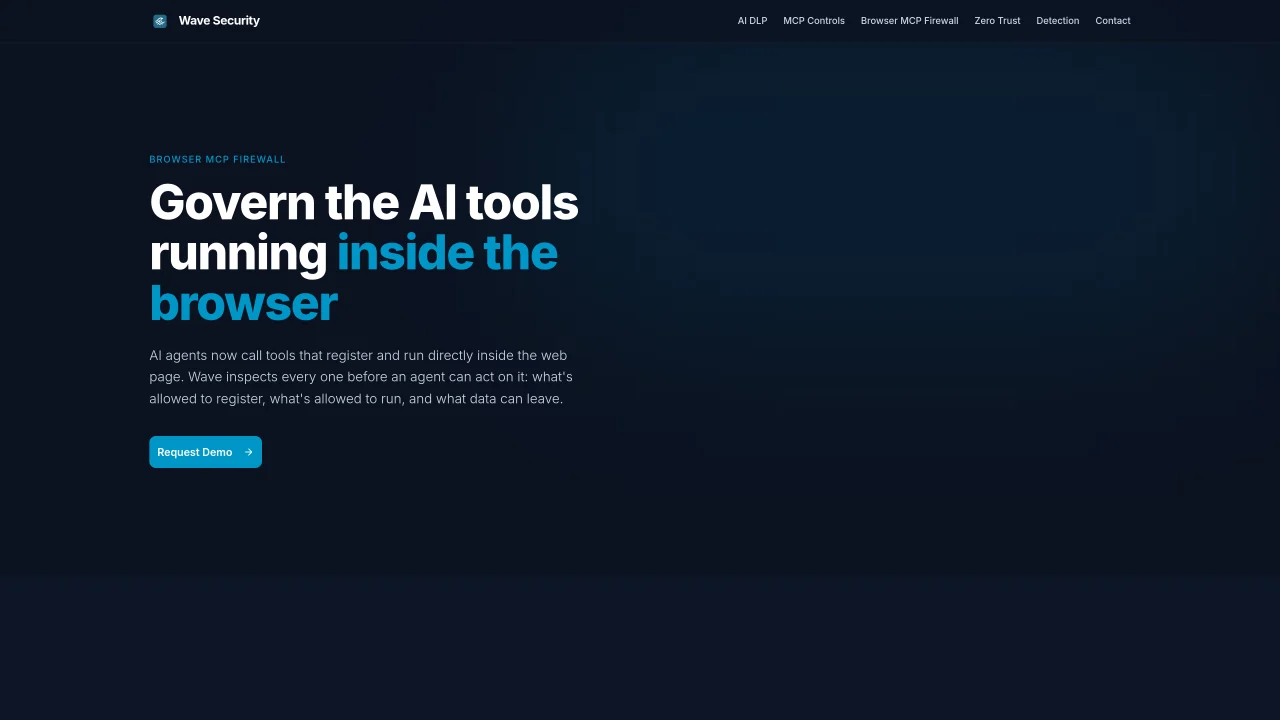
Wave Security provides a browser-native firewall and data loss prevention system designed to govern AI agents that call tools registered and executed directly within web pages using the WebMCP specification. The tool inspects tool registration and execution to control what tools are available, what data can enter or leave, and how calls are handled in real time. It enforces policies at two critical points: during tool registration, where tools can be hidden or denied based on name, metadata, or schema, and during execution, where inputs and outputs are inspected and can be allowed, warned, blocked, or limited before returning to the agent. Wave also offers input and output data loss prevention, runtime hardening against malicious patterns, and live policy management that can be pushed instantly across managed browsers. Evidence collection and auditing are built in, with detailed transcripts and exportable bundles for compliance and review. The system currently operates in Chrome and is expected to expand to other browsers as WebMCP adoption grows.
Wave Security provides a browser-native firewall and data loss prevention system that governs AI agents interacting with tools registered and executed directly within web pages using the WebMCP specification. It controls tool availability, data flow, and real-time call handling to enforce security policies.
The tool is designed for organizations that need to secure AI agents operating within web browsers, particularly those using WebMCP to register and execute tools. It suits enterprises concerned with data loss prevention, policy enforcement, and compliance in AI-driven workflows.
Policies are enforced at two critical points: during tool registration, where tools can be hidden or denied based on name, metadata, or schema, and during execution, where inputs and outputs are inspected and controlled in real time before returning to the agent.
Wave Security currently operates in Chrome and is expected to expand to other browsers as WebMCP adoption grows.
Yes, Wave Security includes evidence collection and auditing capabilities, such as detailed transcripts and exportable bundles, to support compliance and review processes.
To get started, visit the Wave Security website to learn more about the tool and its capabilities. The system can be integrated into managed browsers to begin enforcing policies and securing AI agent interactions.
We use essential cookies to run aitoolnavio™, and optional cookies to analyze traffic and measure our marketing. You choose what we use — optional cookies stay off unless you turn them on. See our Privacy Policy.
One short email a week: fresh tools worth trying, honest takes and the updates that actually matter. No spam, unsubscribe any time.
Tesla’s AI stack powers Full Self-Driving, Optimus humanoid robots, and real-world autonomy with neural networks, custom hardware, and Dojo-scale training.
Customize, deploy, and control AI models securely.
Standardize application packaging and execution with portable containers for consistent local and cloud workflows.
AI-first electronic design automation for ICs, advanced packaging, and systems with hardware-assisted acceleration and elastic cloud delivery.
Unified AI-powered platform for real-time monitoring, analytics, and security across cloud infrastructure, applications, and services.
Prevention-first, AI-powered cybersecurity platform protecting networks, clouds, and endpoints with unified controls and autonomous response.
Automate tasks, analyze data, and ensure data security with advanced measures.
Cloud communications platform that lets developers embed SMS, voice, WhatsApp, email, video, verification, and conversational AI via APIs.
AI-powered endpoint security with XDR, cloud or on-prem control, and low system impact for ransomware, email threats, and account takeover prevention.
Automate error tracking, monitor application performance, and gain insights with advanced analytics.
Identify stolen identities, uncover copyright infringements, and find unauthorized use of images with precision.
Instant threat detection and response, AI-powered prevention, unified dashboard for full visibility and control.
Wave Security AI DLP MCP ControlsContact for Pricing SunglassesFreeWave Security AI DLP MCP ControlsContact for Pricing
 KoreshieldSubscriptionWave Security AI DLP MCP ControlsContact for Pricing
 Context FenceFreemiumWave Security AI DLP MCP ControlsContact for Pricing
 AIBIMFree
Matched on what this tool does — grouped by the job you would be replacing.
matches Tool availability control by name, metadata, or schema · Real-time call protection with allow/warn/block/limit actions · Input and output data loss prevention with redaction
Open-source input firewall that scans AI agent prompts and files for security threats before model ingestion
Runtime security service that inspects AI support workflows for untrusted content and actions
Local policy proxy that intercepts and validates AI coding agent tool calls before execution
Runtime security and governance tool for LLM applications and agents
matches Real-time LLM observability with full trace capture · Execution budget and circuit breaker enforcement · Input policy guardrails for prompt injection prevention
matches Scans prompts, files, repositories, web pages, and MCP tool metadata · Enforcing firewall for blocking secret leakage · Token tax analysis of request payloads
matches Input DLP with credential patterns · Shannon entropy detection for encoded secrets · Unicode normalization anti-evasion
Runtime evaluation and enforcement for AI agents in production
Enterprise AI orchestration platform that connects autonomous agents to business apps via a single governed endpoint.
Runtime control and observability for production AI agents
Local control plane for inspecting and restricting Claude Code tool usage
Debug and govern AI agent loops directly in the code editor
Cyera is a powerful data security platform designed to enhance the detection, management, and protection of sensitive data across diverse environments.
AI-native security platform that detects and mitigates risks across AI lifecycles with automated remedies for robust protection.
Command-line tool for AI agent governance, data loss prevention and quality control