
Frontier-grade Claude models with agentic workflows, strong coding, and enterprise guardrails delivered via developer console, web app, and cloud partners.

VISTAlabs
0Popularity
About VISTAlabs
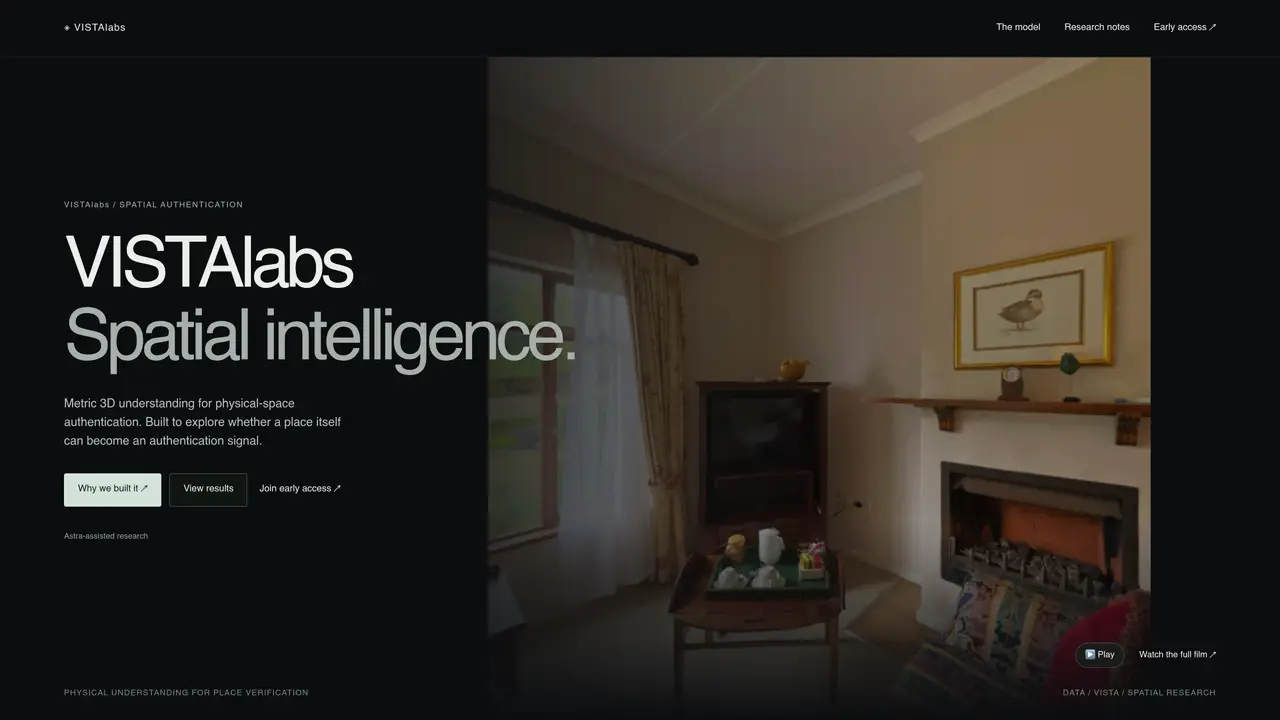
VISTAlabs is a research model focused on spatial intelligence for physical-space authentication. It explores whether a place itself can serve as an authentication signal by generating metric 3D reconstructions from 360° panoramic inputs. The model processes RGB, depth, and normal data to produce aligned geometric representations, including metric depth, 3D points, and Gaussian splats for photorealistic rendering. VISTAlabs emphasizes metric scale estimation and camera geometry retention, enabling comparisons of spatial structure across sessions and devices. The system includes two pathways: one using VISTA-derived depth for full 3D reconstruction and another using a single RGB image with DepthPro for limited novel-view synthesis. Demonstrations cover three real interiors, showcasing soft light, fine structure, and high-resolution Gaussian splats. The research highlights the challenges of data consistency across captures, sessions, and environmental changes, using controlled synthetic environments for supervision.
Key features
- Metric depth estimation from panoramic inputs
- 3D point cloud generation with retained geometry
- Gaussian splat rendering for photorealistic output
- Camera geometry retention and virtual source-view frustums
- Two processing pathways: VISTA depth and single RGB image
- Controlled synthetic data generation for metric supervision
- Cross-session alignment research objective
- Normal and depth map alignment with shared pixel grid
Use cases
- Physical-space authentication research
- Metric 3D reconstruction from panoramic imagery
- Spatial consistency evaluation across sessions
Pros
- Generates metric 3D reconstructions from 360° panoramic inputs
- Supports two pathways: full VISTA depth and single RGB image with DepthPro
- Retains camera geometry and spatial relationships for cross-session alignment
- Produces photorealistic Gaussian splats for detailed scene representation
- Uses controlled synthetic environments for metric supervision and evaluation
Cons
- No validated multi-session benchmark or authentication matcher provided
- Single-image pathway restricts novel views to supported camera paths
- Cross-session consistency and spatial error require separate validation
- Private training data and generation recipe are not disclosed
Frequently asked questions about VISTAlabs
What does VISTAlabs do?
VISTAlabs explores whether a physical space itself can serve as an authentication signal by generating metric 3D reconstructions from 360° panoramic inputs. It processes RGB, depth, and normal data to produce aligned geometric representations, including metric depth, 3D points, and Gaussian splats for photorealistic rendering.
Who is VISTAlabs designed for?
VISTAlabs is designed for researchers and developers interested in spatial intelligence and physical-space authentication, particularly those exploring metric 3D understanding for place verification and repeatable scene geometry.
How does VISTAlabs estimate physical scale?
The model estimates physical scale by retaining camera geometry and using retained geometry to derive endpoint distances, rather than relying on external measurements like a tape measure.
What are the two pathways in VISTAlabs?
VISTAlabs includes two pathways: one that uses VISTA-derived depth for full 3D reconstruction and another that uses a single RGB image with DepthPro for limited novel-view synthesis.
What are the limitations of VISTAlabs' demonstrations?
The current demonstrations do not establish independent physical-scale accuracy, validated multi-session benchmarks, or authentication performance. They focus on presenting the model's capabilities rather than validating security claims.
How can I get started with VISTAlabs?
Prospective users can join the early access program or explore the research notes and demonstrations provided on the VISTAlabs website to understand the model's capabilities and limitations.