
Frontier-grade Claude models with agentic workflows, strong coding, and enterprise guardrails delivered via developer console, web app, and cloud partners.

WebScanify
$129Starting price
0Popularity
About WebScanify
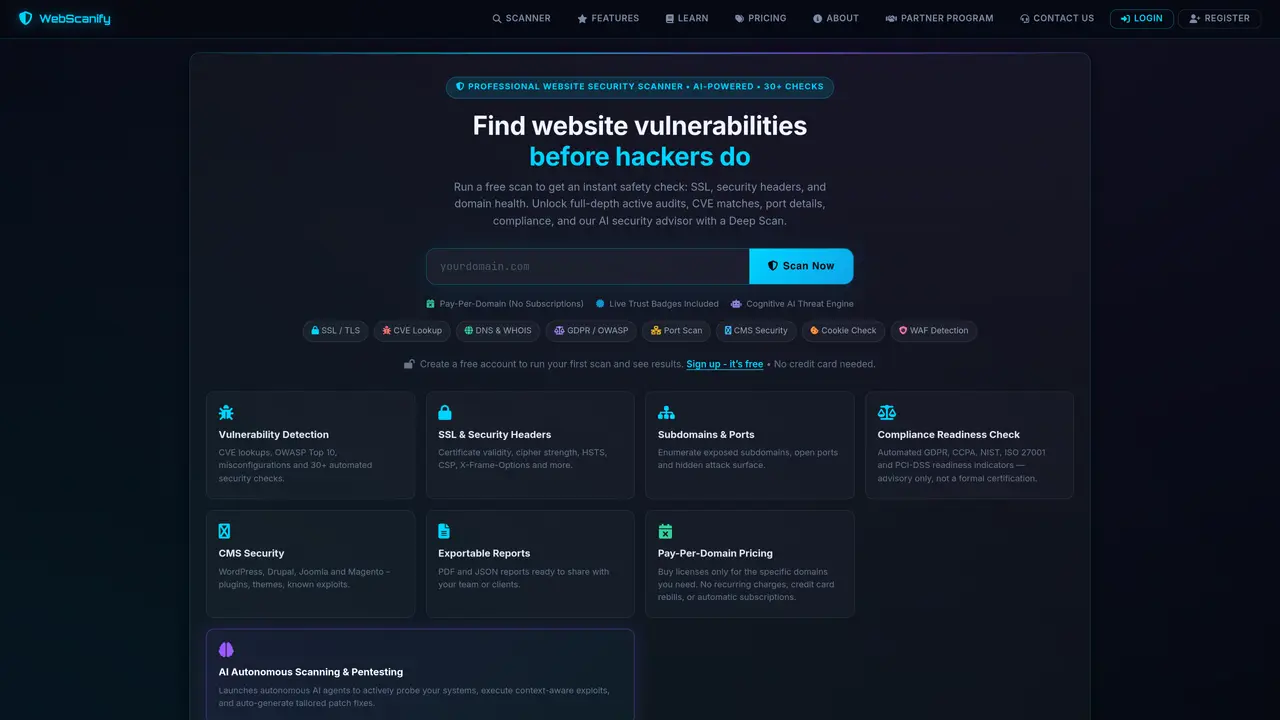
WebScanify performs automated security scans on websites to identify vulnerabilities, misconfigurations, and compliance gaps. It checks SSL/TLS configurations, security headers, subdomains, open ports, and known CVEs while mapping findings to OWASP Top 10 and GDPR/CCPA/NIST/ISO 27001/PCI-DSS standards. The tool offers both quick free scans and deeper active audits that simulate attacks using AI agents to probe systems and generate tailored remediation guidance. Reports are exportable in multiple formats including PDF, JSON, and SARIF for sharing with teams or clients. Users can run scans on-demand or schedule recurring checks, with pricing based on the number of domains rather than user seats. Authentication is required for active scanning, and scans must comply with legal authorization requirements.
Key features
- SSL/TLS certificate validation and cipher strength analysis
- OWASP Top 10 and CVE vulnerability matching
- Subdomain enumeration and port scanning
- CMS security checks for WordPress, Drupal, Joomla, and Magento
- AI Security Advisor for plain-English explanations and fix plans
- Multi-format report exports (PDF, JSON, HTML, Word, SARIF)
- Compliance readiness indicators for multiple standards
- Domain-based license management with no seat limits
Use cases
- Pre-launch website security reviews and compliance readiness checks
- Ongoing monitoring of small to medium website portfolios
- Agency or developer client website audits with multi-domain dashboards
Pros
- AI-powered vulnerability detection and remediation guidance
- 30+ automated security checks covering SSL, headers, CVEs, ports, subdomains, and CMS platforms
- Pay-per-domain pricing with no recurring subscriptions or forced contracts
- Exportable reports in PDF, JSON, HTML, Word, and SARIF formats
- Compliance readiness checks for GDPR, CCPA, NIST, ISO 27001, and PCI-DSS
Cons
- Active scanning requires account authorization and explicit permission
- No free tier beyond initial basic scans
- Pricing scales with domain count rather than scan volume
- Authenticated scans require temporary credential input
Frequently asked questions about WebScanify
What does WebScanify do?
WebScanify is a website security scanner that performs automated vulnerability assessments, including checks for SSL/TLS configurations, security headers, subdomains, open ports, and known CVEs. It also evaluates compliance with standards like OWASP Top 10, GDPR, CCPA, NIST, ISO 27001, and PCI-DSS.
Who should use WebScanify?
WebScanify is designed for website owners, security professionals, developers, and compliance teams who need to identify vulnerabilities, misconfigurations, and compliance gaps in their web assets. It suits both technical and non-technical users.
How does WebScanify pricing work?
WebScanify uses a pay-per-domain pricing model, where users purchase licenses for specific domains rather than subscribing to a recurring plan. This allows for flexible and cost-effective scanning without automatic renewals or credit card rebills.
What integrations or features does WebScanify offer?
WebScanify includes features such as AI-powered threat detection, CVE lookups, OWASP Top 10 mapping, SSL/TLS checks, subdomain enumeration, port scanning, CMS security analysis, and compliance readiness indicators. Reports can be exported in PDF, JSON, and SARIF formats.
What are the limitations of WebScanify?
Active scanning requires legal authorization, as it simulates attacks to identify real vulnerabilities. Users must confirm ownership or explicit permission to scan systems. Additionally, authenticated scans require temporary login credentials, which are not stored after the scan.
How do I get started with WebScanify?
Users can create a free account to run initial scans without a credit card. To access full-depth active audits and advanced features, users need to purchase domain-specific licenses. Scans can be run on-demand or scheduled for recurring checks.