
Cloud platform for web scraping, browser automation, and AI data extraction with 20,000+ pre-built tools and scalable cloud runs.

Scryb
$29Starting price
0Popularity
About Scryb
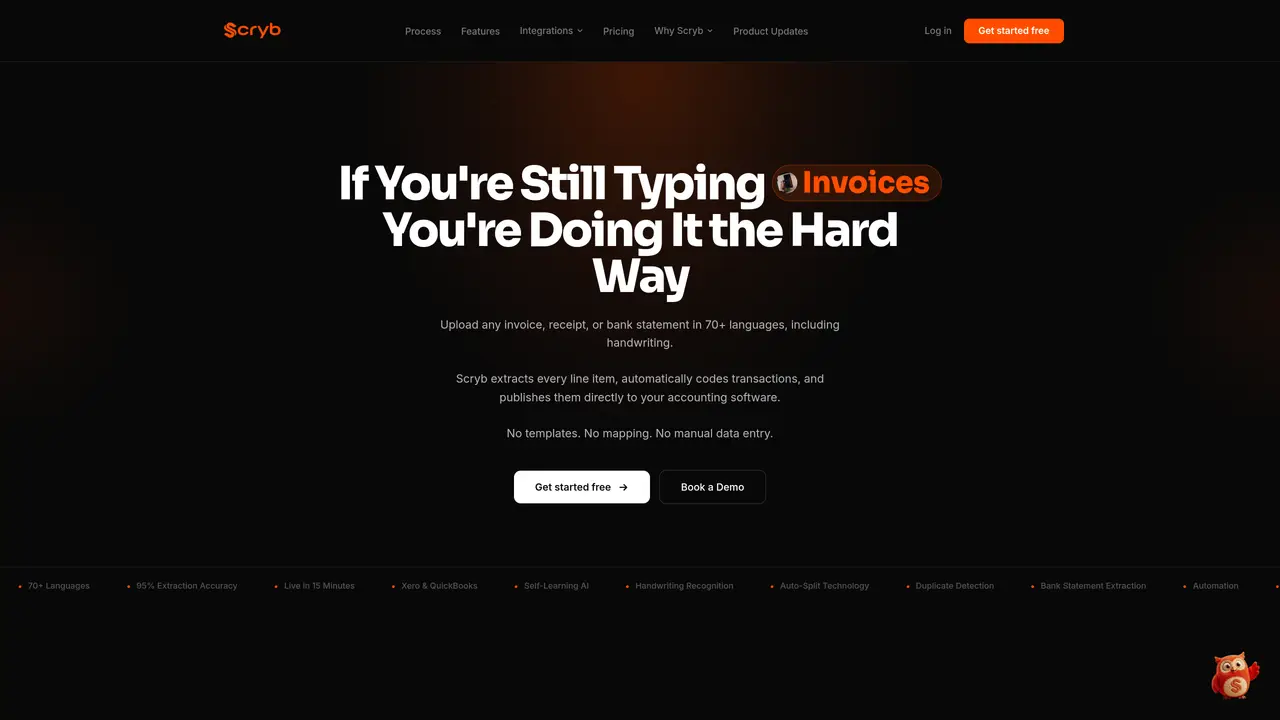
Scryb automates the extraction and processing of financial documents such as invoices, receipts, and bank statements, converting unstructured data into structured, accounting-ready transactions. It supports over 70 languages and can read handwritten content, handling low-quality or inconsistently formatted files without requiring manual templates or mapping. The tool integrates with major accounting platforms including QuickBooks, Xero, Zoho Books, Odoo, and Business Central, enabling direct posting of transactions and reducing manual data entry. Scryb offers features like duplicate detection, auto-split technology for mixed documents, and self-learning AI that adapts to bookkeeping rules over time. Documents can be uploaded via email, WhatsApp, cloud storage services like Google Drive, SharePoint, and Dropbox, or through private deployment options for enhanced security and compliance. Processed data can also be exported to CSV or Excel for further use, making it suitable for finance teams, accounting firms, and small businesses seeking to streamline bookkeeping workflows. Scryb is designed for teams looking to eliminate manual invoice processing and improve accuracy in financial record-keeping. Its AI-powered extraction and automated coding capabilities allow users to process complex documents quickly, while integrations with accounting software ensure seamless synchronization. The platform also supports private deployment for organizations with strict security or compliance requirements, ensuring data remains protected within their own infrastructure.
Key features
- Line item extraction from invoices, bills, and receipts
- Handwriting recognition for handwritten documents
- Bank statement extraction and conversion to transactions
- Auto-split technology for mixed PDFs
- Duplicate transaction detection
- Self-learning AI for automated coding
- Integration with cloud storage (Google Drive, SharePoint, Dropbox)
- Export to CSV/Excel or direct posting to accounting software
Use cases
- Automating invoice and receipt processing for small businesses
- Reconciling bank statements with accounting software
- Handling international documents in multiple languages
Pros
- Supports 70+ languages including handwriting recognition
- Integrates with multiple accounting platforms (QuickBooks, Xero, Zoho Books, Odoo, Business Central)
- Self-learning AI for automated transaction coding
- Handles bank statement extraction and duplicate detection
- Offers private deployment options for security
Cons
- No free tier mentioned
- Requires specific accounting software integrations
- Limited to document processing for accounting tasks
Frequently asked questions about Scryb
What types of documents can Scryb process?
Scryb can process invoices, receipts, bank statements, and handwritten documents in over 70 languages, handling messy or low-quality files without manual templates.
Which accounting systems does Scryb integrate with?
Scryb integrates with QuickBooks, Xero, Zoho Books, Odoo, and Business Central, allowing direct posting of extracted transactions into these systems.
How does Scryb handle duplicate transactions?
Scryb includes duplicate detection to flag potential duplicate transactions before they are posted, helping maintain clean and accurate financial records.
Can Scryb process documents sent via email or WhatsApp?
Yes, Scryb supports automation through email and WhatsApp, where documents sent to a designated email or via WhatsApp are automatically processed and synchronized with the connected accounting system.
Does Scryb offer options for organizations with strict security requirements?
Scryb provides private deployment options, allowing organizations to deploy the tool securely on their own on-premise environment or preferred cloud platform to meet security and compliance needs.
Can processed data be exported for further use?
Yes, Scryb allows exporting processed data to CSV or Excel, enabling users to download clean, accounting-ready files for additional analysis or import into other systems.