
WordPress plugin exposing 240 tools to MCP-compatible AI clients for site management and data retrieval.

AI Engine
$79Starting price
0Popularity
About AI Engine
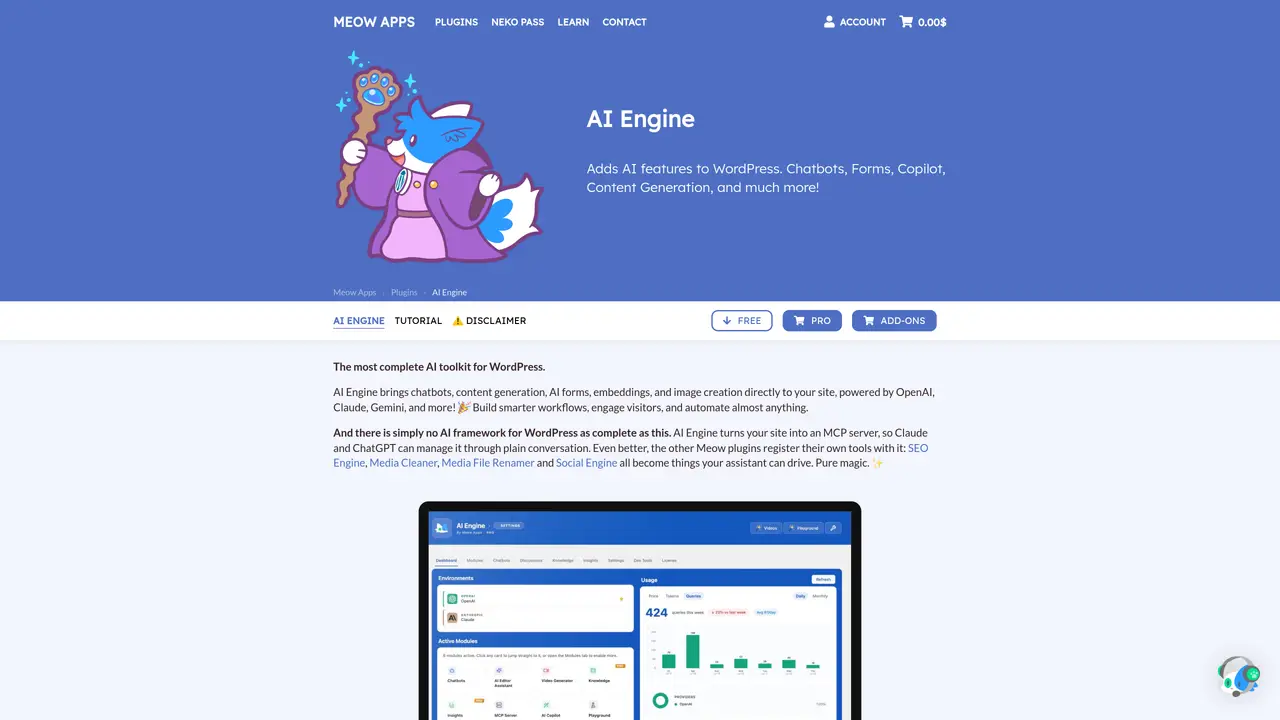
AI Engine is a powerful plugin for WordPress that utilizes the power of Artificial Intelligence (AI) to enhance the user experience. With AI Engine, users can create fresh and engaging content for their WordPress site using the latest GPT technology. Additionally, users can explore AI-powered tasks such as translation and correction in the AI playground, helping to improve their site’s performance. AI Engine makes it easy to add AI-enhanced features to any WordPress site with a few clicks. With its intuitive user interface and advanced features such as automated content generation and task optimization, users can quickly and easily create engaging content and see results. AI Engine also includes a variety of helpful tools and resources to help users get the most out of the plugin. AI Engine is an invaluable resource for anyone looking to take their WordPress site to the next level. With its powerful AI capabilities, users can create content faster, optimize tasks easily, and get the most out of their WordPress experience.
Key features
- Automate content generation
- Explore AI-powered tasks such as translation and correction
- Optimize tasks for improved WordPress performance
- Intuitive user interface
- Advanced features for automated content generation and task optimization
- Helpful tools and resources
Use cases
- Creating fresh and engaging content for a WordPress site
- Exploring AI-powered tasks such as translation and correction in the AI playground
- Optimizing tasks for improved WordPress performance
Pros
- Enables integration with multiple AI providers (OpenAI, Claude, Gemini, Mistral, etc.) without vendor lock-in
- Turns WordPress into an MCP server for AI agents to manage site tasks via natural language
- Offers a full in-admin workspace with chat, content generation, and image creation tools
- Supports embeddings and knowledge bases from site content or PDFs for context-aware responses
- Provides usage insights and token cost tracking to prevent unexpected billing
Cons
- Requires users to manage their own API keys and provider accounts
- Feature-rich interface may present a learning curve for beginners
- Advanced capabilities like MCP server functionality depend on external AI agent support
Frequently asked questions about AI Engine
What is AI Engine and what does it do for WordPress?
AI Engine is a WordPress plugin that integrates AI capabilities such as chatbots, content generation, forms, embeddings, and image creation directly into a WordPress site. It supports multiple AI providers like OpenAI, Claude, and Gemini, allowing users to leverage their own accounts and models without vendor lock-in.
Who should use AI Engine?
AI Engine is designed for WordPress users looking to enhance their site with AI features, including content creators, developers, agencies, and site administrators. It suits those who want to automate workflows, engage visitors, or manage their site through AI agents.
Does AI Engine require coding knowledge to use?
No coding is required for most features. AI Engine offers an intuitive interface for building chatbots, generating content, and managing AI tasks. However, advanced users can leverage APIs or MCP integration for deeper customization.
Can AI Engine work with external AI models and providers?
Yes, AI Engine supports multiple AI providers including OpenAI, Anthropic, Google, Mistral, Perplexity, and OpenRouter. Users can switch between models or providers at any time without being locked into a single service.
What are the pricing options for AI Engine?
AI Engine offers a free version with core features and a Pro version with advanced capabilities such as AI forms, function calling, embeddings, and usage insights. Pricing details are available on the plugin’s official website.
How does AI Engine handle data privacy and security?
AI Engine allows users to bring their own AI provider accounts and API keys, ensuring data is processed according to the user’s chosen provider’s policies. The plugin itself does not store or manage user data beyond what is necessary for its operation.