
Open-source platform combining product analytics, session replay, A/B testing, and feature flags in one toolkit for product engineers.

ARRM
$99/moStarting price
0Popularity
About ARRM
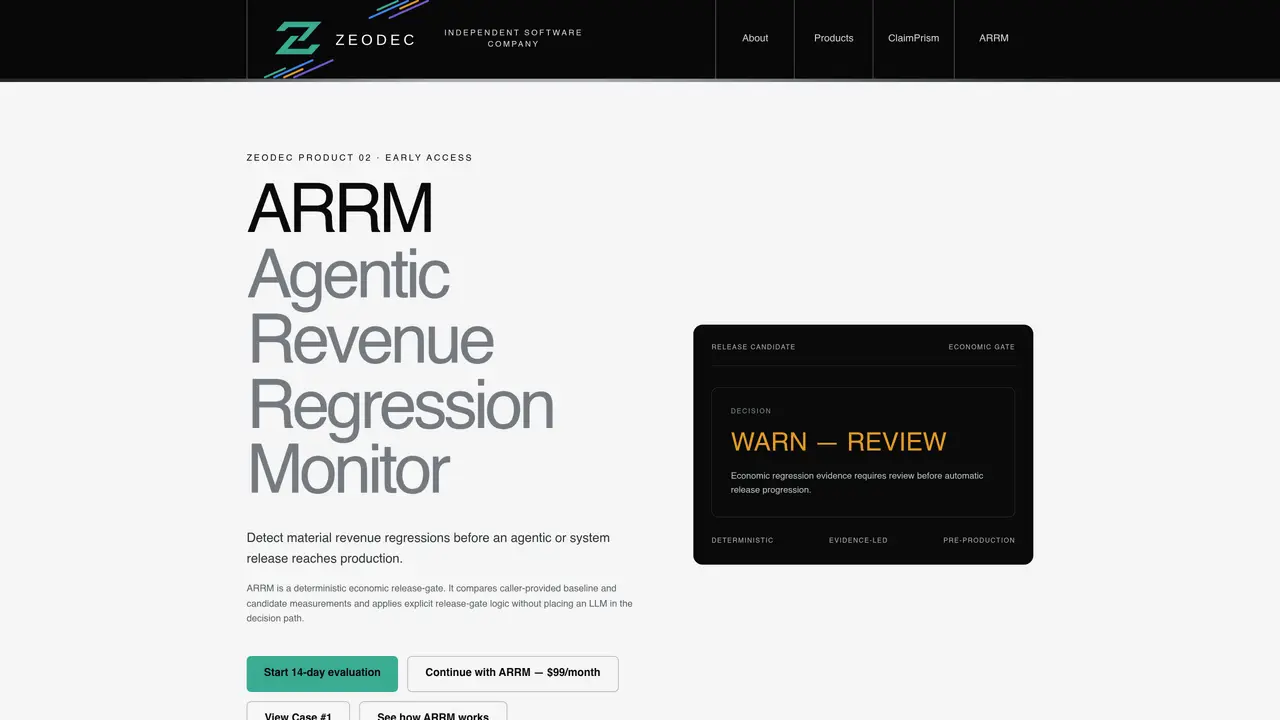
ARRM is a deterministic economic release-gate designed to detect material revenue regressions before an agentic or system release reaches production. It compares caller-provided baseline and candidate measurements across specified economic metrics and scenarios, applying explicit release-gate logic without placing an LLM in the decision path. The tool is intended for teams shipping systems where release decisions can directly affect revenue outcomes, such as agentic commerce, pricing and monetization systems, or revenue-sensitive automation workflows. ARRM returns a deterministic PASS, WARN, or FAIL result mapped to PROCEED, REVIEW, or BLOCK, enabling automated release workflows. It operates by evaluating economic behavior rather than functional changes, focusing on material regressions that may not be exposed by conventional checks. The system relies on caller-supplied evidence and explicit rules for metric direction, thresholds, materiality, and evidence sufficiency to ensure repeatable release-gate behavior. Designed for pre-production use, ARRM provides a machine-readable result suitable for integration into CI/CD pipelines.
Key features
- Compares baseline and candidate economic measurements
- Detects material revenue regressions
- Returns PASS, WARN, or FAIL results
- Integrates with GitHub Actions
- Generates machine-readable report artifacts
- Supports deterministic release-gate logic
- Focuses on pre-production economic validation
- Designed for revenue-sensitive automation workflows
Use cases
- Agentic commerce systems where releases affect revenue
- Pricing and monetization system changes
- Revenue-sensitive automation workflows
Pros
- Deterministic release-gate logic without LLM involvement
- Focuses on economically meaningful regressions rather than generic model drift
- Machine-readable results for CI/CD integration
- Explicit rules for repeatable behavior
- Designed for revenue-sensitive release decisions
Cons
- No hosted metric collection or enterprise control plane
- No SLA or certification implied
- Limited to caller-provided baseline and candidate measurements
- Early Access only, with monthly subscription after evaluation
Frequently asked questions about ARRM
What does ARRM do?
ARRM is a deterministic economic release-gate that detects material revenue regressions before an agentic or system release reaches production. It compares baseline and candidate measurements across specified economic metrics and scenarios, returning a PASS, WARN, or FAIL result without using an LLM in the decision process.
Who should use ARRM?
ARRM is designed for teams shipping systems where release decisions can directly affect revenue outcomes, such as agentic commerce, pricing and monetization systems, or revenue-sensitive automation workflows.
How does ARRM work?
ARRM operates by evaluating economic behavior rather than functional changes. Users supply baseline and candidate measurements, and ARRM applies explicit rules for metric direction, thresholds, materiality, and evidence sufficiency to determine a deterministic release-gate result.
Can ARRM integrate with CI/CD pipelines?
Yes, ARRM provides a machine-readable result suitable for integration into CI/CD pipelines, including a canonical GitHub Actions integration path and a machine-readable report artifact.
What are the possible outcomes of ARRM?
ARRM returns a deterministic PASS, WARN, or FAIL result, which maps to PROCEED, REVIEW, or BLOCK, enabling automated release workflows based on economic regression evidence.
Is ARRM suitable for pre-production use only?
Yes, ARRM is designed for pre-production use, focusing on detecting material revenue regressions before a release reaches production.