
AI platform for upscaling images, enhancing photos, and generating high-quality creative assets with contextual detail.

Memoria
$9.99Starting price
0Popularity
About Memoria
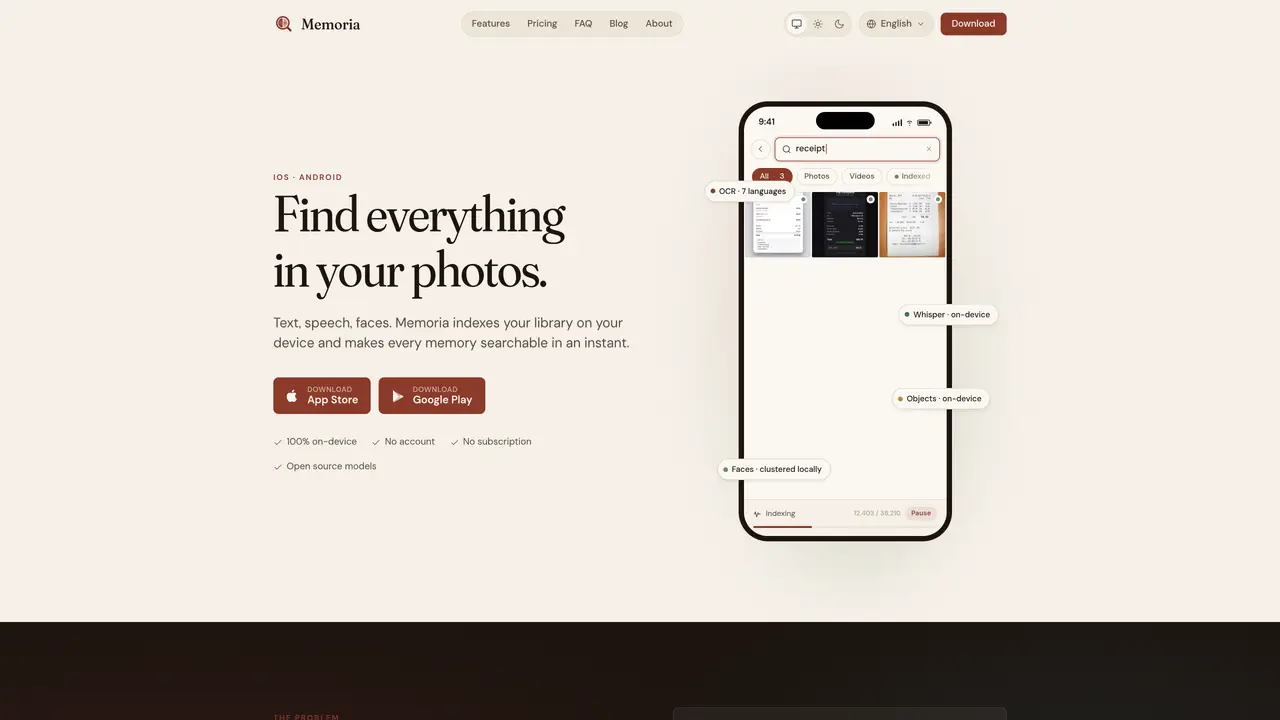
Memoria indexes a user’s photo and video library directly on the device, enabling full-text search across text in images, spoken words in videos, recognized objects, and grouped faces. It supports three search modes: optical character recognition for documents, whiteboards, screenshots and memes; speech transcription for lectures, meetings and voice notes; and face detection that clusters photos by person. All processing occurs locally without cloud uploads, accounts or subscriptions. The app builds a unified index that remains private and accessible offline, with instant search results. Indexing runs in the background and continues even when the app is closed. Supported features include seven OCR languages, on-device Whisper for audio transcription in 99+ languages, and local face clustering and object recognition.
Key features
- On-device optical character recognition
- On-device speech transcription via Whisper
- Local face detection and clustering
- Object recognition in images
- Background indexing of media library
- Offline search across text, speech, faces and objects
- No account creation required
- One-time purchase option for full access
Use cases
- Locating documents or notes in photos by text
- Finding videos by spoken keywords or lyrics
- Browsing all photos of a specific person
Pros
- 100% on-device processing with no cloud uploads
- No account or subscription required
- Supports text, speech, faces and objects in search
- Open-source models used for core functions
- GDPR-compliant by design
Cons
- Limited to mobile platforms (iOS and Android)
- No web or desktop version available
- OCR supports only seven languages
Frequently asked questions about Memoria
What is Memoria and what does it do?
Memoria is an app that indexes a user’s photo and video library directly on their device, enabling full-text search across text in images, spoken words in videos, recognized objects, and grouped faces. It supports three search modes: optical character recognition, speech transcription, and face detection.
Who is Memoria designed for?
Memoria is designed for anyone who needs to quickly find specific content within their personal photo and video collections, such as documents, lectures, meetings, or photos of people. It is particularly useful for users who prioritize privacy and offline access.
Does Memoria require an account or subscription?
No, Memoria does not require an account or subscription. All processing occurs locally on the device, and users can try the app for free with limited indexing before making a one-time purchase to unlock full functionality.
How does Memoria handle privacy and data security?
Memoria processes all data locally on the device, with no cloud uploads or tracking. Photos and videos remain in the user’s library, and only anonymous usage data is collected, which can be opted out of in settings.
What languages does Memoria support for OCR and audio transcription?
OCR supports 7 languages: English, French, German, Spanish, Italian, Portuguese, and Japanese. Audio transcription supports 99+ languages through the on-device Whisper model.
How do I get started with Memoria?
Users can download Memoria from the App Store or Google Play, try it for free with limited indexing, and then make a one-time purchase to unlock full library indexing and additional features.