
AI-powered medical search engine that delivers synthesized, cited answers from peer-reviewed research for clinicians.

Clinician AI Assist
0Popularity
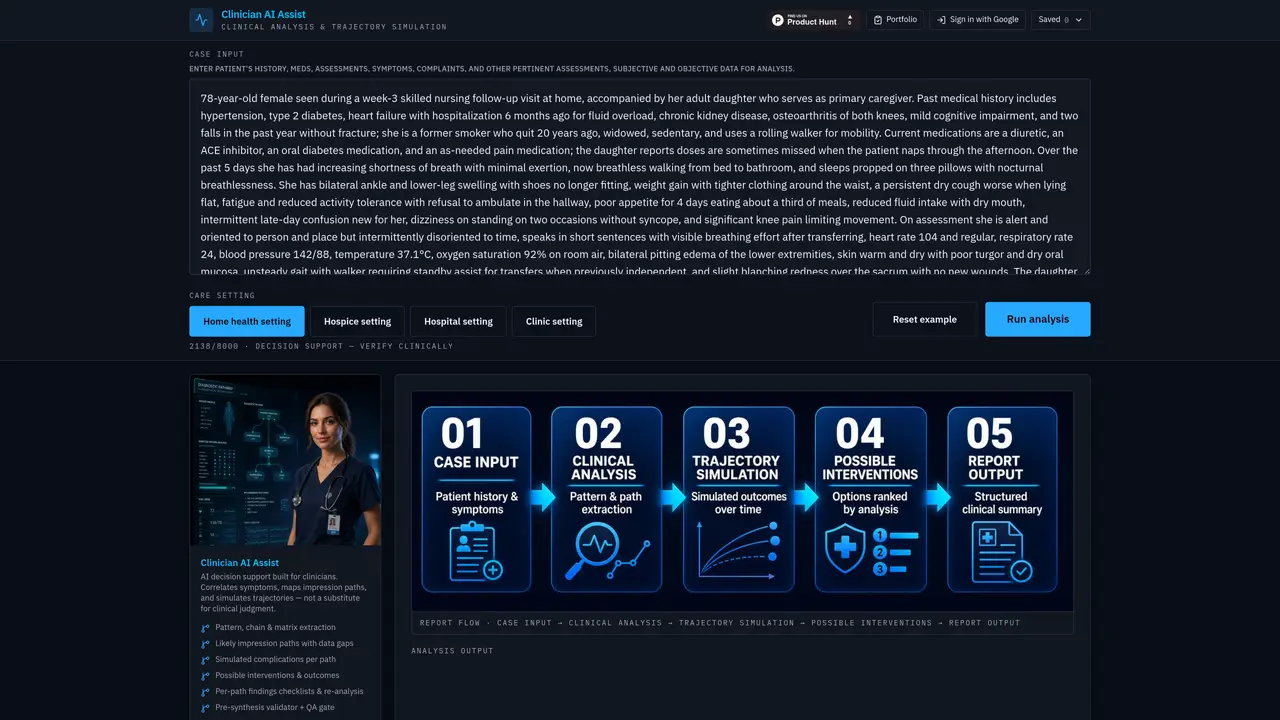
About Clinician AI Assist
Clinician AI Assist is a clinical decision-support tool designed for licensed healthcare professionals. It analyzes patient histories, medications, assessments, symptoms, and other clinical data to provide structured insights. The software correlates symptoms, maps potential impression paths, and simulates possible trajectories based on the entered information. It organizes findings, presents differential diagnoses, lists diagnostic and treatment options, and highlights missing information for clinician review. The tool also generates conditional simulations exploring potential outcomes if specific pathways are operative. Outputs include per-path findings, checklists, and synthesized reports with cited guidelines and literature sources. Reports can be saved and exported as PDFs for further clinical consideration. The system is intended solely as a reference tool to support independent clinical judgment and is not a substitute for professional medical evaluation or decision-making.
Key features
- Symptom correlation and pattern extraction
- Impression path mapping with data gap identification
- Trajectory simulation for potential complications
- Per-path findings checklists and re-analysis options
- Pre-synthesis validator and QA gate
- Guideline and literature citation in reports
- Conditional intervention and outcome simulations
- PDF report export functionality
Use cases
- Home health follow-up for chronic condition management
- Hospice care planning with symptom trajectory analysis
- Hospital discharge planning with risk simulation
Pros
- Analyzes structured patient data including history, medications, and assessments
- Maps multiple impression paths and simulates potential trajectories
- Provides cited guidelines and literature sources for transparency
- Generates checklists and workflow diagrams for clinical review
- Supports PDF export of analysis reports
Cons
- Does not diagnose conditions or replace clinical judgment
- Cannot issue orders, triage decisions, or treatment directives
- No FDA clearance or approval
- Patient-facing text requires clinician approval before release
Frequently asked questions about Clinician AI Assist
What is Clinician AI Assist and who is it designed for?
Clinician AI Assist is a clinical decision-support tool designed for licensed healthcare professionals. It analyzes patient histories, medications, assessments, symptoms, and other clinical data to provide structured insights and support independent clinical judgment.
How does Clinician AI Assist work?
The tool correlates symptoms, maps potential impression paths, and simulates possible trajectories based on entered clinical information. It organizes findings, presents differential diagnoses, lists diagnostic and treatment options, and highlights missing information for clinician review.
Can Clinician AI Assist diagnose patients or replace clinical judgment?
No, Clinician AI Assist is not a substitute for professional medical evaluation or decision-making. Its output is reference information to support independent clinical review and does not diagnose conditions, confirm findings, or issue treatment orders.
What types of outputs does Clinician AI Assist generate?
The tool generates per-path findings, checklists, synthesized reports with cited guidelines and literature sources, and conditional simulations exploring potential outcomes. Reports can be saved and exported as PDFs for further clinical consideration.
What are the limitations of Clinician AI Assist?
The tool cannot declare time-critical or emergent conditions, direct care, predict individual patient outcomes, or provide unsupported timing precision. It is not approved by the FDA and requires clinician review before relying on any output.
How do I get started with Clinician AI Assist?
Users can sign in with Google, enter patient data such as history, medications, assessments, and symptoms, then run an analysis to receive structured insights, simulations, and reports for clinical review.