
Summarizes, extracts, and rewrites content from files.
Brain aOS
$95/moStarting price
0Popularity
About Brain aOS
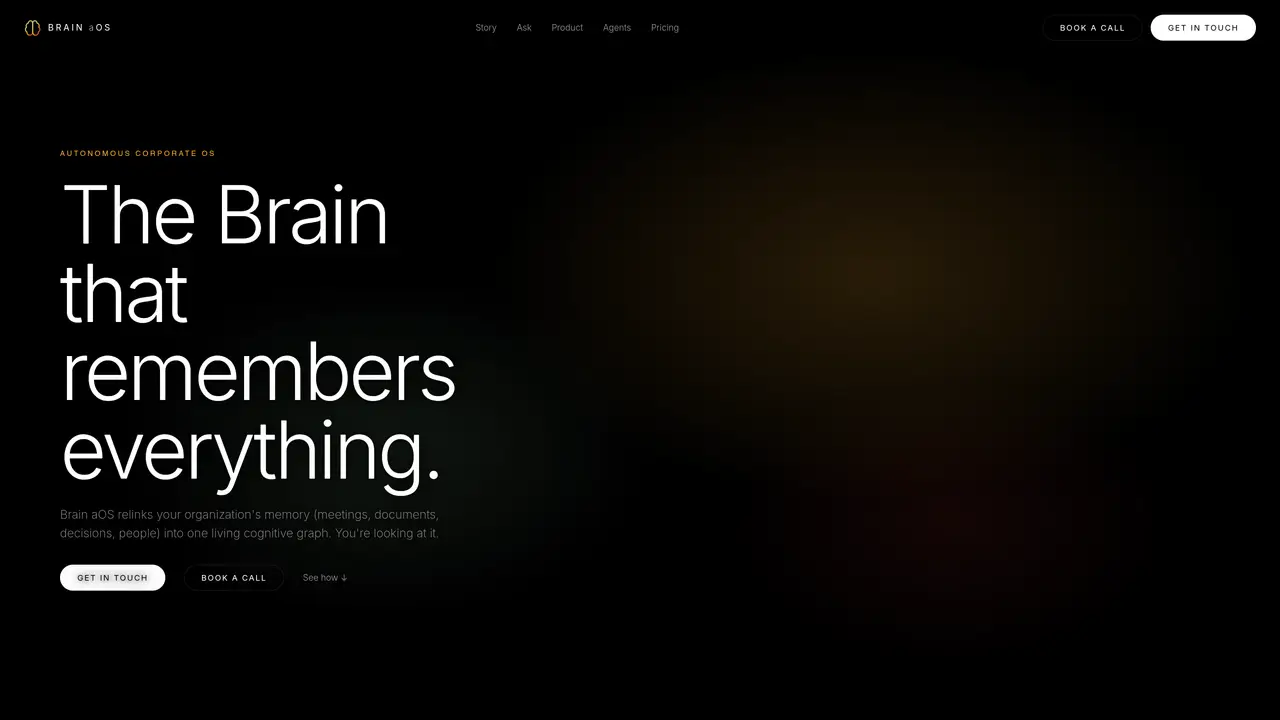
Brain aOS ingests corporate communications and documents—meetings, emails, chats, CRM records—and converts them into a structured knowledge graph rather than raw text. The system automatically extracts entities such as people, decisions, risks and projects, then reconstructs their relationships so that context is preserved even when employees leave. Users can query the graph in natural language to retrieve decisions, causal chains or scenario projections, with answers anchored to original sources. The workspace presents a unified interface combining graph visualization, chat, project boards and living profiles of contacts and employees. Boards and idea assessments are integrated into the same graph, allowing teams to track deals, evaluate proposals against historical data, and maintain up-to-date records without manual updates. Autonomous agents operate under human-in-the-loop approval gates, performing tasks while ensuring reversibility and auditability. The platform includes a native MCP server so that coding agents and AI employees share the same organizational memory and permissions as their human counterparts.
Key features
- Automatic ingestion of meetings, documents, email and chat
- Structured knowledge graph with entities and relationships
- Natural-language query engine with causal chain and what-if modes
- Unified workspace for graph, chat, boards and profiles
- Living contact profiles built from organizational records
- Project boards synchronized with the knowledge graph
- Idea assessment scored against historical data
- Supervised autonomous agents with reversible actions
Use cases
- Recovering lost context after employee departures
- Tracking stalled deals and associated risks
- Evaluating new product ideas against past decisions
Pros
- Structures unstructured data into a queryable knowledge graph
- Supports multiple data sources (meetings, email, chat, CRM, documents)
- Provides natural-language recall with source attribution
- Integrates project boards, idea scoring and living contact profiles
- Offers supervised autonomy with explicit approval gates
Cons
- Private beta with cohort-based onboarding
- Minimum five-seat requirement
- Self-hosted deployment required
Frequently asked questions about Brain aOS
What is Brain aOS?
Brain aOS is an autonomous corporate operating system that converts organizational communications and documents into a structured knowledge graph, preserving context and relationships even when employees leave.
Who is Brain aOS designed for?
The tool is designed for organizations seeking to retain institutional knowledge, improve decision-making, and automate workflows by centralizing company memory into a living cognitive graph.
How does Brain aOS handle data privacy and security?
Brain aOS uses tenant isolation, local embeddings, and human-in-the-loop approval gates to ensure data privacy and security, with content never leaving to third-party embedding APIs.
Can Brain aOS integrate with existing tools like Slack, Notion, or GitHub?
Yes, Brain aOS supports integrations with tools such as WhatsApp, Gmail, Google Workspace, Notion, GitHub, Figma, Jira, and Slack for seamless data ingestion and workflow automation.
What is the pricing model for Brain aOS?
Brain aOS uses a per-seat pricing model with graduated tiers, where each band of seats costs less than the previous one, and all plans include the full product features.
How do autonomous agents work in Brain aOS?
Autonomous agents in Brain aOS operate under human-in-the-loop approval gates, performing tasks while ensuring reversibility, auditability, and alignment with organizational permissions.