
Summarizes, extracts, and rewrites content from files.

DocSanitizer
$14.99/moStarting price
0Popularity
About DocSanitizer
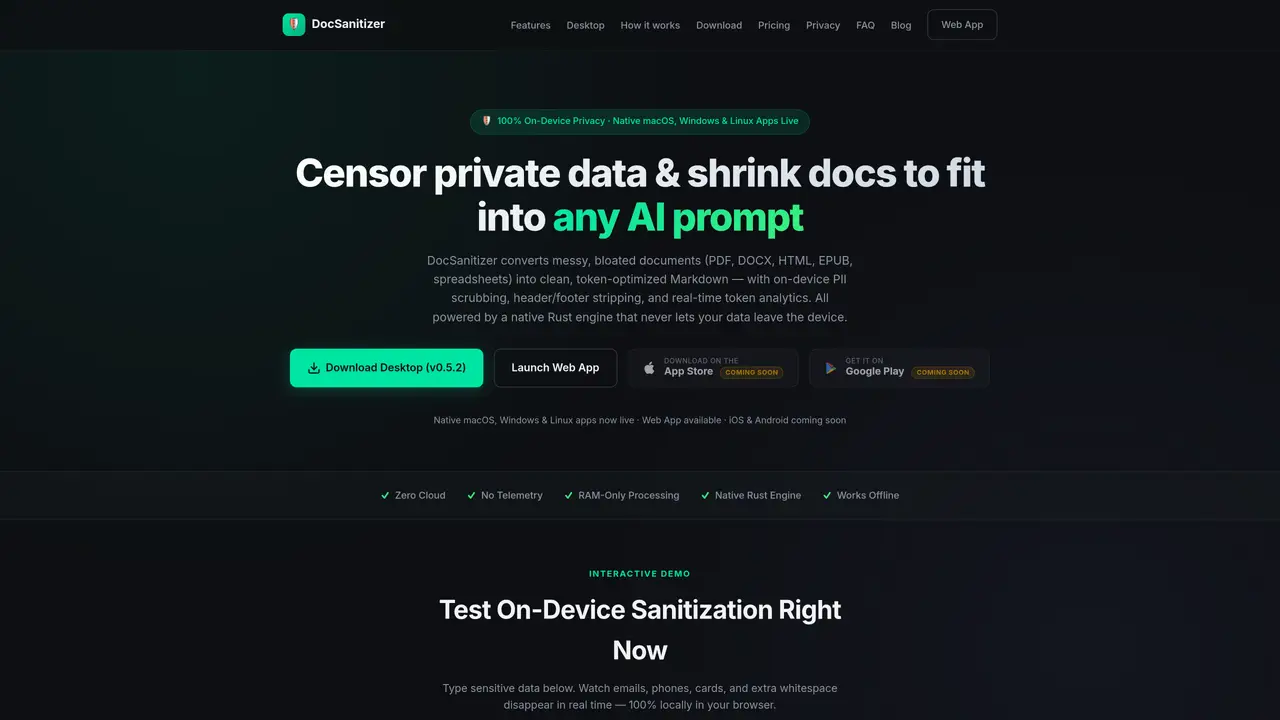
DocSanitizer processes documents to prepare them for AI prompts by removing personally identifiable information and optimizing token usage. It supports formats including PDF, DOCX, HTML, EPUB, spreadsheets, and images via on-device OCR. The tool performs PII redaction such as emails, phone numbers, credit cards, and medical codes, with advanced features like reversible pseudonyms and privacy audit reports. Processing occurs entirely on the user’s device using a native Rust engine and ONNX Runtime, ensuring no data leaves the system. Token optimization reduces document size for better AI prompt fitting, and features include auto-chunking, custom regex rules, and multi-format support. The desktop application is available for macOS, Windows, and Linux, with a web app and mobile apps planned for the future.
Key features
- PII redaction (emails, phones, credit cards, SSNs, IBAN, API keys)
- Token optimization with on-device tiktoken counting
- Multi-format document processing (PDF, DOCX, HTML, EPUB, CSV/Excel, images)
- AI Deep Scan for person-name detection using on-device DistilBERT
- Privacy audit report generation with export options
- Reversible pseudonyms for data restoration
- Auto-chunking with structured XML wrappers
- Hardware-accelerated on-device OCR for images
Use cases
- Preparing confidential documents for AI chatbots while maintaining privacy
- Sanitizing medical or legal documents for compliance with data protection regulations
- Optimizing large documents to fit within AI prompt token limits
Pros
- 100% on-device processing with no cloud dependency
- Supports multiple document formats including PDF, DOCX, HTML, EPUB, and spreadsheets
- Includes on-device AI Deep Scan for person-name detection via DistilBERT
- Offers token optimization to reduce document size for AI prompts
- Provides privacy audit reports and reversible pseudonyms for data protection
Cons
- Free tier limited to 5 files per day and 15 pages per file
- Mobile apps are listed as coming soon with no current availability
- Pro features such as advanced PII redaction and auto-chunking require a paid license
Frequently asked questions about DocSanitizer
What does DocSanitizer do?
DocSanitizer prepares documents for AI prompts by removing personally identifiable information and optimizing token usage. It supports formats like PDF, DOCX, HTML, EPUB, spreadsheets, and images via on-device OCR, ensuring all processing occurs locally on the user’s device.
Who is DocSanitizer designed for?
The tool is designed for professionals handling sensitive documents, such as researchers, legal teams, healthcare providers, and developers who need to sanitize data before using AI tools while maintaining strict privacy.
Does DocSanitizer require an internet connection?
No, DocSanitizer operates entirely offline, with all processing performed locally on the user’s device using a native Rust engine and ONNX Runtime. No data is sent to external servers.
What privacy measures does DocSanitizer include?
DocSanitizer ensures 100% on-device processing with no telemetry, cloud uploads, or network calls. It uses RAM-only processing and provides privacy audit reports to document what data was removed or masked.
What features are available in the free version?
The free version allows processing up to 5 files per day, with a limit of 15 pages per file. It includes basic PII redaction (emails, phone numbers, NDC, and ICD-10 codes), header/footer stripping, and on-device token counting.
How do I get started with DocSanitizer?
Users can download the native desktop app for macOS, Windows, or Linux from the official website. The web app is also available for immediate use, with mobile apps planned for future release.