
Summarizes, extracts, and rewrites content from files.

LedgerInfra
$1480Starting price
0Popularity
About LedgerInfra
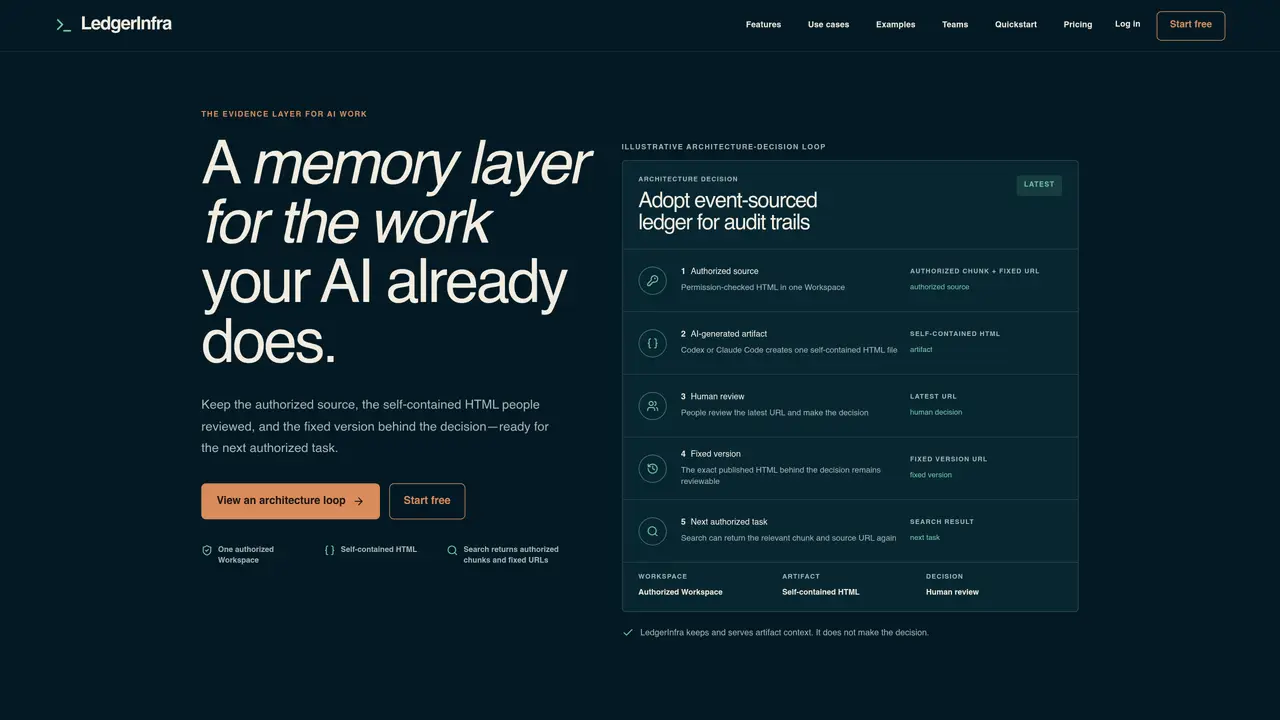
LedgerInfra provides a memory layer for organizational AI workflows by storing and serving verifiable HTML artifacts and their source URLs. It maintains fixed versions of reviewed artifacts so subsequent AI tasks can start from auditable context rather than assumptions. The tool supports self-contained HTML files created by agents like Codex or Claude Code, preserving their original structure including CSS, JavaScript, images, and diagrams. Human reviewers can inspect the latest URL, make decisions, and reference the exact fixed version of the artifact. Search and graph retrieval functions allow agents to locate relevant chunks and trace version lineage within a single authorized workspace. The platform enforces clear ownership boundaries through organizations and workspaces, with role-based access control for members and viewers. It integrates with existing development pipelines by storing artifacts without converting them into proprietary formats or templates.
Key features
- Self-contained HTML artifact preservation
- Fixed version URL generation for reviewed content
- Hybrid search returning authorized chunks and fixed URLs
- Graph retrieval for version lineage and references
- Workspace-based organization with role controls
- Versioned storage with configurable retention
- Integration with AI agents like Codex and Claude Code
- No conversion of HTML artifacts into templates
Use cases
- Maintaining audit trails for AI-generated reports
- Preserving verifiable context for iterative AI development
- Enabling reliable handoffs between human reviewers and AI agents
Pros
- Preserves exact HTML artifacts with all dependencies intact
- Maintains fixed versions of reviewed content for auditability
- Supports hybrid retrieval with search and graph-based exploration
- Enforces workspace boundaries and role-based access control
- Integrates with existing AI tools without proprietary conversions
Cons
- No free tier beyond initial trial
- Limited to HTML artifacts (no other document formats)
- Requires manual human review for decision-making
- Graph retrieval limited to one-hop lineage in lower tiers
Frequently asked questions about LedgerInfra
What is LedgerInfra and what does it do?
LedgerInfra provides a memory layer for organizational AI workflows by storing and serving verifiable HTML artifacts and their source URLs. It maintains fixed versions of reviewed artifacts so subsequent AI tasks can start from auditable context rather than assumptions.
Who should use LedgerInfra?
LedgerInfra is designed for organizations that rely on AI agents to generate artifacts requiring human review and auditability. It suits teams that need to preserve the exact context behind decisions for future tasks.
How does LedgerInfra integrate with existing development pipelines?
LedgerInfra integrates by storing artifacts without converting them into proprietary formats or templates. It preserves the original structure of self-contained HTML files, including CSS, JavaScript, images, and diagrams.
What kind of artifacts can be stored in LedgerInfra?
LedgerInfra supports self-contained HTML files created by agents like Codex or Claude Code. These files can include slides, reports, or interactive demos with their original styling and functionality intact.
Does LedgerInfra support versioning of artifacts?
Yes, LedgerInfra maintains both latest and fixed versions of artifacts. The fixed version URL remains available for the exact HTML that was reviewed, even as the latest URL updates.
How does LedgerInfra handle access control and ownership?
LedgerInfra enforces clear ownership boundaries through organizations and workspaces. It offers role-based access control with roles such as admin, editor, and viewer, ensuring only authorized users can access or retrieve content.