
Generate AI images, discover unique prompts, and save favorite images for quick reference.

AI Prompt Optimizer
FreeStarting price
0Popularity
About AI Prompt Optimizer
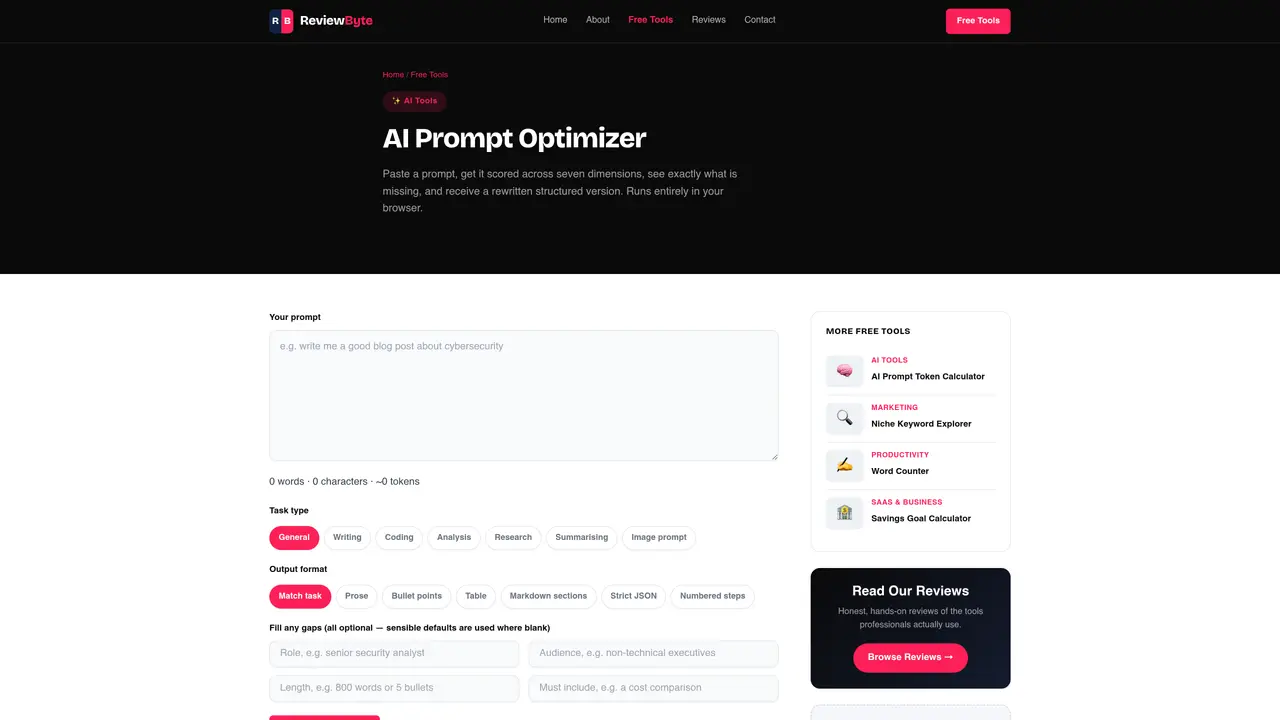
A browser-based tool that evaluates prompts across seven dimensions—task clarity, context, constraints, output format, role, audience, and examples—and flags issues such as vague quality words, conflicting signals, or unresolved pronouns. It then rewrites the prompt into a structured version while preserving the original wording under the task section. The scoring system uses a published weighting system, and detected issues subtract from the total score up to a cap of 25 points. The tool operates entirely client-side, with no server calls, storage, or analytics, ensuring prompts remain private. The optimized output follows a fixed order: role, task, context, constraints, output format, and quality bar, designed for iterative editing. The tool does not assess the feasibility or factual accuracy of requests, only structural completeness.
Key features
- Seven-dimension prompt scoring with published weights
- Issue detection for vague terms, conflicting signals, and unresolved pronouns
- Structured prompt rewriting with preserved original wording
- Client-side execution with no external data transmission
- Multiple output formats: prose, bullets, tables, JSON, numbered steps
- Task type selection: general writing, coding, analysis, research, summarizing, image prompts
- Downloadable optimized prompts as text files
- Real-time token estimation for input and output
Use cases
- Refining unclear or overly vague prompts for better AI responses
- Structuring prompts for consistent output formats like tables or JSON
- Debugging prompts by identifying missing role, audience, or constraints
Pros
- Scores prompts across seven weighted dimensions
- Rewrites prompts into structured formats while preserving original wording
- Operates entirely in-browser with no data transmission or storage
- Provides a detailed breakdown of missing elements and phrasing issues
- Uses a deterministic, rule-based approach with published scoring weights
Cons
- No server-side processing or cloud integration
- Limited to client-side execution with no account or saved history
- Does not evaluate the factual correctness or feasibility of prompts
- Output structure is fixed and may not suit all use cases
Frequently asked questions about AI Prompt Optimizer
Does this prompt optimizer use an AI model?
No. It is entirely rule-based, running fixed dictionaries, word counts, and a published weighting in your browser. Calling an AI model would introduce an exposed API key, per-request costs, and text leaving your device.
Does my prompt get sent anywhere or stored?
No. Nothing you type leaves the browser tab. There are no server calls, logging, accounts, or analytics attached to the text. The tool works offline after the page loads.
How is the prompt quality score calculated?
Seven dimensions are scored from zero to one hundred and combined using published weights. Detected issues then subtract from that total, capped at 25 points. Task clarity carries the highest weight.
Will the optimized prompt work with any AI model?
The structure it produces is model-neutral and works with any general-purpose assistant. The tool avoids model-specific syntax and hidden tricks.
What does the tool check for in a prompt?
It checks for vague quality words, conflicting length signals, unresolved pronouns, multiple questions, prohibitions without instructions, and politeness filler. These issues are flagged and subtracted from the score.
Can the tool assess if my request is feasible or factually correct?
No. It performs structural analysis only. A perfectly structured prompt asking for something impossible still scores 100. The score reflects completeness, not feasibility or factual accuracy.