
AI-powered writing tool for paraphrasing, summarizing, and enhancing writing effortlessly.

TextRank
$0.07Starting price
0Popularity
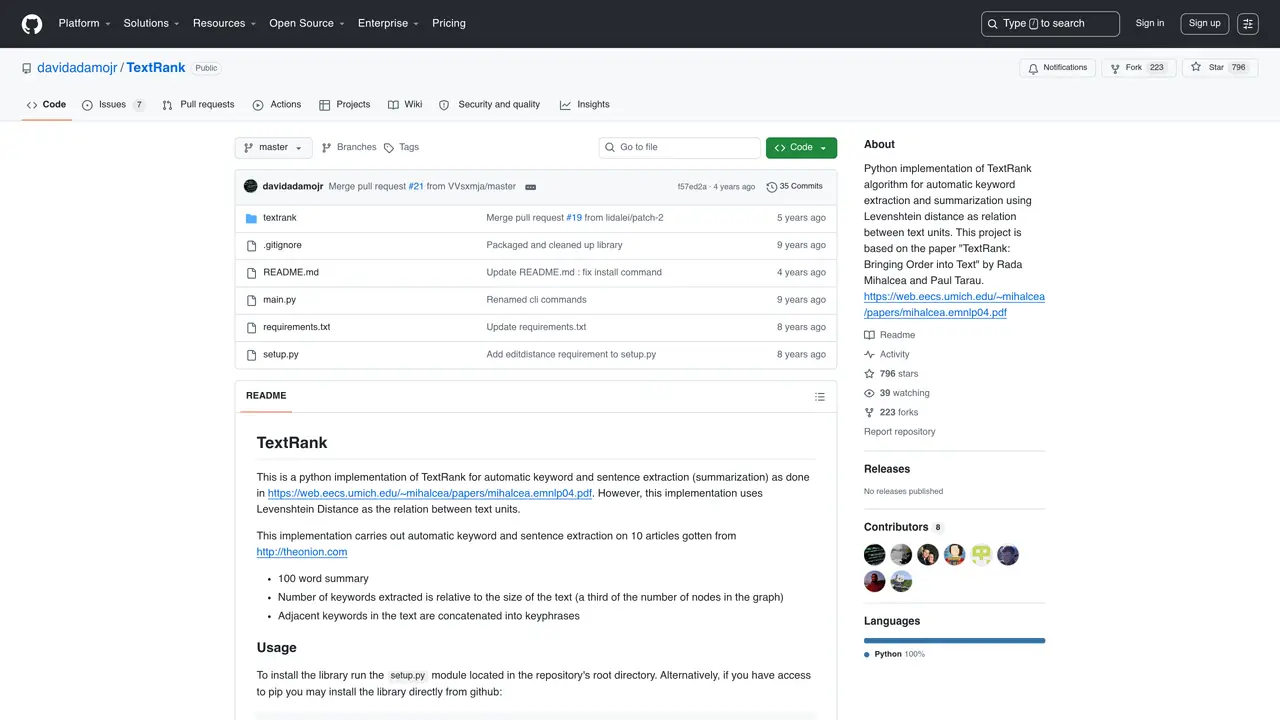
About TextRank
TextRank is the perfect tool for anyone who needs to quickly and accurately summarize large amounts of text. It uses advanced natural language processing algorithms to extract key phrases and sentences from input text, providing an efficient way to summarize longer documents. It also enables users to quickly identify important topics and themes within their text, as well as to assess the overall sentiment and tone of a document. TextRank is a fast, efficient, and powerful tool used by content creators, researchers, and digital marketers to make sense of large volumes of text in a matter of seconds. It is extremely user friendly and can be easily integrated into any existing workflow. With TextRank, you can quickly and accurately summarize text, identify key topics, and assess the sentiment and tone of any document. Make sense of large amounts of text quickly and accurately with TextRank.
GitHub, Inc.
San Francisco, California, US · Founded 2008
- Founders
- Tom Preston-Werner, Chris Wanstrath, PJ Hyett, Scott Chacon
- Founded
- 2008
- Headquarters
- San Francisco, California, US
- Legal status
- Subsidiary of Microsoft (NASDAQ: MSFT)
Key features
- Summarize documents
- Identify key topics and themes
- Assess sentiment and tone
- Advanced natural language processing algorithms
- Efficient way to summarize longer documents
- User-friendly interface
- Easy integration into existing workflow
Use cases
- Content creation: quickly summarize large amounts of text for blog posts, articles, or research papers
- Research and academia: identify key topics and themes in academic texts, assess sentiment and tone of documents
- Digital marketing: use TextRank to analyze customer feedback, reviews, and social media conversations
Pros
- Implements the TextRank algorithm for automatic keyword extraction and summarization
- Uses Levenshtein distance to measure relations between text units
- Based on the foundational paper 'TextRank: Bringing Order into Text' by Mihalcea and Tarau
- Open-source Python implementation with community support and contributions
- Supports both keyword and sentence extraction for summarization tasks
Cons
- Requires downloading NLTK resources for initial setup
- Command-line interface may be less intuitive for non-technical users
- Limited to Python-based integration, restricting cross-platform usability
Frequently asked questions about TextRank
What is TextRank?
TextRank is a Python implementation of the TextRank algorithm for automatic keyword extraction and summarization. It uses graph-based ranking to identify key phrases and sentences in text, based on the paper 'TextRank: Bringing Order into Text' by Rada Mihalcea and Paul Tarau.
Who should use TextRank?
TextRank is suitable for researchers, content creators, digital marketers, and anyone needing to quickly extract key information from large volumes of text. It is particularly useful for summarizing articles, identifying topics, and analyzing document structure.
How does TextRank work?
TextRank models text as a graph where nodes represent sentences or words, and edges represent relationships such as Levenshtein distance. It then applies a ranking algorithm to determine the most important nodes, which are extracted as keywords or summary sentences.
What are the main features of TextRank?
The tool supports automatic keyword and keyphrase extraction, sentence-based summarization, and uses Levenshtein distance to measure relationships between text units. It also allows customization of summary length and keyword quantity based on input text size.
How do I get started with TextRank?
Install the library via pip using 'pip install git+https://github.com/davidadamojr/TextRank.git'. Download required NLTK resources with 'textrank initialize', then use commands like 'textrank extract_summary ' or 'textrank extract_phrases ' to process text.
Does TextRank require any dependencies?
Yes, TextRank depends on NetworkX, NLTK 3.0, NumPy, and Click. These are installed automatically with pip, but NLTK resources must be downloaded separately using the 'textrank initialize' command before use.