
OpenAI builds and deploys advanced AI models like GPT-4o for autonomous agents and workflows.

Agentic Architecture Framework
£3/moStarting price
0Popularity
About Agentic Architecture Framework
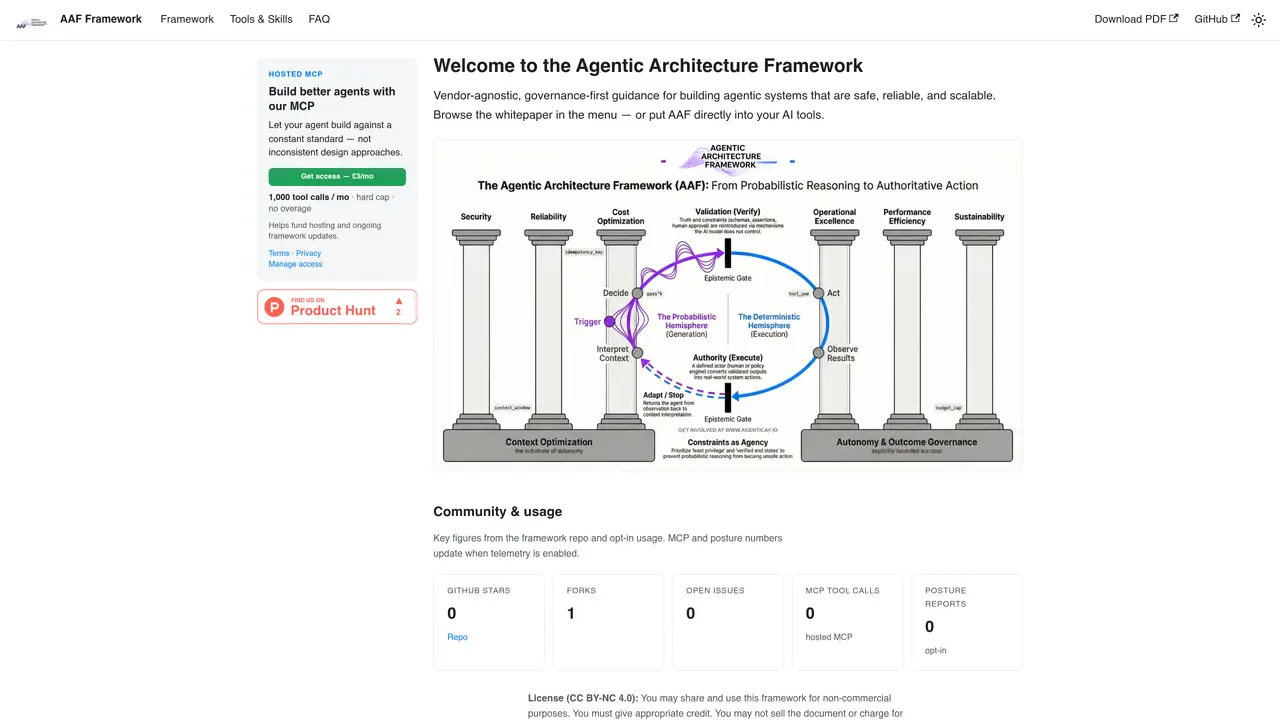
The Agentic Architecture Framework provides vendor-agnostic, governance-first guidance for constructing agentic systems. It focuses on establishing consistent standards rather than relying on inconsistent design approaches across different platforms. The framework is designed to support the development of AI agents that are safe, reliable, and scalable, addressing the challenges of interoperability and governance in multi-vendor environments. It is intended for teams building agentic systems who require a structured approach to ensure consistency and compliance. The framework can be integrated directly into existing AI tools or used as a reference through its whitepaper. It emphasizes modularity and governance, allowing developers to adapt it to their specific needs while maintaining a high standard of reliability and safety.
Key features
- Governance-first guidance
- Vendor-agnostic architecture
- Modular design for adaptability
- Safety and reliability focus
- Whitepaper and direct integration options
- Community-driven development
- License permitting commercial product use
- Standardized tool and skill definitions
Use cases
- Building safe and reliable AI agents across multiple vendors
- Establishing governance frameworks for agentic systems
- Integrating agentic capabilities into existing AI tools
Pros
- Vendor-agnostic design
- Governance-first approach
- Supports safe and scalable agentic systems
- Modular and adaptable structure
- Non-commercial license allows sharing and use with attribution
Cons
- Limited to non-commercial sharing and use without attribution
- No explicit mention of multi-language support
- Requires integration into existing tools for full functionality
- Hosted MCP access requires a paid subscription
Frequently asked questions about Agentic Architecture Framework
What is the Agentic Architecture Framework?
The Agentic Architecture Framework is a vendor-agnostic, governance-first guidance system for building AI agents that are safe, reliable, and scalable. It provides consistent standards to address interoperability and governance challenges in multi-vendor environments.
Who should use the Agentic Architecture Framework?
The framework is intended for teams developing agentic systems who require a structured approach to ensure consistency and compliance. It is designed for developers and organizations building AI agents across different platforms.
How can I access the Agentic Architecture Framework?
The framework can be accessed through its whitepaper for reference or integrated directly into existing AI tools. It is also available via GitHub and includes an MCP (Model Context Protocol) for agent interactions.
What is the pricing model for the Agentic Architecture Framework?
The framework offers a hosted MCP service with a usage-based model, including a capped number of tool calls per month. This model helps fund hosting and ongoing framework updates while maintaining accessibility.
Can I use the Agentic Architecture Framework for commercial products?
Yes, the framework can be used to build commercial products. However, the whitepaper itself cannot be sold or used for paid training under the CC BY-NC 4.0 license, which requires appropriate credit for non-commercial use.
How does the Agentic Architecture Framework ensure governance and safety?
The framework emphasizes modularity and governance, providing structured standards to ensure reliability and safety in agentic systems. It supports consistent design approaches across different platforms, reducing risks in multi-vendor environments.