

Unify customer data, automate workflows, and scale experiences with Einstein AI, Copilot, and Data Cloud in one CRM platform.
110M visits/mo+1.1%#1 Business & Marketing
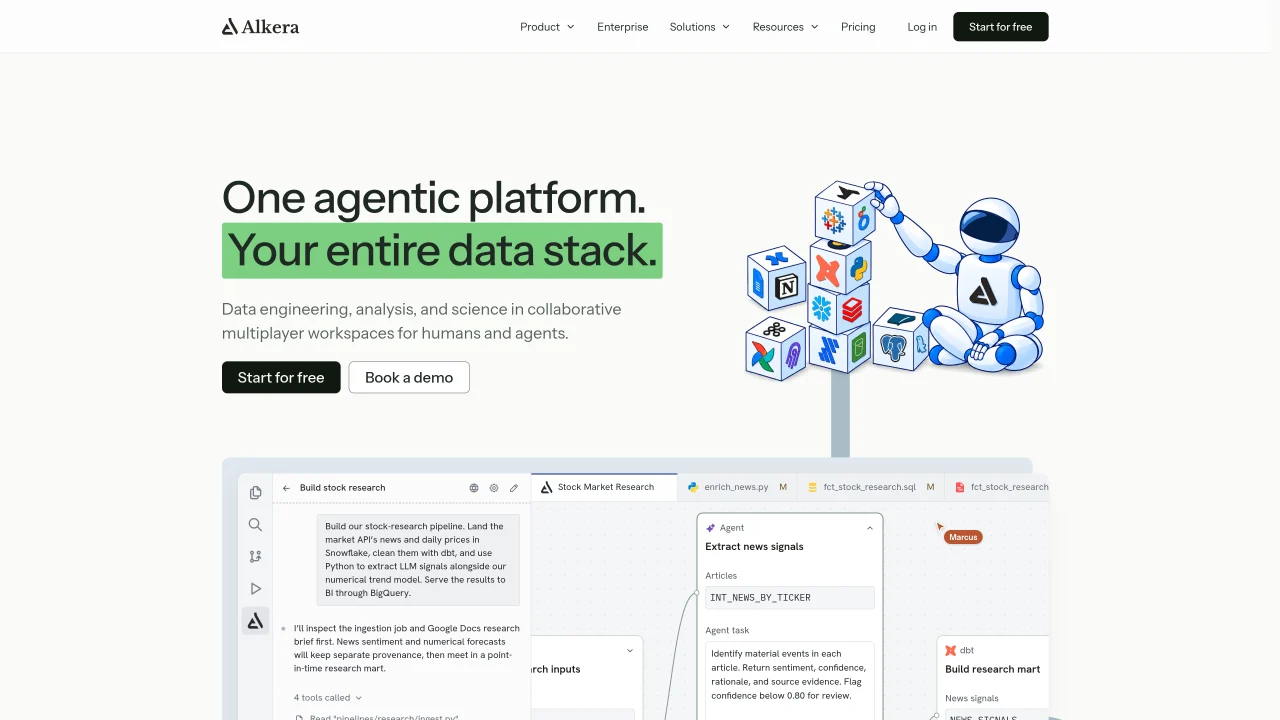
Alkera provides a shared workspace where teams and AI agents collaborate on data engineering, analysis, and science tasks. The platform integrates with existing tools such as Airflow, dbt, Snowflake, Databricks, and Looker to trace column-level lineage across data pipelines. It automatically detects issues like job failures or stale data and proposes fixes in isolated sandboxes before deployment. Users can create SQL and Python notebooks, run GPU-accelerated jobs, and share interactive dashboards that update dynamically when inputs change. The system reads context from connected knowledge bases to maintain consistent business definitions and enforce quality standards through CI/CD gates. Each knowledge entry displays its sources and verification status, supporting traceability and governance. The platform emphasizes real-time collaboration, allowing teams to work together on analyses and artifacts that update live for all members.
Databench is an agentic data platform that provides collaborative multiplayer workspaces for humans and AI agents to perform data engineering, analysis, and science tasks. It integrates with existing tools like Airflow, dbt, Snowflake, and Databricks to enable real-time collaboration and dynamic updates.
Databench is designed for data teams, including data engineers, analysts, and scientists, as well as organizations looking to enforce data quality standards and maintain consistent business definitions across their data stack.
Databench integrates with a wide range of tools, including orchestration platforms like Airflow, transformation tools like dbt, data warehouses like Snowflake and Databricks, and business intelligence tools like Tableau and Looker.
Yes, Databench automatically detects issues such as job failures, stale data, and data correctness problems. It proposes fixes in isolated sandboxes and enforces quality standards through CI/CD gates.
Databench supports real-time collaboration, allowing teams and agents to work together on chats, notebooks, and dashboards. Changes made by one user update live for all members, ensuring everyone stays aligned.
You can start using Databench by signing up for a free account or booking a demo on the Alkera website. The platform also offers open-source components and extensive documentation for self-guided exploration.
alkera.ai · third-party estimates from Similarweb
Last 3 months · grows by one month every month
Share of visits by channel
No measurable traffic from Social, Paid Referrals or Search.
Share of visits · estimated visits
Automation & Agents · Sep 2026
Traffic figures are third-party estimates, good for scale and trends; they can differ from a company's own numbers. Updated monthly.
We use essential cookies to run Aitoolnavio, and optional cookies to analyze traffic and measure our marketing. You choose what we use — optional cookies stay off unless you turn them on. See our Privacy Policy.
One short email a week: fresh tools worth trying, honest takes and the updates that actually matter. No spam, unsubscribe any time.
Unify customer data, automate workflows, and scale experiences with Einstein AI, Copilot, and Data Cloud in one CRM platform.
Build conversational forms, capture rich responses, and automate follow-ups with AI-powered surveys and workflows.
Transforms thoughts into actions, enhancing productivity and efficiency.
Automate code, research, and documents using agents.
All-in-one team productivity platform combining chat, docs, video meetings, workflows, and AI tools in one place.
Automate workflow, optimize operations, and detect potential issues with this efficient AI-driven solution.
AI-powered IDE for autonomous coding tasks and agentic development workflows
AI Recruitment engine to hire top global talent
Automate tailored conversations, analyze customer behavior, and automate lead gen, customer service, and sales.
AI job search copilot that matches roles to skills, optimizes resumes for ATS, generates cover letters, and autofills applications with real-time insights.
Source, match, and manage talent with predictive analytics for effortless recruiting.
Personal assistant that coordinates tasks across apps and devices via text or call
Matched on what this tool does — grouped by the job you would be replacing.
matches Automated data correctness monitoring · Column-level lineage tracing · CI/CD quality gates
AI-powered platform that improves data team efficiency with search, cataloging, and monitoring capabilities.
Monitor, manage, and enhance data integrity efficiently with Metaplane.
Observability, monitoring and security platform for AI agents
matches Multiplayer workspaces · Interactive dashboard sharing · Knowledge base integration
matches GPU-accelerated notebooks
matches Sandboxed change testing
Collaborative data analytics platform for teams to explore, analyze, and publish insights using SQL, Python, R, and AI agents in a governed workspace.
Collaborative workspace where teams and AI agents work together in shared rooms
Shared AI workspace for teams to collaborate with persistent context
AI assistant for safe, reliable productivity with code, collaboration, and integrations.
API-hosted virtual desktops for developers building computer-use AI agents with low-latency control, autoscaling, and session persistence.
Build reliable SQL data pipelines faster with copilot.
Structured AI-assisted framework for rigorous production code audits
AI-assisted Playwright test generation and maintenance for web apps