
Meta AI enhances machine learning, NLP, and computer vision capabilities.

Verity
$8Starting price
0Popularity
About Verity
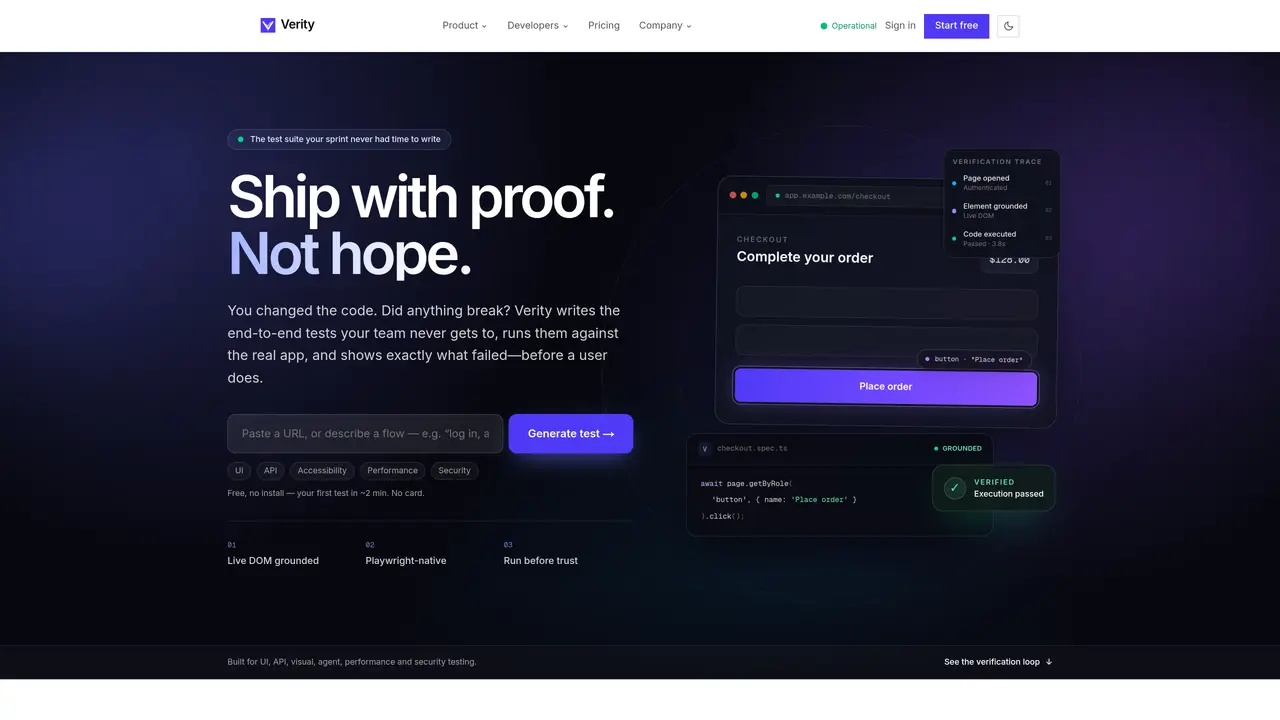
Verity generates and maintains Playwright end-to-end tests by observing live application behavior. It converts real user journeys into runnable test code, executes the tests against the live product, and provides evidence of verification. The tool supports UI, API, visual, agent, performance, and security testing. Generated tests are grounded in the live DOM and executed before being marked as ready, reducing false positives. It detects DOM drift and proposes repairs for broken selectors. Verity integrates with CI pipelines and runs in the cloud or on-premises. The platform emphasizes human ownership of the test suite while automating maintenance tasks such as locator healing and flake detection.
Key features
- AI test generation from live product behavior
- DOM-grounded test execution with evidence
- Self-healing locators for DOM drift
- Flake detection and confidence scoring
- CI/CD pipeline integration
- UI, API, visual, agent, performance, and security testing
- Repair proposals for broken selectors
- Cloud sandbox for instant testing
Use cases
- Generating regression tests for new features before release
- Maintaining test suites during UI framework updates
- Verifying API contract changes and responses
Pros
- AI-generated Playwright tests from live user journeys
- Self-healing locators that adapt to DOM changes
- Supports UI, API, visual, agent, performance, and security testing
- CI integration with unlimited runs
- Provides verification evidence for releases
Cons
- No forward-deployed engineer in self-serve tiers
- Limited to Playwright framework
- Visual, agent, performance, and security testing restricted to higher tiers
- Monthly test generation limits in self-serve plans
Frequently asked questions about Verity
What is Verity and what does it do?
Verity is an AI-augmented testing platform that generates and maintains Playwright end-to-end tests by observing live application behavior. It converts real user journeys into runnable test code, executes the tests against the live product, and provides evidence of verification to ensure nothing breaks before release.
Who should use Verity?
Verity is designed for engineering teams, QA engineers, and developers who need to maintain reliable end-to-end tests without spending excessive time on manual test writing and maintenance. It suits teams looking to bridge the gap between rapid feature development and robust test coverage.
How does Verity integrate with existing workflows?
Verity integrates with CI pipelines and supports both cloud and on-premises deployment. It is Playwright-native, meaning generated tests fit directly into existing Playwright-based testing frameworks and workflows.
Can Verity detect and fix broken tests automatically?
Yes, Verity detects DOM drift and proposes repair suggestions for broken selectors. It also separates flaky failures from real issues and maintains locator health to reduce false positives in the test suite.
What types of testing does Verity support?
Verity supports UI, API, visual, agent, performance, and security testing. It generates tests grounded in the live DOM and executes them to provide verifiable evidence before marking tests as ready.
How do I get started with Verity?
Getting started with Verity involves pointing it to a URL and the user journey you want to test. Verity then observes the live product, writes Playwright tests, runs them, and returns the code along with evidence of verification.