
OpenAI builds and deploys advanced AI models like GPT-4o for autonomous agents and workflows.

Gemini Robotics 2
0Popularity
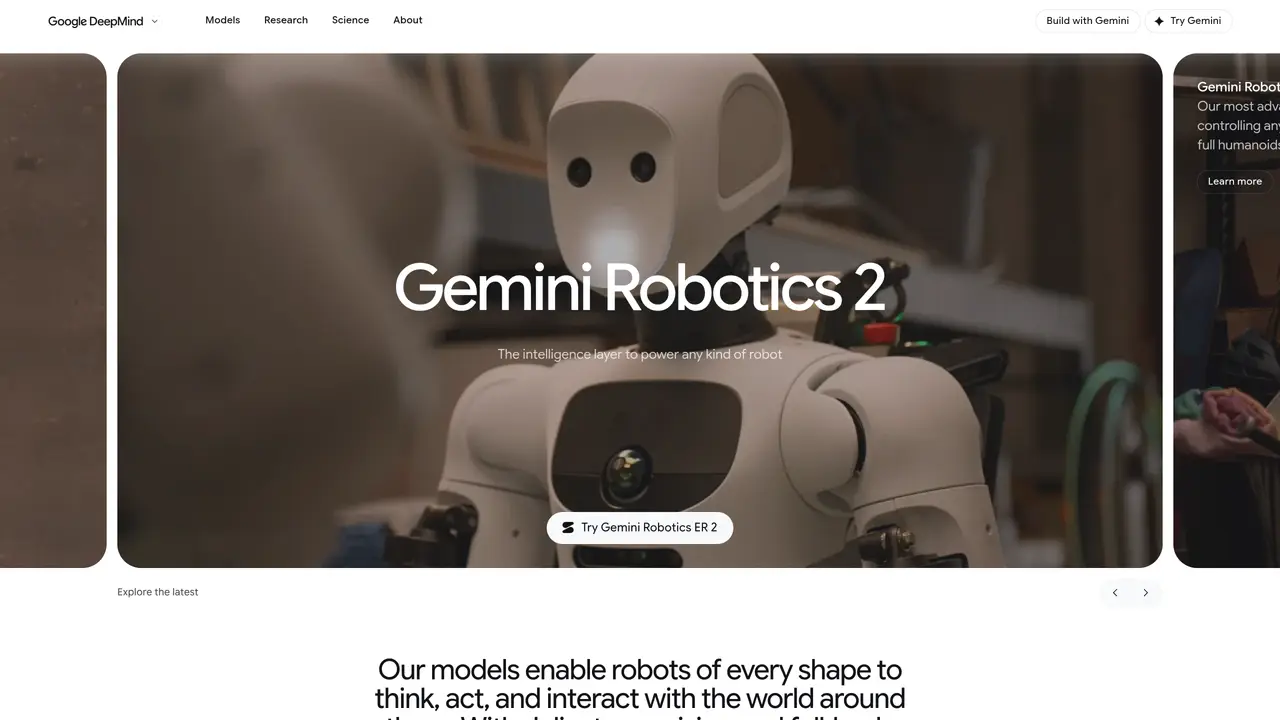
About Gemini Robotics 2
Gemini Robotics 2 is Google DeepMind’s vision-language-action and embodied reasoning stack designed to power real-world robots. The system translates visual context and plain-language goals into actionable motor control, enabling robots to perceive, reason, and interact with their surroundings autonomously. It combines a vision-language-action model for direct motor control with an embodied reasoning model for multi-step planning and coordination, operating as a unified system. The stack supports whole-body dexterity, allowing robots to handle delicate and complex tasks with precision. It is engineered to adapt in real time to shifting environments, human collaboration, and dynamic workloads, making it suitable for scenarios where tasks and conditions vary daily. Designed for robotics teams, enterprise automation groups, researchers, and startups, it emphasizes adaptability, explainability during execution, and operational uptime, particularly in safety-critical or human-centered settings.
Google DeepMind
London, United Kingdom · Founded 2010
- Founders
- Shane Legg, Demis Hassabis
- Founded
- 2010
- Headquarters
- London, United Kingdom
Key features
- Converts vision and language into precise, low-latency motor commands for robots
- Generates long-horizon plans with spatial reasoning and dynamic constraint handling
- Coordinates multi-robot workflows, enabling communication, task division, and re-planning flexibly
- Delivers whole-body humanoid control for balance, reach, grasp, and locomotion
- Adapts to new embodiments quickly, including efficient on-device execution options
- Provides natural-language tasking with real-time redirection and explanations
- Includes a safety and governance layer for layered safeguards during operation
- Supports humanoid whole-body control in dynamic, cluttered environments
- Enables multi-robot collaboration for shared industrial or lab workflows
- Offers lightweight on-device variants for latency, privacy, or offline operation
Use cases
- Industrial automation where tasks vary daily and environments shift
- Service robots collaborating with humans in dynamic settings
- Research labs exploring embodied AI with multi-step task planning
Pros
- Converts vision and language inputs directly into motor control for real-time robot actions
- Enables multi-step task planning and whole-body dexterity in dynamic environments
- Supports coordination across multiple robots and human collaboration
- Adapts in real time to changing environments and user interventions
- Designed for minimal retuning across diverse hardware configurations
Cons
- Requires integration with robotic hardware and control systems
- Complexity may necessitate technical expertise for deployment and maintenance
- Dependent on robust perception systems for accurate environment modeling
Gemini Robotics 2 videos
Frequently asked questions about Gemini Robotics 2
What does Gemini Robotics 2 do?
It is a vision-language-action and embodied reasoning stack that converts visual and language inputs into motor control for robots, enabling them to perform tasks autonomously in dynamic environments.
Who is this tool best suited for?
It suits robotics teams building general-purpose manipulators and humanoids, enterprise automation groups, lab researchers exploring embodied AI, and startups piloting service, warehouse, or field deployments.
How does it integrate with robotic hardware?
The system fuses perception and language to generate control trajectories, which are then executed by the robot’s hardware, requiring compatibility with the robot’s control systems.
Can it coordinate multiple robots?
Yes, it supports coordination across multiple robots and collaboration with humans in shared environments.
Does it require internet connectivity?
The core models can run locally on robotic devices, with an on-device version optimized for efficiency, though some configurations may benefit from cloud-based processing.
How do I get started with Gemini Robotics 2?
Interested users can explore the models and documentation on Google DeepMind’s website to evaluate compatibility with their robotic systems and deployment requirements.