
OpenAI builds and deploys advanced AI models like GPT-4o for autonomous agents and workflows.

Manifest
0Popularity
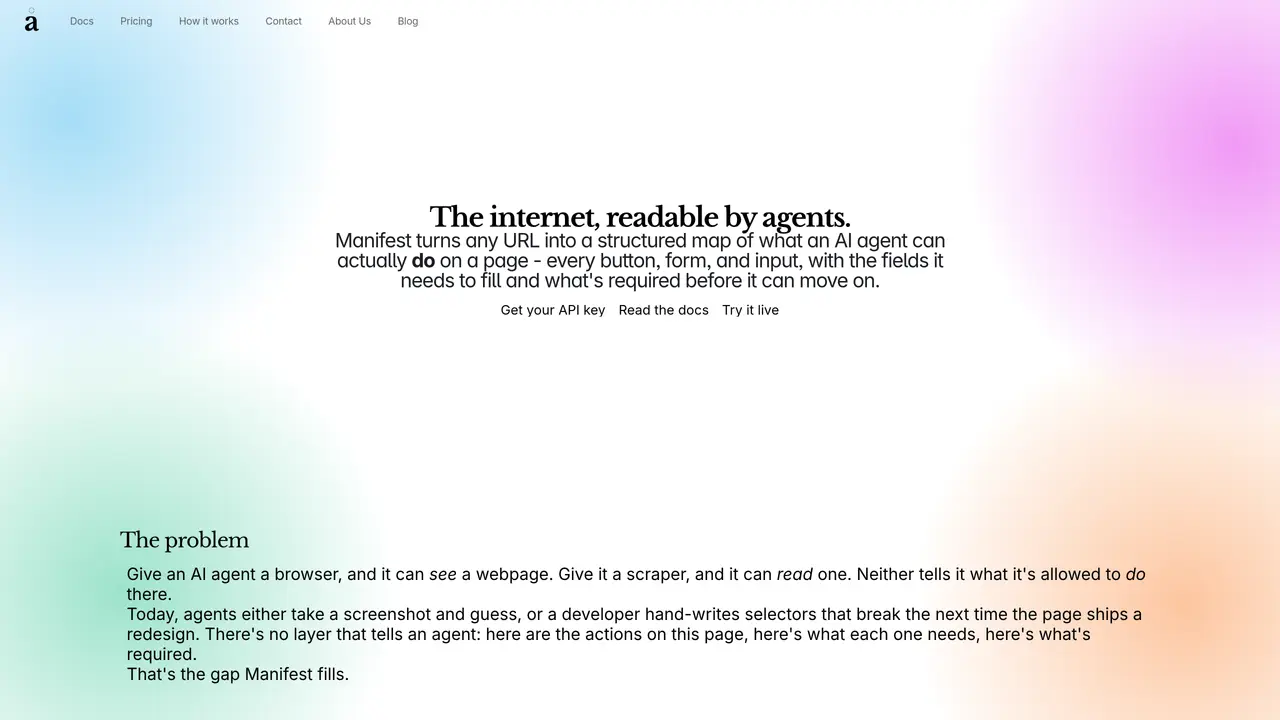
About Manifest
Manifest is an API tool that transforms any URL into a structured JSON map detailing every interactive element on a webpage, including buttons, forms, and input fields. It analyzes the page’s accessibility tree and DOM to capture required fields, input types, placeholders, and disabled states, providing AI agents with a clear, reasoned description of available actions. This removes the need for hand-written CSS selectors or error-prone screenshot-based approaches. Manifest serves as a reliable action layer between AI agents and live web pages, designed to adapt to UI redesigns without breaking functionality. By generating a machine-readable map of a page’s interactive elements, it enables agents to navigate and interact with web interfaces autonomously and accurately. The tool is particularly useful for automating workflows that require real-time interaction with dynamic web content, ensuring consistent performance even as web interfaces evolve.
Key features
- Converts any webpage URL into a structured JSON action map
- Captures buttons, forms, and input fields with their states
- Reads accessibility tree and DOM for accurate element mapping
- Identifies required fields, input types, and placeholders
- Eliminates need for manual CSS selectors or screenshot-based methods
- Designed to survive UI redesigns without breaking
- Provides machine-readable descriptions of interactive elements
- Enables autonomous AI agent interaction with web pages
Use cases
- Automating data extraction from dynamic web forms
- Enabling AI agents to interact with live web interfaces
- Testing and validating web application workflows programmatically
Pros
- Provides a structured JSON map of all interactive elements on a webpage, including buttons, forms, and input fields
- Analyzes both the accessibility tree and DOM to capture required fields, input types, placeholders, and disabled states
- Enables AI agents to autonomously navigate and interact with dynamic web content without hand-written selectors
- Designed to adapt to UI redesigns, reducing the risk of broken functionality due to page changes
- Offers a machine-readable format that allows agents to reason about available actions and their prerequisites
Cons
- Requires an API key for access, which may not be suitable for all users
- Dependent on the accuracy of the webpage's accessibility tree and DOM structure
- May not fully capture complex or custom interactive elements not exposed in standard accessibility trees
Frequently asked questions about Manifest
What does Manifest do?
Manifest transforms any URL into a structured JSON map detailing every interactive element on a webpage, including buttons, forms, and input fields. It analyzes the page’s accessibility tree and DOM to provide a machine-readable description of available actions for AI agents.
Who is Manifest designed for?
Manifest is designed for AI agents and developers who need to automate interactions with dynamic web content. It is particularly useful for workflows requiring real-time navigation and form submissions on evolving web interfaces.
How does Manifest work?
Manifest visits a URL, reads the accessibility tree (like a screen reader), and cross-references it with the DOM to extract details such as required fields, input types, and disabled states. This information is compiled into a clean JSON action manifest that agents can use to interact with the page.
How can I get started with Manifest?
To get started, obtain an API key from the Manifest website, then integrate the API or MCP server into your project. Use the provided endpoint to send a URL, and receive a structured JSON manifest of the page’s interactive elements.
Does Manifest support integrations with other tools?
Yes, Manifest supports integration via MCP (Model Context Protocol) or a direct REST API. The MCP server can be added to your project's MCP client configuration, or you can call the REST endpoint directly with an API key.
What are the key benefits of using Manifest over browser tools or scrapers?
Unlike browser tools that provide DOM access or scrapers that extract content, Manifest specifically returns available actions on a page, including required fields and input types. This allows agents to reason about what to click, fill, or submit without relying on fragile selectors or screenshots.