
Generate captions, optimize content, and enhance with custom images for maximum engagement.
48M visits/mo+3.2%#3 Image & Design
Be the first member to say you use it
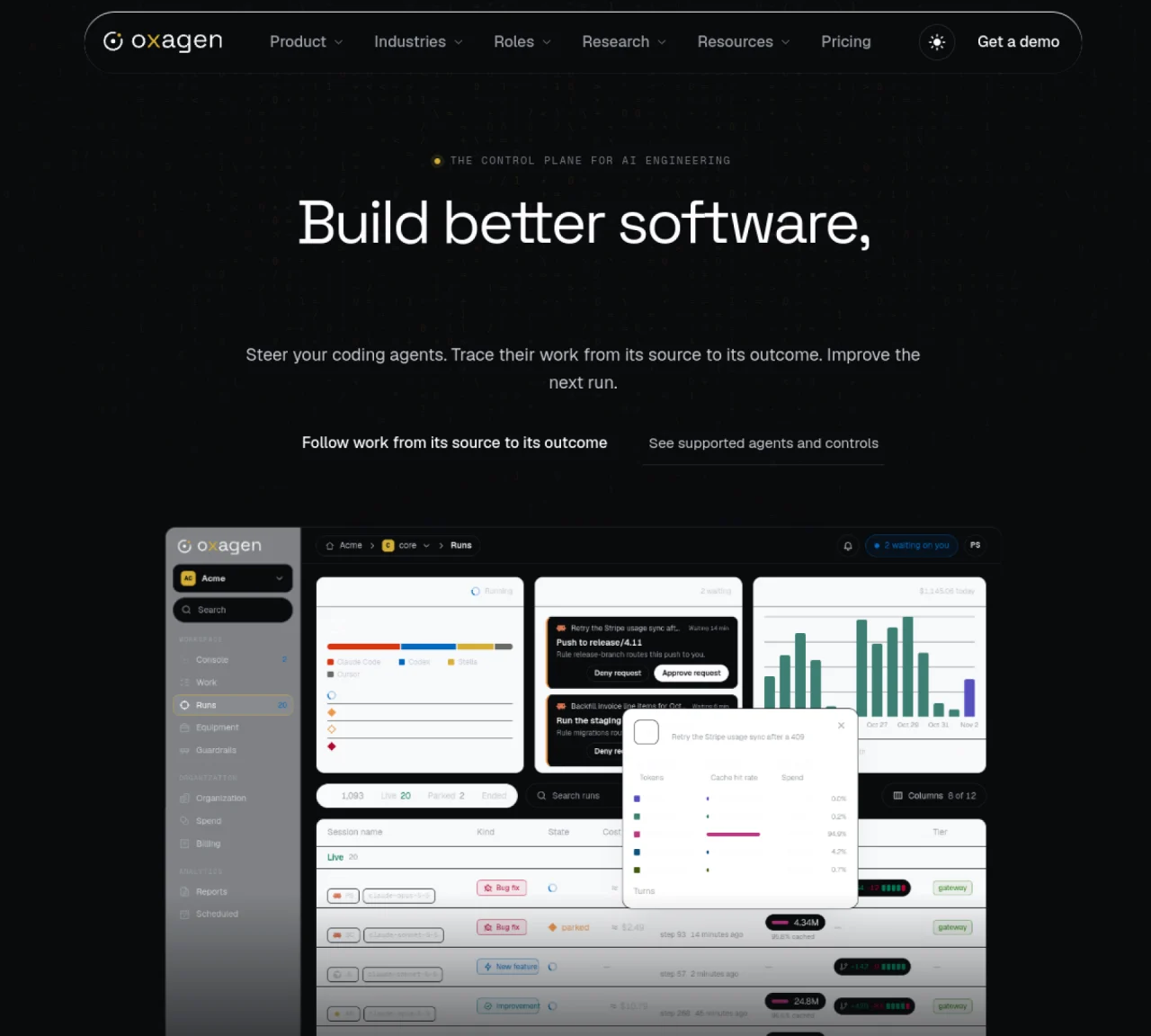
Oxagen provides a control plane for managing AI coding agents throughout the software development lifecycle. It traces agent work from the initial work item to the final pull request, recording each step for review and improvement. The platform supports multiple coding agents such as Claude Code, Codex, Cursor, and Stella, allowing teams to integrate their existing tools. Oxagen enforces mandates, budgets, and approvals to ensure agents operate within defined constraints, including spend limits and identity-based access controls. Users can monitor live runs, review step-by-step execution details, and analyze spending down to individual work items. The system includes features for identifying unproductive spend and optimizing future agent behavior based on past performance. It also provides cloud sandboxes for testing agent changes in isolated environments before deployment.
Oxagen is a control plane for managing AI coding agents throughout the software development lifecycle. It traces agent work from the initial work item to the final pull request, recording each step for review and improvement.
Oxagen is designed for teams and organizations that use AI coding agents such as Claude Code, Codex, Cursor, and Stella. It suits developers, security teams, and managers who need to oversee agent operations and enforce constraints.
Oxagen enforces budgets and spending limits, allowing users to monitor live runs, review step-by-step execution details, and analyze spending down to individual work items. It also identifies unproductive spend and optimizes future agent behavior.
Yes, Oxagen supports multiple coding agents, including Claude Code, Codex, Cursor, and Stella. It allows teams to integrate their existing tools and manage them under a unified control plane.
Oxagen provides live run monitoring, step-by-step execution details, and a console for tracking agent decisions. Users can also review spending analytics and identify unproductive spend.
Users can enroll their first agent by following the getting started guide on Oxagen's documentation. The platform offers a CLI, API, and MCP server for integration and management.
We use essential cookies to run aitoolnavio™, and optional cookies to analyze traffic and measure our marketing. You choose what we use — optional cookies stay off unless you turn them on. See our Privacy Policy.
One short email a week: fresh tools worth trying, honest takes and the updates that actually matter. No spam, unsubscribe any time.
Generate captions, optimize content, and enhance with custom images for maximum engagement.
Build conversational forms, capture rich responses, and automate follow-ups with AI-powered surveys and workflows.
AI-powered IDE for autonomous coding tasks and agentic development workflows
Automate workflow, optimize operations, and detect potential issues with this efficient AI-driven solution.
Personal assistant that coordinates tasks across apps and devices via text or call
Transforms thoughts into actions, enhancing productivity and efficiency.
Source, match, and manage talent with predictive analytics for effortless recruiting.
Automate code, research, and documents using agents.
AI Recruitment engine to hire top global talent
All-in-one team productivity platform combining chat, docs, video meetings, workflows, and AI tools in one place.
AI automation and agent-building platform with 3,000+ app integrations
AI job search copilot that matches roles to skills, optimizes resumes for ATS, generates cover letters, and autofills applications with real-time insights.
Matched on what this tool does — grouped by the job you would be replacing.
matches Work item to pull request tracing · Mandates and identity-based access control · Spend budgets and run stops
Centralize and govern coding agents shipping work.
Centralized control plane for managing internal AI agents across teams
AI agent control plane and LLM gateway for policy enforcement and audit
Control plane and tamper-evident audit ledger for governing AI agents
matches Work item to pull request tracing · Live run monitoring and steering · Step-by-step run analysis
matches Work item to pull request tracing · Step-by-step run analysis · Pull request compliance checking
Parallel AI coding agent IDE that runs multiple agents side by side in isolated git worktrees for faster, comparative development.
Run projects with agents in shared, reviewable channels.
Coordinates coding agents to turn backlog issues into tested pull requests
Native desktop cockpit to run and coordinate multiple AI coding agents on a local machine
Enforces design system rules in AI-generated code and pull requests
Reviews codebases, changes, pull requests and designs with an AI agent