

Generate captions, optimize content, and enhance with custom images for maximum engagement.
46M visits/mo-10%#3 Image & Design
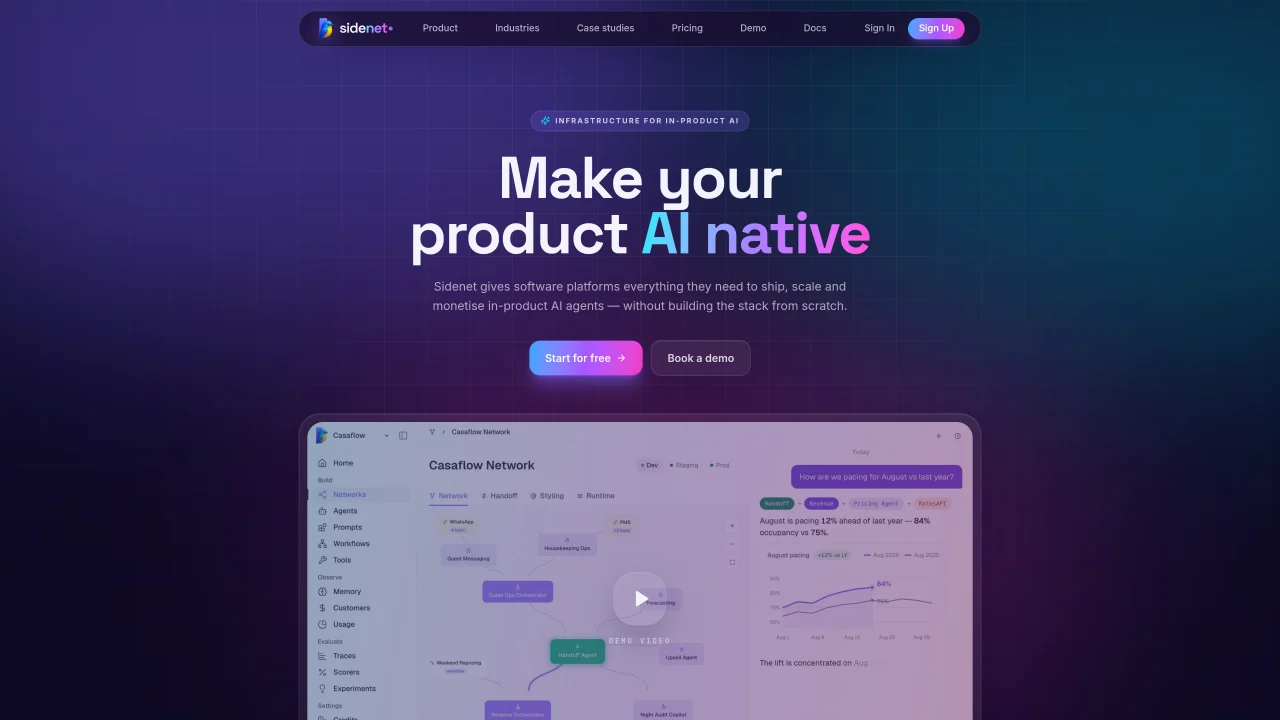
Sidenet provides infrastructure for software platforms to ship, scale and monetize in-product AI agents without building the underlying stack. It handles the operational layers between a product and AI models, including agents, workflows, memory, evaluations, traces, costs, guardrails and model selection. Teams configure agents in Studio using prompt variables, memory modes, guardrails and versioned releases without needing to learn a framework or host infrastructure. Tools can be added via OpenAPI specs or MCP servers, with access to over 1,000 integrations. The platform supports 605 models from 60+ providers, filtered by region, retention and training policy, with EU-hosted and zero-retention options available. Workflows automate known processes such as repricing or reporting, while networks allow a primary assistant to route requests to specialist agents. The system is embedded directly into a product’s API with the same permissions, enabling users to ask, act, schedule and automate tasks within the application.
Sidenet provides infrastructure for software platforms to launch, scale, and monetize in-product AI agents without building the underlying stack. It handles operational layers such as agents, workflows, memory, evaluations, traces, costs, guardrails, and model selection, allowing teams to focus on user experience rather than infrastructure.
Sidenet is designed for vertical SaaS companies and software platforms that want to embed AI agents directly into their products. It suits teams that need to ship AI capabilities quickly without hiring an AI team or managing infrastructure.
Sidenet integrates directly into a product’s API with the same permissions, enabling users to ask, act, schedule, and automate tasks within the application. It supports OpenAPI specs, MCP servers, and over 1,000 integrations, with authentication handled seamlessly.
Sidenet supports 605 models from 60+ providers, including OpenAI, Anthropic, Gemini, Mistral, Meta, Cohere, Grok, Groq, DeepSeek, and Qwen. Users can filter models by region, retention, and training policy, with EU-hosted and zero-retention options available.
Yes, Sidenet supports workflows that automate known processes such as repricing, reporting, or reconciliation. These workflows can run on a schedule, via webhooks, or when triggered by an agent, delivering results directly to users without additional tasks.
Sidenet provides traces to show why an agent gave a specific answer, including model calls, memory, and tool usage, each timed and priced. It also offers evaluations to test prompt or model changes against golden sets, ensuring improvements before deployment.
We use essential cookies to run aitoolnavio™, and optional cookies to analyze traffic and measure our marketing. You choose what we use — optional cookies stay off unless you turn them on. See our Privacy Policy.
One short email a week: fresh tools worth trying, honest takes and the updates that actually matter. No spam, unsubscribe any time.
Generate captions, optimize content, and enhance with custom images for maximum engagement.
Build conversational forms, capture rich responses, and automate follow-ups with AI-powered surveys and workflows.
Automate code, research, and documents using agents.
AI-powered IDE for autonomous coding tasks and agentic development workflows
Source, match, and manage talent with predictive analytics for effortless recruiting.
Automate workflow, optimize operations, and detect potential issues with this efficient AI-driven solution.
Transforms thoughts into actions, enhancing productivity and efficiency.
AI Recruitment engine to hire top global talent
All-in-one team productivity platform combining chat, docs, video meetings, workflows, and AI tools in one place.
Personal assistant that coordinates tasks across apps and devices via text or call
AI automation and agent-building platform with 3,000+ app integrations
AI job search copilot that matches roles to skills, optimizes resumes for ATS, generates cover letters, and autofills applications with real-time insights.
Matched on what this tool does — grouped by the job you would be replacing.
matches Agent configuration in Studio with prompt variables and guardrails · Workflows for automated processes like repricing and reporting · Networks for routing requests to specialist agents
Open-source platform to visually build, deploy, and manage LLM apps, agents, and RAG pipelines with drag-and-drop workflows and APIs.
TypeScript-native framework for building production-grade AI agents with workflows, memory, and built-in observability.
Open-source workspace to visually build, deploy, and manage AI agents with over 1,000 integrations and built-in context storage.
Zero Trust sandbox platform for building, running and governing production AI agents
matches Over 1,000 integrations via OpenAPI or MCP · 605 models from 60+ providers with EU-hosted options · Cost tracking per customer, agent and model
Unified API and marketplace to route, manage, and switch between 100+ AI models with SLA-backed throughput and automated vendor selection.
Unified API gateway for routing and managing AI model requests
Single endpoint routing LLM API calls to minimize inference costs
A multi-model LLM orchestration API that compares, blends, and routes prompts across 30+ models with cost and latency metrics.