
OpenAI builds and deploys advanced AI models like GPT-4o for autonomous agents and workflows.

Unabyss
$1Starting price
51KMonthly visits
28Popularity
About Unabyss
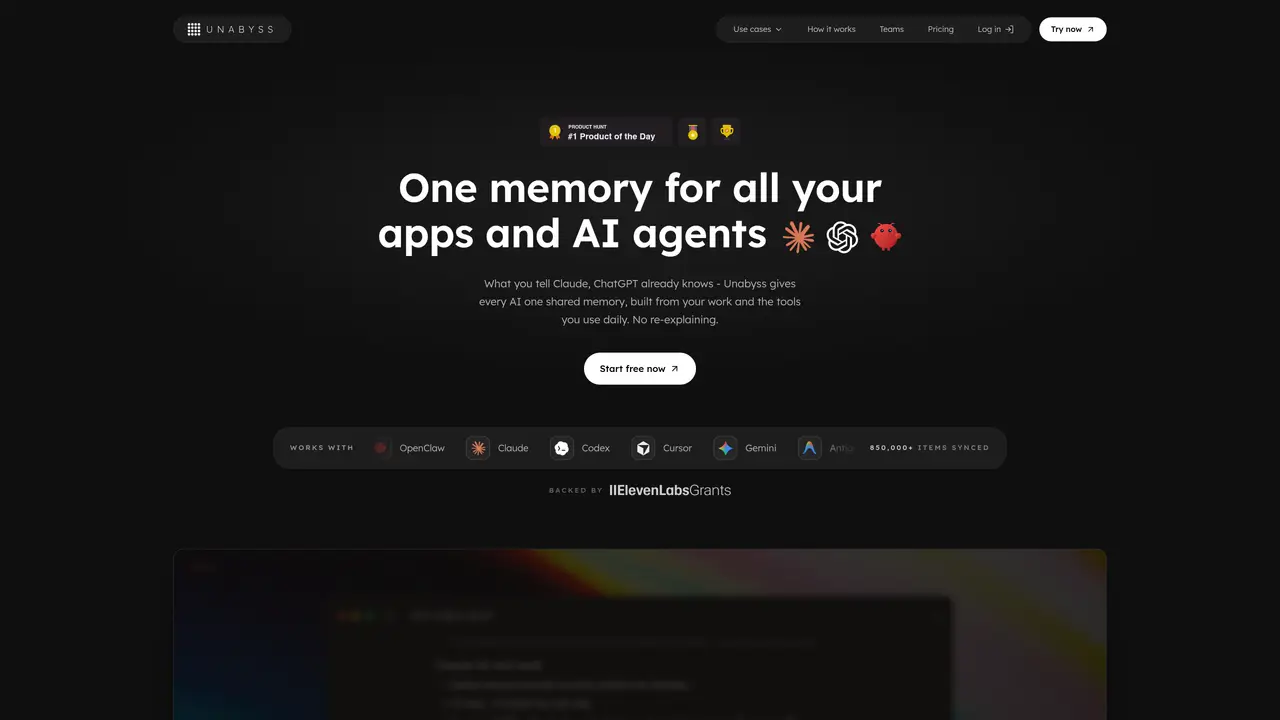
Unabyss positions itself as a universal context layer for AI tools, turning scattered notes, docs, emails, and transcripts into a single, queryable context headquarter. It connects to apps such as Notion, Slack, GitHub, Gmail, Google Drive, calendars, meeting tools, and more, then uses context engineering to segment, score, and gate information before it reaches language models. Through MCP connectivity, Unabyss lets agents and IDE copilots consistently access the same structured, self-updating knowledge instead of living in their own silos. The result is AI that responds with up-to-date information, understands both personal and professional context, and stays on-brand without constant prompt babysitting. Key Features: Universal Context Hub: Aggregates data from productivity, communication, code, and storage tools into a single indexed store ready for AI retrieval. MCP-based Agent Access: Exposes that context through MCP to agents and tools such as Claude, Cursor, Gemini, Perplexity, VS Code, and ChatGPT with a single install command. Context Segmentation Engine: Automatically tags every item by topic, confidence, sensitivity, source application, and personal versus professional axis for highly targeted retrieval. Precision Retrieval & Compression: Scores and extracts only the specific lines relevant to a query, often cutting prompt tokens by up to 10x compared with generic RAG chunk-dumping. Granular Permission Layer: Offers retrieval-time scopes that can exclude private information, company-confidential material, or entire source apps so blocked content never reaches the model. Self-Updating Context: Continuously ingests and refreshes content from connected tools so standups, financials, specs, and roadmaps stay current without manual syncing.
Key features
- Universal Context Hub
- MCP-based Agent Access
- Context Segmentation Engine
- Precision Retrieval & Compression
- Granular Permission Layer
- Self-Updating Context
Use cases
- Software Engineers & Builders: Using Unabyss with Cursor, Claude Code, and GitHub so coding agents share the same project context and past discussions.
- Founders & Startup Teams: Centralizing investor updates, product specs, standups, and roadmaps so every AI reflects the latest state of the business.
- Marketers & Content Teams: Pulling brand guidelines, campaign results, and content drafts into one source so generated copy stays consistent from the first draft.
Pros
- Acts as a universal context layer, aggregating data from over 25 productivity, communication, and development tools into a single indexed store for AI retrieval
- Enables consistent, self-updating context access across multiple AI agents and IDE copilots via MCP connectivity
- Automatically segments and tags context by topic, sensitivity, source, and professional/personal axis for precise retrieval
- Reduces prompt token usage by extracting only relevant information, often improving efficiency compared to generic RAG approaches
- Provides granular permission controls to exclude private or confidential content from AI access at retrieval time
Cons
- Requires initial setup and connection to multiple tools, which may involve configuration overhead for some users
- Relies on continuous synchronization with external tools, which could introduce latency or dependency on third-party services
Frequently asked questions about Unabyss
What is Unabyss and what problem does it solve?
Unabyss acts as a universal context layer for AI tools, aggregating data from productivity, communication, code, and storage tools into a single indexed store. It eliminates the need to repeatedly explain context to different AI agents by providing a shared memory accessible across tools like Claude, ChatGPT, Cursor, and others.
How do I connect Unabyss to my AI tools?
Unabyss can be added to supported AI tools such as Claude, ChatGPT, Cursor, and others through its official connector in their directories. The process typically involves signing up, connecting your data sources, and authorizing the AI tool to access Unabyss, often in just a few steps.
Which apps and services can Unabyss connect to?
Unabyss supports over 25 integrated apps including Notion, Slack, GitHub, Gmail, Google Drive, Google Calendar, Linear, Obsidian, and meeting tools like Fireflies and tl;dv. It continuously ingests and refreshes content from these connected tools to keep context up to date.
Does Unabyss offer any privacy or permission controls?
Yes, Unabyss includes a granular permission layer that allows users to exclude private information, company-confidential material, or entire source apps at retrieval time. This ensures blocked content never reaches the AI model, maintaining data privacy and security.
Can Unabyss be used by teams or is it only for individuals?
Unabyss offers plans for both individuals and teams. Individual plans support up to 3 connected agents, while team or power user plans provide unlimited agents and connected accounts, along with multi-account support for Google apps and early access to new features.
What is the pricing model for Unabyss?
Unabyss offers a free tier to start, followed by paid plans that scale based on the number of connected agents and accounts. Pricing tiers include options for individuals and power users, with annual billing available and a 7-day free trial for paid plans.
Unabyss Website Engagement
Last Update: 9 days ago
Total Monthly Visits
0
Bounce Rate
0%
Visit Duration (avg)
0.00s
Pages Per Visit
0
Country Rank
0
United States
Global Rank
0
Monthly Traffic
Traffic Sources
Traffic Share By Country
- United States44.6%
- Poland21.7%
- India8.9%
- Germany5.7%
- United Kingdom5.6%