
Design, distribute, and analyze surveys online or via email with real-time insights using Survey Monkey.
38M visits/mo-3.9%#2 Business & Marketing

Analyze user interactions with LLMs to uncover satisfaction trends, power users, and cost-benefit insights for AI development.
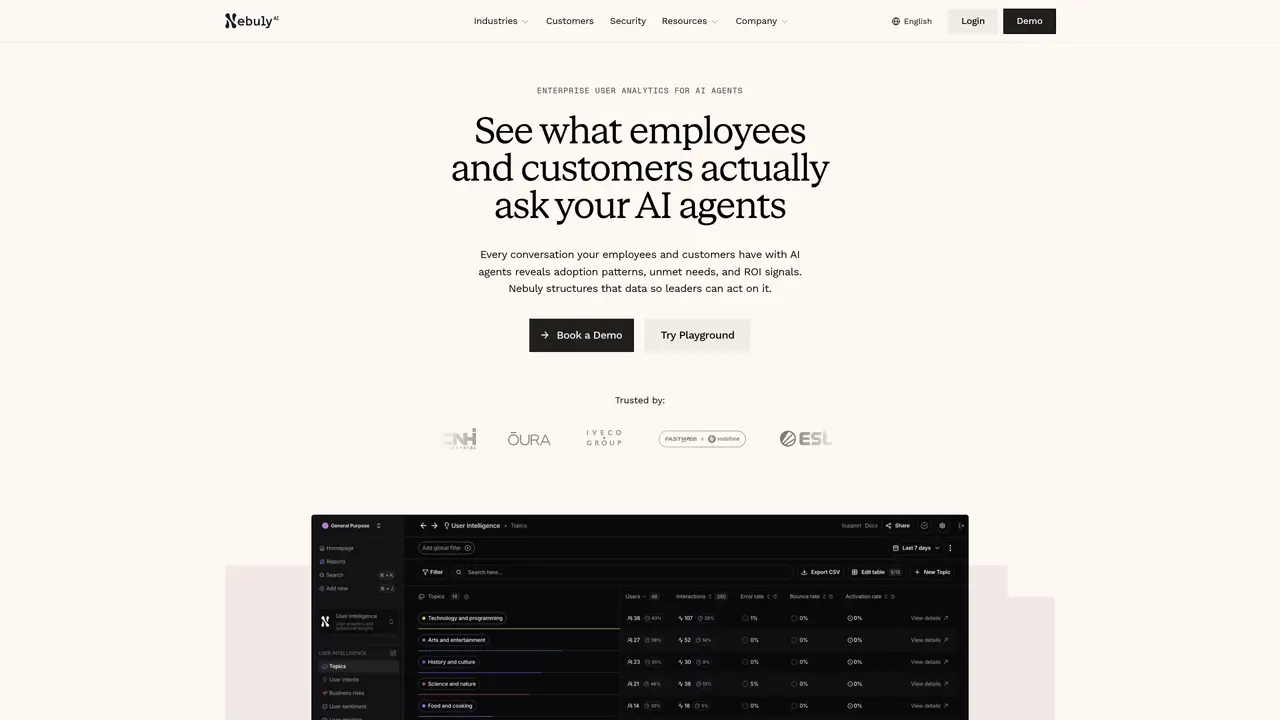
Nebuly is a user intelligence platform built for large language models (LLMs) that analyzes every interaction between users and LLMs. It monitors user behavior in real time, extracting key insights such as what users like or dislike, the most common questions, and patterns in satisfaction. The platform helps businesses understand their users more deeply by identifying power users, dissatisfied users, and emerging trends in engagement. Nebuly also tracks costs associated with LLM usage, linking them directly to user satisfaction levels to provide a clear cost-benefit analysis. This enables teams to optimize AI workloads, improve model performance, and align development efforts with actual user needs. By capturing instant user feedback, it supports iterative improvements and efficient resource allocation across AI projects.
Nebuly is an enterprise user analytics platform for AI agents that captures and structures conversations between employees or customers and AI systems. It reveals adoption patterns, unmet needs, and ROI signals from these interactions to help leaders make data-driven decisions.
Nebuly is designed for enterprises deploying internal or customer-facing AI agents, including IT, data science, marketing, HR, and product teams looking to measure adoption, fluency, and productivity gains from AI interactions.
Nebuly maps completed AI tasks to time saved and estimated dollar value, tracking productivity gains from each interaction. It links cost data to user satisfaction to provide a clear cost-benefit analysis for AI workloads.
Yes, Nebuly assesses AI fluency across departments and roles, highlighting who needs targeted training based on their interaction patterns and success rates with AI agents.
Yes, Nebuly analyzes conversations from both internal employees and external customers to surface real questions, tasks, and workflows, helping businesses understand user behavior across all AI touchpoints.
Prospective users can book a demo or try the playground on the Nebuly website to explore how the platform structures AI conversation data and surfaces actionable insights for their organization.
nebuly.com · third-party estimates from Similarweb
Last 4 months · grows by one month every month
Share of visits · estimated visits
Business & Marketing · Sep 2026
Traffic figures are third-party estimates, good for scale and trends; they can differ from a company's own numbers. Updated monthly.
We use essential cookies to run aitoolnavio™, and optional cookies to analyze traffic and measure our marketing. You choose what we use — optional cookies stay off unless you turn them on. See our Privacy Policy.
One short email a week: fresh tools worth trying, honest takes and the updates that actually matter. No spam, unsubscribe any time.
Design, distribute, and analyze surveys online or via email with real-time insights using Survey Monkey.
Create targeted campaigns, automate email campaigns, and analyze performance for maximum ROI.
Discover keywords, analyze competitors' SEO strategies, and make data-driven decisions for website performance.
Analyze website performance, track competitors' tactics, and access comprehensive analytics and optimization features.
YouTube and Instagram growth toolkit with AI-powered optimization and analytics
Develop, run data jobs, transform datasets, leverage ML algorithms for actionable insights.
Streamline hiring, monitor job performance, and choose flexible pricing plans.
Unified AI-powered platform for real-time monitoring, analytics, and security across cloud infrastructure, applications, and services.
Securely store, analyze, and scale data while enhancing security and performance with encryption and automated backups.
AI-powered customer feedback platform for mid-market businesses to run conversational surveys and extract insights.
Automate review requests, analyze sentiment, and monitor ratings with a streamlined dashboard for improved customer feedback.
Monitor brand performance, create content for social media, and gain insights with deep analytics.
Matched on what this tool does — grouped by the job you would be replacing.
matches Real-time monitoring of LLM user interactions · Tracking of user satisfaction trends and sentiment · Identification of power users and dissatisfied users
See and improve brand visibility inside AI.
Identify sentiment, anticipate needs, track satisfaction with actionable analytics from customer conversations.
Platform for tracking and optimizing AI workflows across teams
Automate customer service, monitor satisfaction, and customize customer experience for businesses.