An AI-driven experience management platform for enterprises to collect multi-channel feedback, analyze structured and unstructured data, and deliver actionable insights.

Splunk
$0.06/mStarting price
1.1MMonthly visits
51Popularity
About Splunk
Splunk is an advanced analytics and monitoring platform designed to help organizations extract valuable insights from their data. It provides a powerful suite of features that enable users to gather, store, analyze, and visualize their data in a unified platform. Splunk is easy to set up, intuitive to use, and offers an extensive range of integrations with other platforms and tools. Its dynamic dashboard capabilities allow users to quickly and easily explore their data and create meaningful visualizations that can be shared with colleagues. Splunk also offers advanced search capabilities, allowing users to perform complex searches across large datasets with ease. With its powerful analytics and monitoring capabilities, Splunk helps organizations make informed decisions and gain valuable insights into their operations. Whether used by IT teams to monitor system performance, or by business teams to analyze customer trends, Splunk is the perfect tool for any organization looking to get the most out of their data.
Splunk Inc.
San Francisco, United States · Founded 2004
- Founded
- 2004
- Headquarters
- San Francisco, United States
- Legal status
- Public company
Key features
- Monitor system performance
- Detect anomalies in data
- Generate meaningful visualizations
- Explore large datasets with advanced search capabilities
- Unified platform for gathering, storing, analyzing, and visualizing data
- Easy setup and intuitive use
- Extensive range of integrations with other platforms and tools
Use cases
- Monitoring system performance and detecting anomalies in IT teams
- Analyzing customer trends and generating meaningful visualizations for business teams
- Exploring large datasets with advanced search capabilities to gain valuable insights into operations
Pros
- Unified platform for security and observability, consolidating data from diverse sources
- AI-powered capabilities for threat detection, incident response, and performance monitoring
- Supports petabyte-scale data processing with cross-domain machine data integration
- Extensive ecosystem with over 2,000 integrations via Splunkbase
- Built-in threat intelligence from Cisco Talos for enhanced security operations
Cons
- Complex setup and configuration may require significant expertise
- Potential high costs associated with large-scale data ingestion and storage
Frequently asked questions about Splunk
What is Splunk and what does it do?
Splunk is a unified platform for security and observability that unifies machine data across domains into contextualized intelligence. It enables organizations to monitor systems, detect threats, troubleshoot performance issues, and analyze data in real time.
Who should use Splunk?
Splunk is designed for IT teams, security operations, DevOps, and business analysts who need to monitor infrastructure, secure systems, optimize performance, or derive insights from machine data across cloud, on-premises, and hybrid environments.
How does Splunk work with AI?
Splunk integrates AI capabilities to power AgenticOps, enabling automated threat detection, predictive observability, and intelligent troubleshooting. It provides AI-driven insights across security, IT operations, and application performance.
What integrations does Splunk support?
Splunk offers over 2,000 integrations via Splunkbase, including native support for OpenTelemetry, SDKs, and agents. It connects with cloud platforms, SaaS tools, IT systems, and OT/IoT data sources.
Can Splunk be used for compliance and auditing?
Yes, Splunk provides centralized data visibility and reporting tools that help organizations meet compliance requirements, perform audits, and maintain security and operational standards.
How do I get started with Splunk?
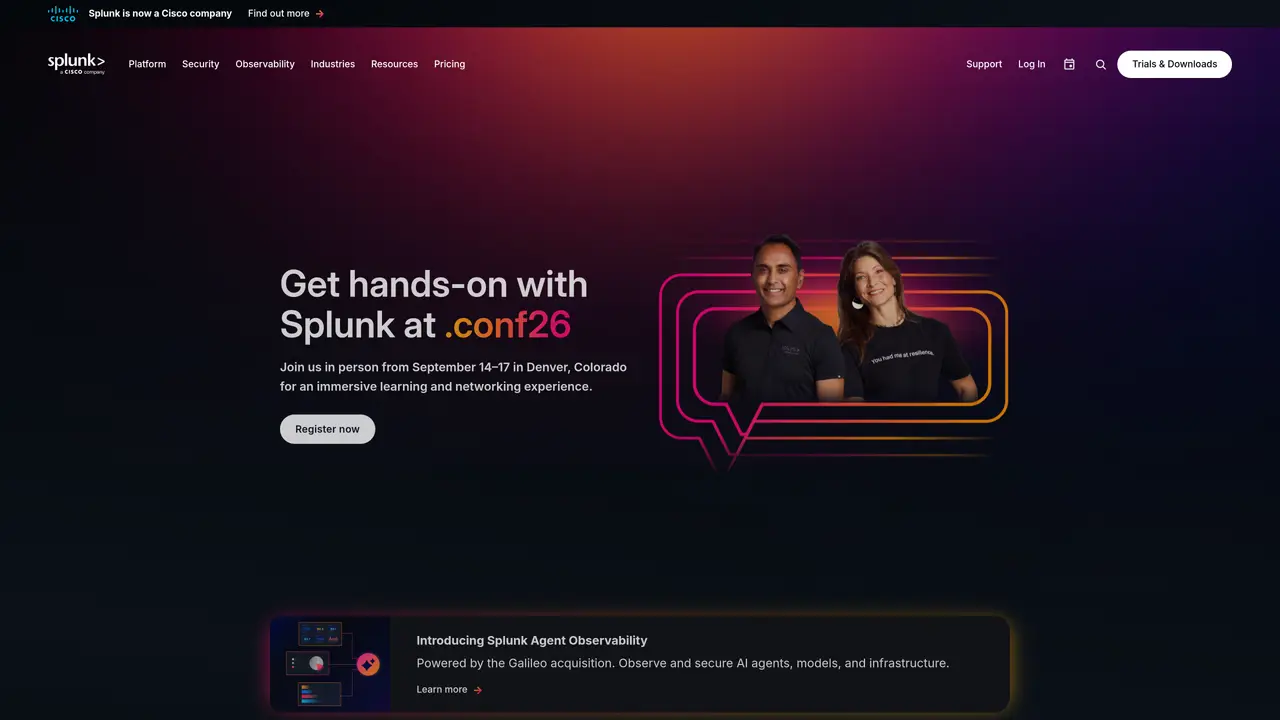
Users can start with Splunk through free trials, product tours, or hands-on experiences at events like .conf26. Documentation, training, and community resources are available to guide setup and usage.
Splunk Website Engagement
Last Update: 9 days ago
Total Monthly Visits
0
Bounce Rate
0%
Visit Duration (avg)
0.00s
Pages Per Visit
0
Country Rank
0
United States
Global Rank
0
Category Rank
#0
Search Engines
Monthly Traffic
Traffic Sources
Traffic Share By Country
- United States34.1%
- India15.1%
- United Kingdom3.8%
- Poland3.4%
- Australia2.8%