Discover personalized fashion, receive expert advice, and enjoy convenient shopping with free shipping and returns.

Grux OS
FreeStarting price
0Popularity
About Grux OS
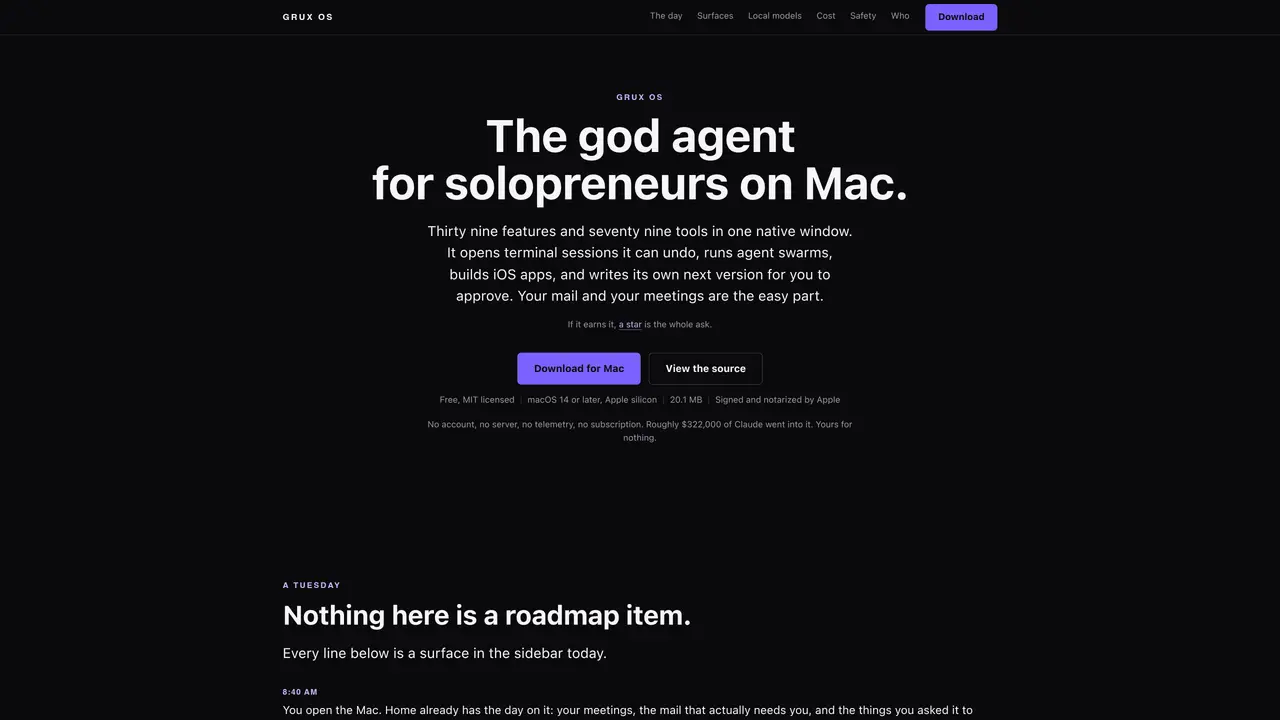
Grux OS is a native Mac application designed as a unified workspace for solopreneurs, consolidating productivity tools into a single sidebar interface. It integrates email, calendar, contacts, notes, and file management alongside an AI assistant capable of reading the active window, transcribing meetings locally, and executing commands with user approvals. The tool offers 39 built-in surfaces such as Chat, Approvals, Cognition Map, Projects, and Local Models, enabling users to manage tasks, research, design, and even develop iOS apps directly within the application. Grux OS prioritizes data privacy by processing everything locally without telemetry, server storage, or account requirements, ensuring that user data remains on the device. It supports local model providers like Ollama, allowing offline operation, and includes features like agent swarms, self-upgrading capabilities, and strict permission controls for sensitive operations. The application is free, MIT-licensed, and requires macOS 14 or later on Apple silicon, with no subscriptions or hidden costs beyond optional model provider fees. Users can customize their setup by selecting only the features they need, minimizing unnecessary permissions and data access. The tool is designed to replace multiple standalone applications by providing a cohesive, privacy-focused alternative that leverages local processing and user-controlled automation.
Key features
- Local model compatibility checker
- Built-in terminal with approvals for sensitive commands
- Meeting transcription with local audio processing
- Integrated mail, calendar and contacts management
- Agent swarm capabilities
- iOS app development tools
- Self-upgrading AI assistant
- Focus logging with window title tracking
Use cases
- Managing daily business operations from a single interface
- Local AI processing for privacy-sensitive workflows
- Automating repetitive tasks with approval-based execution
Pros
- Runs entirely offline with local model support
- Integrates multiple productivity tools in one sidebar
- Strict data privacy with no telemetry or server storage
- Explicit permission system for sensitive operations
- No subscription or account required
Cons
- Requires macOS 14 or later on Apple silicon
- Limited to Mac platform only
- Some features require specific third-party keys or services
Frequently asked questions about Grux OS
What is Grux OS and who is it designed for?
Grux OS is a native Mac application that consolidates productivity tools into a single sidebar interface, designed primarily for solopreneurs. It integrates email, calendar, contacts, notes, and file management with an AI assistant, enabling users to manage tasks, research, and even develop iOS apps locally.
How does Grux OS handle data privacy and security?
Grux OS processes all data locally without telemetry, server storage, or account requirements, ensuring user data remains on the device. It includes strict permission controls, denylists for sensitive operations, and explicit permission requests for features like microphone or screen recording.
Can Grux OS work offline, and does it require an internet connection?
Yes, Grux OS can operate entirely offline by using local model providers like Ollama. It does not require an internet connection for core functionality, though some features may need internet access depending on user configuration.
What are the system requirements for Grux OS?
Grux OS requires macOS 14 or later and runs on Apple silicon. The application is lightweight, with a download size of 22.4 MB, and is signed and notarized by Apple.
How does Grux OS handle AI model selection and costs?
Grux OS allows users to select AI models, including local models like Ollama, which incur no additional costs beyond the model provider's fees. Users pay model providers directly, and Grux OS does not proxy or add markups to these costs.
How do I get started with Grux OS?
Grux OS can be set up from the terminal with a single command. Users can then customize their setup by selecting the features they need, and the application will request permissions only for the selected features.