OpenAI builds and deploys advanced AI models like GPT-4o for autonomous agents and workflows.

Yukkai
0Popularity
About Yukkai
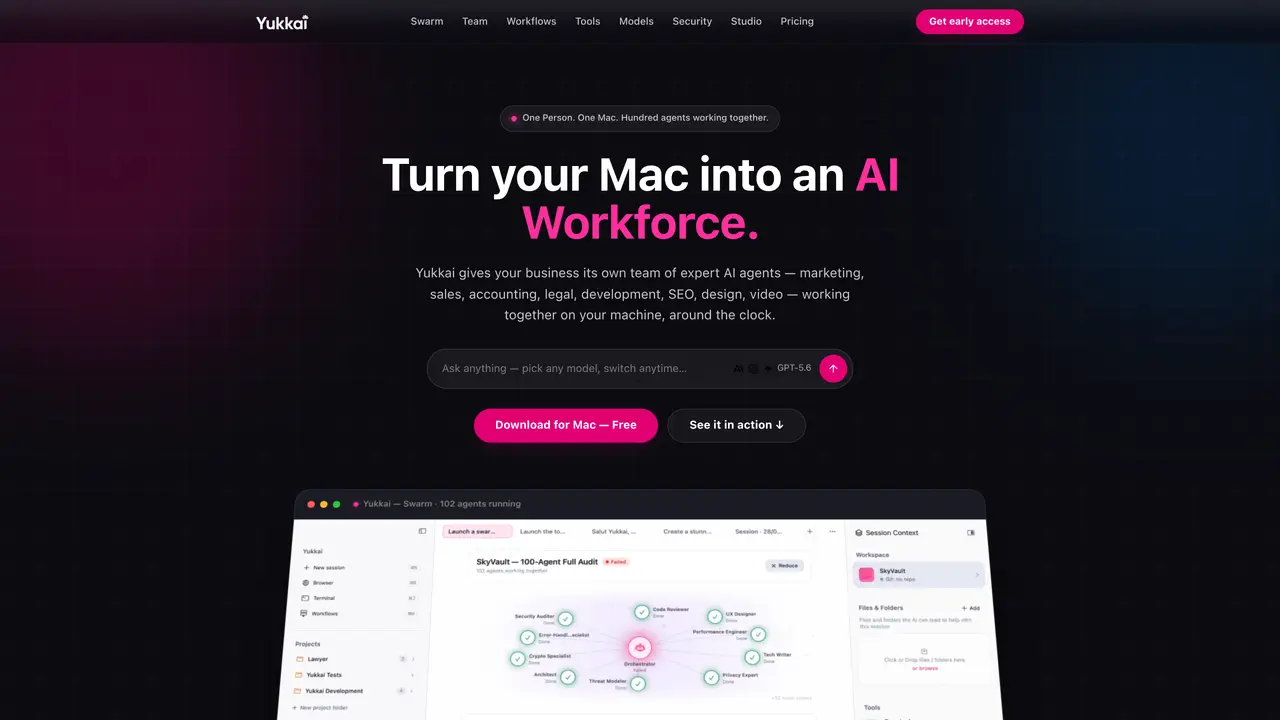
Yukkai turns a Mac into a local AI workforce of up to 100 specialized agents that work in parallel on business tasks such as marketing, sales, accounting, legal, development, SEO, design, and video. The system decomposes goals into parallel tasks, assigns them to agents with defined roles and tools, and merges results while providing a live execution graph. Agents operate with their own skills, tools, and workflows, reporting progress and deliverables like employees. Workflows can be automated with up to 1000 steps, scheduled, and self-healing via an AI Supervisor that retries or reroutes failed steps. The platform integrates over 300 AI models from multiple providers and 50+ local tools, enabling actions such as file operations, terminal commands, desktop control, and browser automation. All work remains on the local machine unless explicitly shared, with human approval required for sensitive actions.
Key features
- Parallel agent execution with live status tracking
- 50+ professional local tools integrated
- 300+ AI models from multiple providers
- Self-healing workflows with error recovery
- Desktop and browser automation capabilities
- Human approval required for sensitive actions
- Markdown report generation for deliverables
- Local file and terminal operations
Use cases
- Automating marketing campaigns with scheduling and brand voice consistency
- Parallel code refactoring and contract auditing across multiple agents
- Generating design assets and video content locally
Pros
- Runs entirely on a single Mac with no cloud dependency
- Up to 100 specialized agents working in parallel
- Supports over 300 AI models from multiple providers
- 50+ built-in local tools for file, terminal, and desktop operations
- Self-healing workflows with up to 1000 steps
Cons
- Requires a Mac to operate
- No pricing details visible on the homepage
- Limited to local execution unless explicitly shared
Frequently asked questions about Yukkai
What is Yukkai and what does it do?
Yukkai turns a Mac into a local AI workforce where up to 100 specialized agents work in parallel on business tasks such as marketing, sales, accounting, legal, development, SEO, design, and video. It decomposes goals into parallel tasks, assigns them to agents with defined roles and tools, and merges results while providing a live execution graph.
Who is Yukkai designed for?
Yukkai is designed for individuals or small teams who want to automate complex business workflows using AI agents on their local machine. It suits users who prefer local processing, human oversight, and the ability to run multiple specialized AI agents simultaneously.
How does Yukkai handle workflow automation and errors?
Yukkai allows users to chain models, tools, and schedules into declarative workflows with up to 1000 steps. Its AI Supervisor autonomously recovers from errors by retrying, rerouting, or repairing failed steps, ensuring workflows run smoothly without constant supervision.
Can Yukkai integrate with external tools or models?
Yes, Yukkai integrates over 300 AI models from multiple providers and supports 50+ local tools. It also allows users to plug in external tool servers via MCP in seconds, enabling actions such as file operations, terminal commands, desktop control, and browser automation.
Does Yukkai require an internet connection to function?
No, all work in Yukkai remains on the local machine unless explicitly shared. It operates offline by default, ensuring data privacy and security, with human approval required for sensitive actions.
How do I get started with Yukkai?
Users can download Yukkai for Mac and start by describing their goals in the command center. The platform guides users through setting up agents, workflows, and tools, with a free plan available to try the system before committing to advanced features.