

Runtime platform for deploying AI workloads, databases and services across clouds or on-premises
303K visits/mo-18%#168 Coding & Development
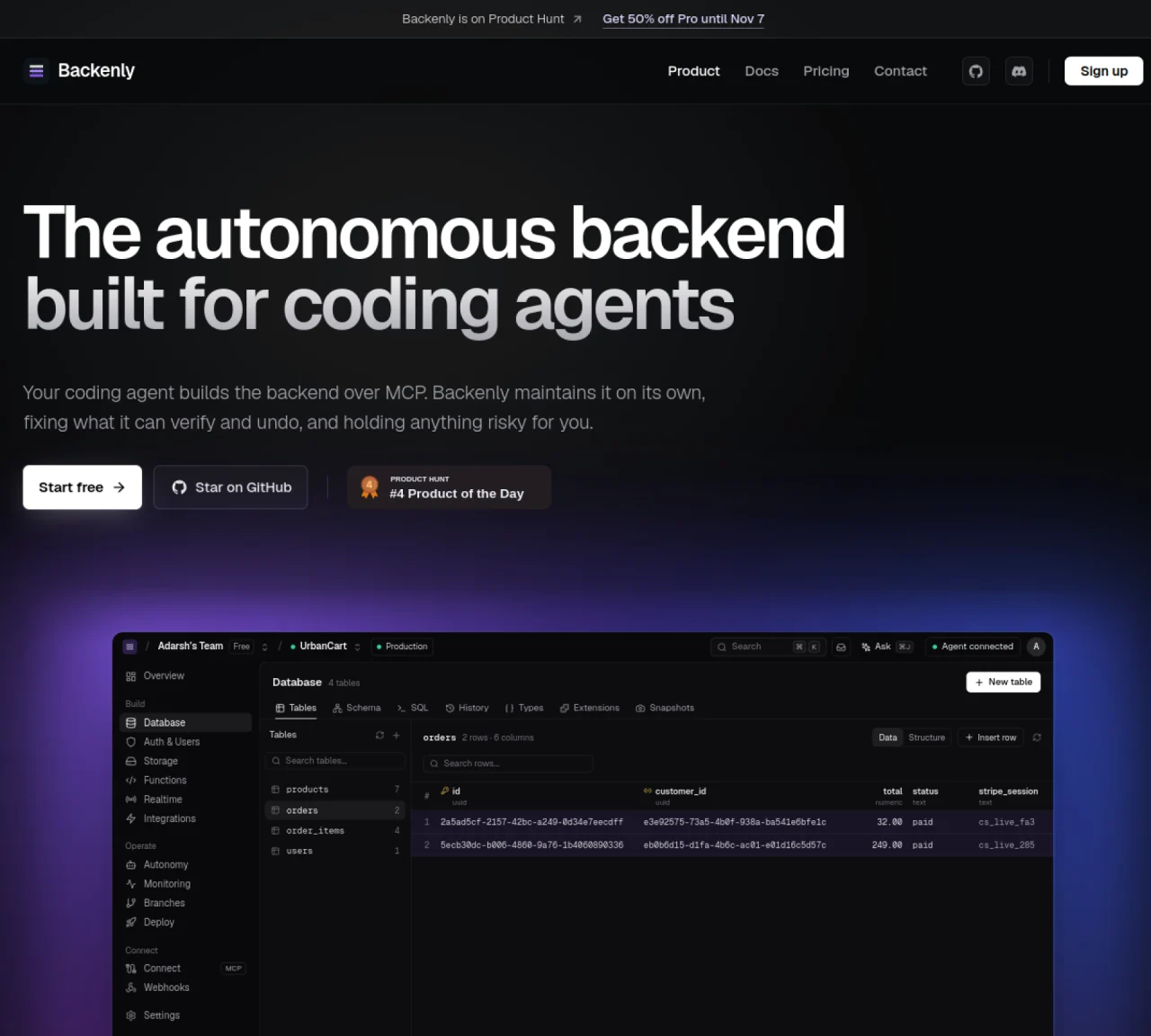
Backenly provides an autonomous backend system designed to work with AI coding agents through the Model Context Protocol (MCP). It maintains and self-heals backend components including database schemas, authentication, storage, functions, and realtime features. The system operates in different modes, allowing certain changes to be applied automatically while requiring explicit approval for destructive or auth-related modifications. Backenly connects to a PostgreSQL database per project, offering standard features such as tables, relations, indexes, constraints, and pgvector support. It provides REST APIs via PostgREST, realtime updates over Server-Sent Events (SSE), and storage buckets with signed URLs. Functions and triggers can run on database events or cron schedules, with webhooks and rate limits included. The platform emphasizes safety through verification, undo capabilities, and a self-healing loop that monitors and repairs issues every minute without human oversight.
Backenly is an autonomous backend system designed to work with AI coding agents through the Model Context Protocol (MCP). It builds, maintains, and self-heals backend components such as database schemas, authentication, storage, functions, and realtime features without requiring constant human oversight.
Backenly is ideal for developers and teams who want to automate backend development and maintenance, especially when using AI coding agents. It suits projects requiring scalable, self-healing databases and APIs with minimal manual intervention.
No. Backenly operates in different modes where safe, additive changes can be applied automatically, while destructive or auth-related modifications always require explicit approval to ensure safety.
Backenly connects to a PostgreSQL database per project, supporting standard features like tables, relations, indexes, constraints, and pgvector. It provides direct connection strings and standard PostgreSQL exports.
Yes. Backenly supports integrations such as Stripe for payments, and provides webhooks, rate limits, and realtime updates via Server-Sent Events (SSE). It also offers REST APIs through PostgREST and storage buckets with signed URLs.
Backenly includes a self-healing loop that monitors and repairs issues every minute without human oversight. It verifies changes, provides undo capabilities, and holds risky modifications for review, ensuring a safety floor that never moves.
We use essential cookies to run aitoolnavio™, and optional cookies to analyze traffic and measure our marketing. You choose what we use — optional cookies stay off unless you turn them on. See our Privacy Policy.
One short email a week: fresh tools worth trying, honest takes and the updates that actually matter. No spam, unsubscribe any time.
Runtime platform for deploying AI workloads, databases and services across clouds or on-premises
Hardware and software stack for high-performance AI inference workloads
Enterprise AI platform for autonomous agent orchestration and real-time data pipelines
Cloud platform providing on-demand and reserved GPU clusters for AI training, fine-tuning and inference
Virtual servers with dedicated NVIDIA GPU acceleration for AI workloads
Unified API gateway for routing, comparing, and operating across 200+ AI models via a single
On-call automation for regulated enterprises that fixes incidents with human approval
Local LLM routing layer for connecting models and tools
Tracks and attributes AI costs across multiple LLM providers with budget controls
Framework for adding AI agents to products with built-in infrastructure
Peer-to-peer AI inference marketplace for running and monetizing models
Marketplace for AI agent tools using the Model Context Protocol standard
Matched on what this tool does — grouped by the job you would be replacing.
matches Autonomous backend maintenance and self-healing · Functions and triggers for database events or cron schedules · Webhooks and rate limits included
AI backend platform that simplifies app development with a database, server functions, and real-time updates for developers.
A backend platform that lets AI coding agents autonomously build, manage, and deploy full-stack apps with integrated databases, storage, and model access.
Turns frontend code into a production-ready backend with Postgres, APIs, auth, and edge functions automatically.
Open-source backend infrastructure provisioned and paid for by AI agents
matches PostgreSQL schema management with tables, relations, and indexes · Authentication with sign-up, OAuth, magic links, and verification emails · REST APIs via PostgREST with filtering, ordering, and pagination
Open-source backend platform providing Postgres, authentication, APIs, and real-time features to build scalable apps quickly.
Open-source backend platform for building and scaling applications
Ship AI apps: Postgres, RAG, agents, workflows.
Unified backend platform combining database, auth, file storage and real-time features