GitHub hosts HunyuanVideo, Tencent's open-source framework for large-scale video generation models, enabling AI-driven video creation.

Eclipse Atesor
$0.0007/pkgStarting price
0Popularity
About Eclipse Atesor
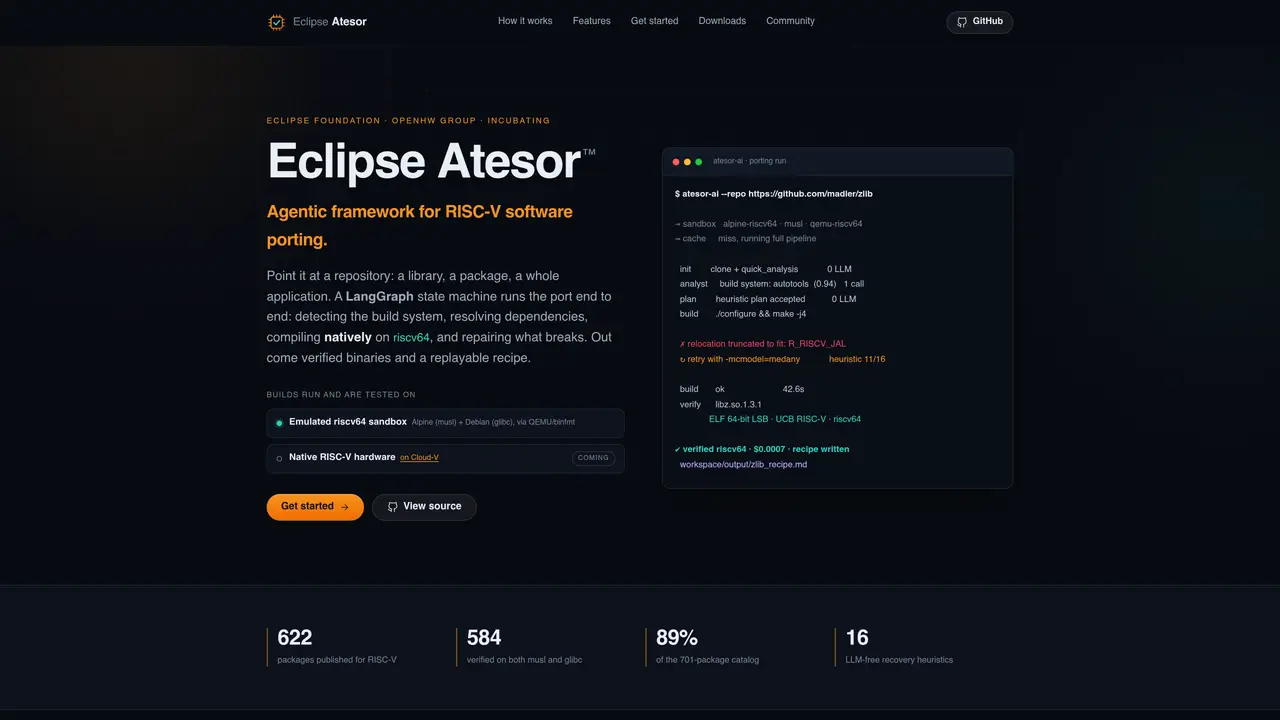
Eclipse Atesor is an agentic framework designed to automate the porting of software to RISC-V architecture. It operates by analyzing a provided repository, detecting the build system, resolving dependencies, compiling natively on riscv64, and repairing build failures. The tool produces verified binaries and a replayable recipe documenting the porting process. Builds are executed and tested within emulated riscv64 sandboxes, including Alpine (musl) and Debian (glibc) environments via QEMU/binfmt, with support for native RISC-V hardware on Cloud-V. The framework uses a LangGraph state machine to manage the porting workflow, minimizing reliance on language models by employing deterministic heuristics for common issues. It handles repetitive porting tasks such as regenerating outdated Autotools scripts, addressing x86-only SIMD dependencies, correcting Go VCS ownership checks, and managing musl versus glibc compatibility. The system is structured around three pillars: scripted operations for deterministic repo inspection, a LangGraph state machine for workflow orchestration, and platform abstraction for distro-specific configurations.
Key features
- Native RISC-V builds without cross-compilation
- ELF architecture verification for output binaries
- 16 LLM-free recovery heuristics for common failures
- Expected-artifact search and artifact curation
- Rate limit and silent OOM kill handling
- Real token accounting with cost caps
- Multi-build system detection (11 systems)
- Platform abstraction for distro-specific configurations
Use cases
- Porting open-source libraries to RISC-V for embedded systems
- Migrating legacy x86 applications to RISC-V environments
- Verifying RISC-V compatibility of software packages across libc families
Pros
- Automates end-to-end RISC-V software porting with minimal manual intervention
- Uses deterministic heuristics to resolve common build failures without excessive LLM calls
- Verifies output binaries for correct RISC-V architecture and expected artifacts
- Supports multiple libc families (musl and glibc) and build systems
- Provides cost control with a hard $1.00 cap per package and real token accounting
Cons
- Limited to RISC-V architecture porting
- Requires emulated or native RISC-V hardware for execution
- No explicit support for other CPU architectures
- May still require human escalation for complex or novel failure cases
Frequently asked questions about Eclipse Atesor
What is Eclipse Atesor and what does it do?
Eclipse Atesor is an agentic framework designed to automate the porting of software to the RISC-V architecture. It analyzes a provided repository, detects the build system, resolves dependencies, compiles natively on riscv64, and repairs build failures to produce verified binaries and a replayable recipe.
Who should use Eclipse Atesor?
Eclipse Atesor is suitable for developers, organizations, or teams working with software porting to RISC-V architecture, particularly those needing to automate repetitive porting tasks or verify compatibility across different environments.
How does Eclipse Atesor handle build failures during porting?
The tool uses a LangGraph state machine to manage the porting workflow, employing deterministic heuristics for common issues and LLM-backed retry loops for more complex problems. It automatically detects and repairs failures such as stale Autotools scripts, x86-only SIMD dependencies, or musl versus glibc compatibility issues.
What environments does Eclipse Atesor support for builds?
Builds are executed and tested within emulated riscv64 sandboxes, including Alpine (musl) and Debian (glibc) environments via QEMU/binfmt. Native RISC-V hardware on Cloud-V is also supported for certain workflows.
How does Eclipse Atesor ensure the correctness of the ported binaries?
The framework verifies binaries by checking their ELF architecture and confirming they are riscv64-compliant. It also uses expected-artifact search to validate outputs and ranks them to ensure correctness before finalizing the port.
What is the role of LangGraph in Eclipse Atesor?
LangGraph is used to create a state machine that orchestrates the porting workflow. It manages deterministic operations, conditional routing, and a build-verify-fix retry loop, minimizing reliance on language models by using heuristics for common issues.