
OpenAI builds and deploys advanced AI models like GPT-4o for autonomous agents and workflows.

Hexum
€0.30Starting price
0Popularity
About Hexum
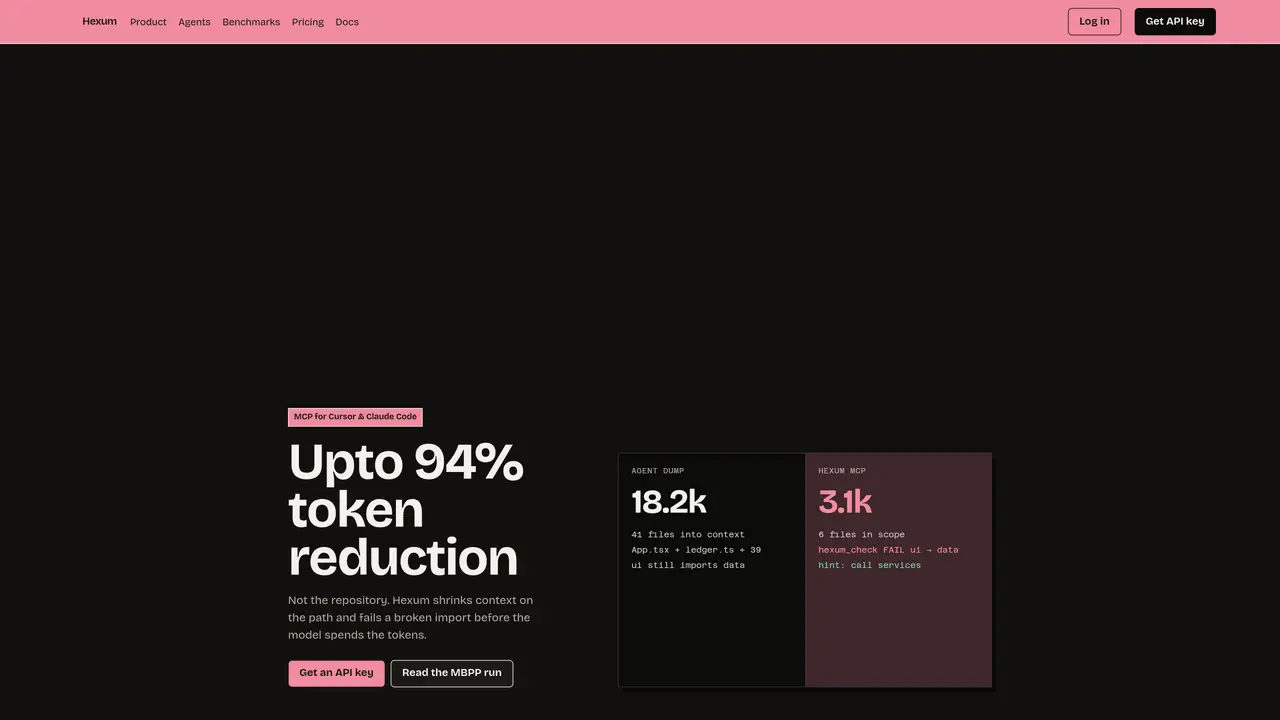
Hexum is a hosted Model Context Protocol server designed for coding agents such as Cursor and Claude Code. It operates between the agent and the model, replacing repository-wide context with a focused subset of files relevant to the current task. The tool uses two primary functions: hexum_shrink, which sends only the necessary context for a given turn, and hexum_check, a deterministic validator that fails the turn if the architecture defined in architecture.hexum is violated. This approach reduces token usage significantly, as demonstrated on benchmarks like MBPP where context dropped from 18.2k to 3.1k tokens while maintaining test pass rates. Hexum does not store repositories, train on user code, or function as an IDE or model itself. It integrates directly into existing agents via MCP and bills based on tokens saved, with no seat fees or monthly caps. The architecture file defines layers and rules for file relationships, ensuring consistent scoping across turns.
Key features
- hexum_shrink sends scoped context instead of full repository
- hexum_check validates architecture deterministically
- Token counts returned for each call
- Zero Data Retention for all payloads
- Usage billing with no monthly cap
- Teams plan with shared billing and pooled usage
- Supports architecture.hexum, .hexum, or *.hexum files
- Cache hits are billed at zero cost
Use cases
- Reducing token costs for coding agents on large repositories
- Enforcing architectural constraints during agent-assisted development
- Validating code structure before model processing
Pros
- Reduces token usage by sending only relevant context to the model
- Deterministic architecture validation without LLM calls
- Zero Data Retention policy for user code
- Billing based on tokens saved, not per seat
- Supports Cursor, Claude Code, and other MCP-compatible agents
Cons
- Requires architecture.hexum file to define layers and rules
- No CLI or browser IDE support
- Pricing based on tokens saved may be less predictable for some users
- Limited to MCP-compatible agents only
Frequently asked questions about Hexum
What is Hexum?
Hexum is a hosted Model Context Protocol server for coding agents like Cursor and Claude Code. It sits between the agent and the model, replacing repository-wide context with a focused subset of files relevant to the current task using functions like hexum_shrink and hexum_check.
Does Hexum replace Cursor or Claude Code?
No. Hexum is an MCP server that integrates with existing agents such as Cursor, Claude Code, Antigravity, Codex, or Grok. It does not function as an IDE or a model itself.
How does Hexum reduce tokens?
Hexum reduces tokens by calling hexum_shrink before the model reads widely, sending only the necessary context for the current task. For example, on MBPP, context dropped from 18.2k to 3.1k tokens while maintaining test pass rates.
Is hexum_check an LLM?
No. hexum_check is a deterministic validator that maps files to layers in architecture.hexum and reports forbidden imports without calling a model.
How is Hexum billed?
Hexum bills based on tokens saved, calculated as input tokens minus tokens still sent to the model. Cache hits are free, and there are no monthly caps or seat fees.
Does Hexum store my repository?
No. Hexum follows a Zero Data Retention policy and does not store repositories or train on user code. MCP payloads are not retained.