GitHub hosts HunyuanVideo, Tencent's open-source framework for large-scale video generation models, enabling AI-driven video creation.

ClariLayer
FreeStarting price
571Monthly visits
0Popularity
About ClariLayer
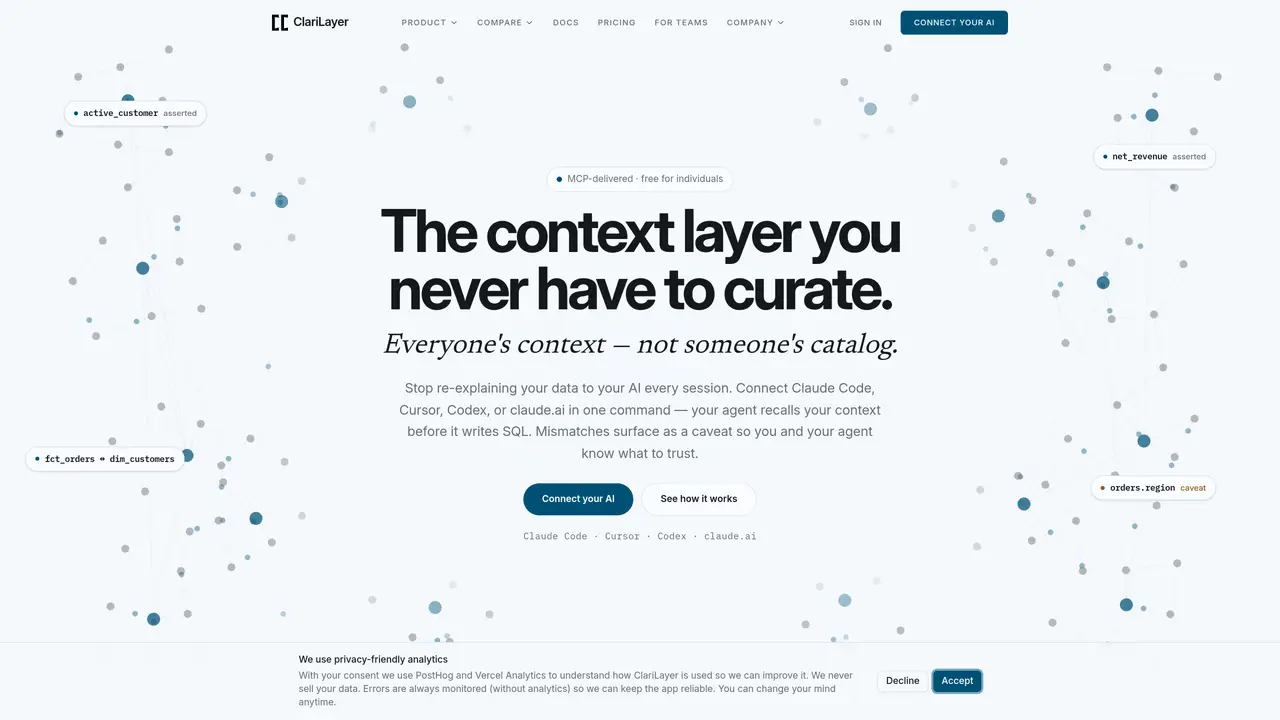
ClariLayer provides a persistent context layer for AI data agents, ensuring they retain and reconcile data definitions across sessions without requiring manual re-explanation. It integrates with popular coding agents such as Claude Code, Cursor, Codex, and claude.ai through an MCP server, enabling agents to recall saved definitions, bootstrap from existing files, and identify discrepancies between stored data and live warehouse results. The tool flags mismatches as caveats, helping users address data drift by comparing asserted definitions with actual warehouse outputs. ClariLayer supports a variety of data sources, including SQL, dbt, CLAUDE.md, dictionaries, and semantic models, while maintaining strict security by never storing warehouse credentials or executing SQL server-side. Designed for analysts and teams, it ensures consistent, verified context for AI-driven analytics and reporting workflows. By bridging the gap between static documentation and dynamic data environments, ClariLayer reduces errors and improves reliability in AI-assisted data tasks.
Key features
- Recall saved data definitions before each session
- Reconcile asserted context with live warehouse results
- Bootstrap from SQL, dbt, CLAUDE.md, dictionaries, or semantic models
- Flag mismatches as caveats for agent awareness
- Maintain context consistency across sessions
- Integrate with Claude Code, Cursor, Codex, or claude.ai
- Never hold warehouse credentials or execute SQL server-side
- Support for HubSpot definitions with bounded evidence
Use cases
- Preventing recurring data mistakes in AI-generated SQL queries
- Maintaining consistent revenue and customer definitions across sessions
- Reducing time spent re-explaining data context to AI agents
Pros
- Recalls saved data definitions across sessions without manual re-entry
- Reconciles asserted context with live warehouse data to flag mismatches
- Integrates with existing coding agents via MCP server
- Supports multiple source types including SQL, dbt, and semantic models
- Free for individual use with no usage meter or per-seat fees
Cons
- Governed Context Edge for teams is in private pilot with no public pricing
- Limited to specific coding agents (Claude Code, Cursor, Codex, claude.ai)
- Requires MCP server installation for full functionality
- No support for non-MCP agents or platforms outside the listed integrations
Frequently asked questions about ClariLayer
What is ClariLayer and what does it do?
ClariLayer provides a context layer for AI data agents, enabling them to recall and reconcile data definitions without manual re-explanation in each session. It integrates with coding agents like Claude Code, Cursor, Codex, and claude.ai via an MCP server to remember saved definitions, bootstrap from existing files, and flag discrepancies between saved and live data as caveats.
Who should use ClariLayer?
ClariLayer is designed for analysts and teams who need consistent, verified context for AI-driven analytics and reporting. It suits users who rely on AI agents for data tasks and want to avoid re-explaining data definitions repeatedly.
How does ClariLayer integrate with AI agents?
ClariLayer integrates with coding agents such as Claude Code, Cursor, Codex, and claude.ai via an MCP server. Users connect their AI agent with a single command, and ClariLayer recalls saved context before the agent writes SQL or performs data tasks.
Does ClariLayer hold warehouse credentials or execute SQL server-side?
No, ClariLayer never holds warehouse credentials or executes SQL server-side. The agent retains its own warehouse access, while ClariLayer reconciles definitions and flags mismatches as caveats without direct data manipulation.
What sources does ClariLayer support for context?
ClariLayer supports sources including SQL files, dbt models, CLAUDE.md files, data dictionaries, and semantic models. It bootstraps context from existing files without requiring a blank-slate setup.
How does ClariLayer handle data drift or discrepancies?
ClariLayer addresses data drift by comparing asserted definitions with live warehouse results. When discrepancies are detected, it flags them as caveats, allowing users and agents to identify what to trust or correct.
ClariLayer Website Engagement
Last Update: 9 days ago
Total Monthly Visits
0
Bounce Rate
0%
Visit Duration (avg)
—
Pages Per Visit
0
Country Rank
—
Unknown
Global Rank
—