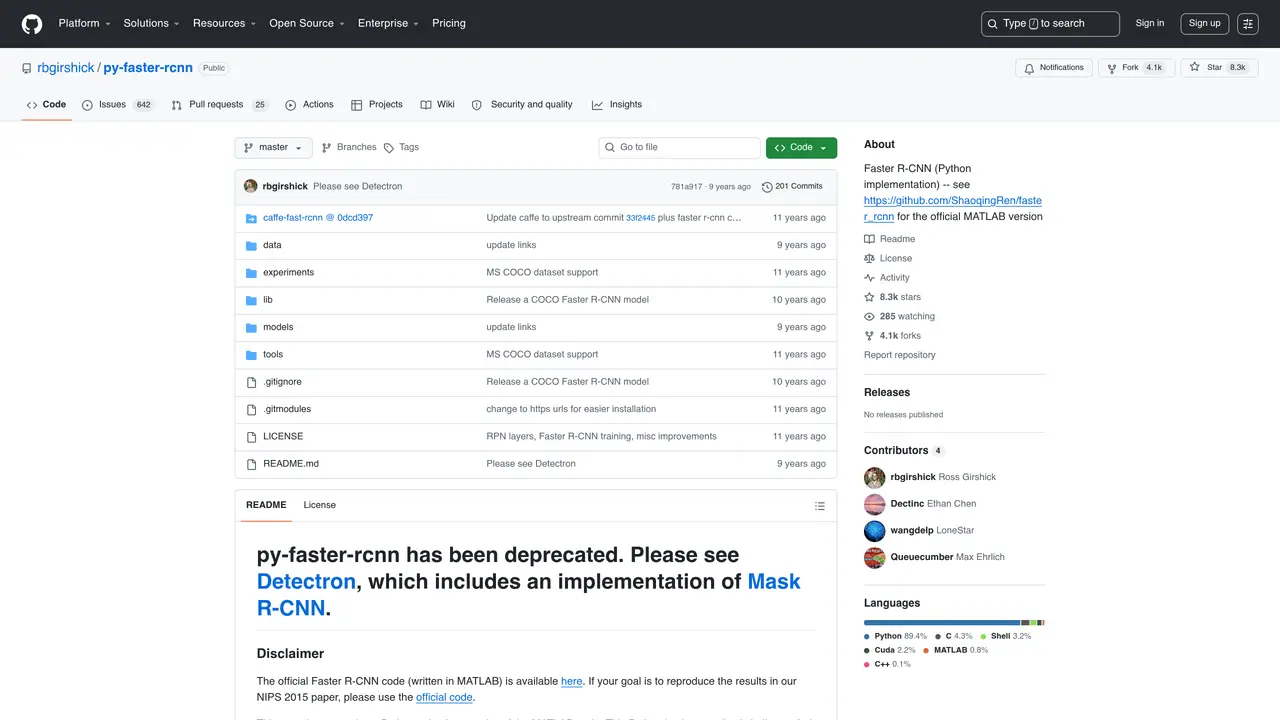
GitHub hosts HunyuanVideo, Tencent's open-source framework for large-scale video generation models, enabling AI-driven video creation.

R-FCN
$0.07Starting price
0Popularity
About R-FCN
R-FCN is a powerful object detection system for image classification and object recognition. It enables users to quickly and accurately identify objects in images, such as cars, pedestrians, and animals. The system uses a deep convolutional neural network to detect objects in an image and then classify them according to their features. R-FCN can detect objects in both still images and in video streams. The system is designed to be fast, accurate, and easy to use. It provides users with high detection accuracy and reliable classification performance. It also has an intuitive user interface, making it easy for both experienced and novice users to work with. This makes it ideal for a wide range of applications, including self-driving cars, surveillance, and machine vision. Additionally, the system is highly scalable and can handle large datasets with ease. Overall, R-FCN is an excellent choice for users looking for a powerful object detection and classification system.
GitHub, Inc.
San Francisco, California, US · Founded 2008
- Founders
- Tom Preston-Werner, Chris Wanstrath, PJ Hyett, Scott Chacon
- Founded
- 2008
- Headquarters
- San Francisco, California, US
- Legal status
- Subsidiary of Microsoft (NASDAQ: MSFT)
Key features
- Object detection in images
- Object recognition in video streams
- Deep convolutional neural network
- High detection accuracy
- Reliable classification performance
- Intuitive user interface
- Scalable and can handle large datasets
Use cases
- Self-driving cars
- Surveillance systems
- Machine vision applications
Pros
- Implements Faster R-CNN architecture for real-time object detection
- Built on a Python-based fork of Fast R-CNN for broader accessibility
- Supports region proposal networks (RPNs) for improved detection accuracy
- Includes approximate joint training for faster optimization compared to alternating methods
- Provides a reimplementation of the original MATLAB-based Faster R-CNN with minor adjustments
Cons
- Deprecated in favor of newer frameworks like Detectron and Mask R-CNN
- Python implementation is approximately 10% slower than the official MATLAB version during testing
- Not fully compatible with models trained using the MATLAB code due to implementation differences
- Requires specific hardware configurations, such as GPUs with sufficient memory for training
Frequently asked questions about R-FCN
What is R-FCN and what does it do?
R-FCN is a region-based convolutional neural network framework designed for object detection in images and video streams. It identifies and classifies objects such as vehicles, pedestrians, and animals by analyzing visual features through deep learning.
Who is R-FCN suitable for?
R-FCN is suitable for researchers, developers, and organizations working on computer vision tasks, including autonomous systems, surveillance, and machine vision applications. It is particularly useful for those requiring real-time or near-real-time object detection capabilities.
How does R-FCN work?
R-FCN uses a deep convolutional neural network to process images, generating region proposals and classifying objects based on learned features. It employs a region proposal network (RPN) to efficiently detect objects and a classification network to assign labels to detected regions.
What are the key features of R-FCN?
R-FCN supports end-to-end training and testing for object detection, includes approximate joint training for faster optimization, and is compatible with models trained using its Python implementation. It also provides tools for evaluating performance on datasets like PASCAL VOC.
What are the limitations of R-FCN?
The Python implementation of R-FCN is approximately 10% slower at test time compared to the official MATLAB version due to CPU-bound operations in Python layers. It may not achieve identical mean average precision (mAP) results as the MATLAB implementation.
How can I get started with R-FCN?
To get started, clone the R-FCN repository, install required dependencies such as Caffe with Python layer support, and follow the provided demo instructions. Ensure your system meets the hardware requirements, particularly for GPU memory when training larger networks.