GitHub hosts HunyuanVideo, Tencent's open-source framework for large-scale video generation models, enabling AI-driven video creation.
Skaftor
$99/mStarting price
0Popularity
About Skaftor
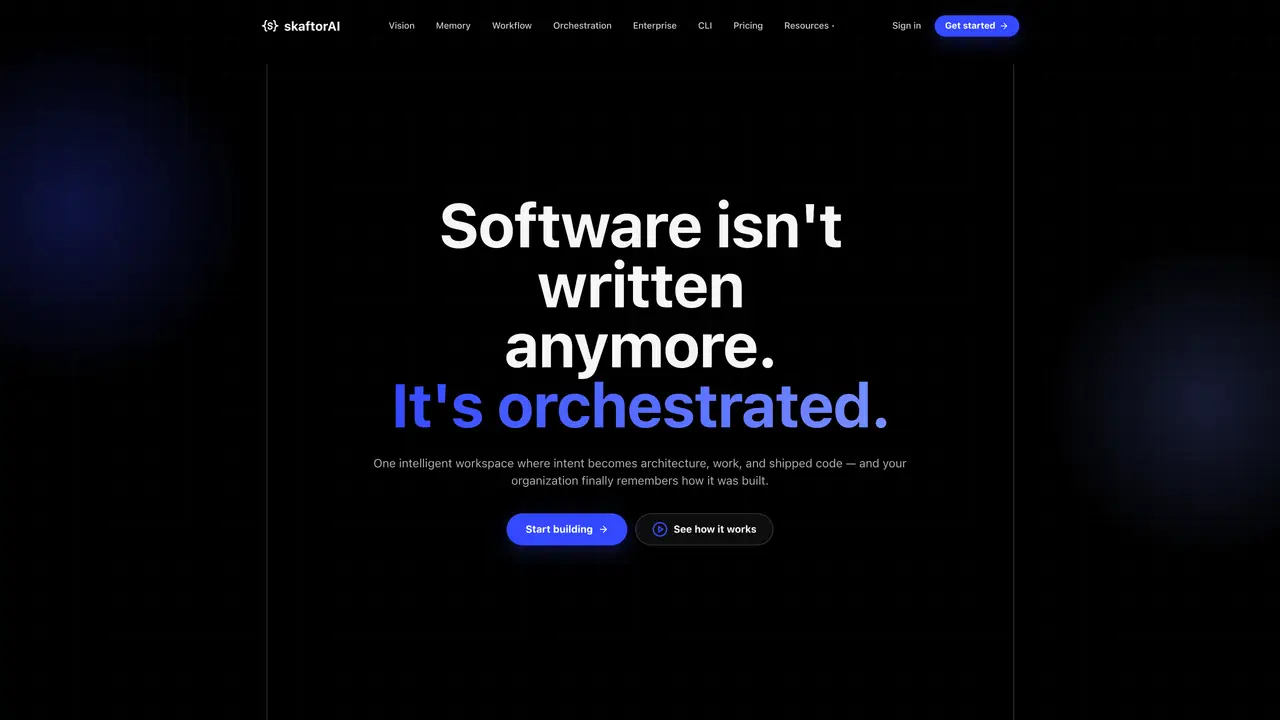
Skaftor provides a unified workspace where software delivery is treated as orchestration rather than manual coding. It connects existing development tools such as GitHub, GitLab, Jira, and Cursor into a single environment where intent is translated into architecture, executable work orders, and deployable code. The system maintains a persistent memory of every decision, enabling teams to trace changes from initial intent through to production while preventing knowledge loss between handoffs. Engineers shift focus from writing lines of code to directing outcomes, with coding agents executing work orders under controlled workflows that include review, approval, and audit trails. The platform supports role-based access, immutable audit logs, and compliance features like SSO and SCIM, ensuring security and traceability across teams and environments. It also includes automated invariant checking to ensure code remains aligned with specifications throughout the development lifecycle.
Key features
- Intent-to-architecture translation
- Work order orchestration and assignment
- Automated pull request creation and review
- Traceable deployment with immutable audit trail
- Knowledge graph linking features, decisions, repos, and people
- Impact analysis and duplicate work detection
- Role-based access control and approval workflows
- Invariant and specification compliance checking
Use cases
- Orchestrating AI-native software delivery from intent to production
- Maintaining organizational memory of software decisions and dependencies
- Enforcing compliance and traceability in regulated development environments
Pros
- Tracks intent through architecture, work orders, and shipped code in one traceable thread
- Integrates with existing tools like GitHub, GitLab, Jira, Cursor, and Claude
- Maintains persistent organizational memory of decisions and artifacts
- Supports role-based access, audit trails, and compliance controls
- Automates invariant checking to prevent silent divergence from specifications
Cons
- No pricing information available on the homepage
- Limited to integration with specific tools and platforms
- Requires adoption of a new workflow model for software delivery
Frequently asked questions about Skaftor
What is Skaftor and what problem does it solve?
Skaftor is an AI-native software delivery platform that treats software development as orchestration rather than manual coding. It connects existing development tools into a unified workspace where intent is translated into architecture, executable work orders, and deployable code while maintaining a persistent memory of every decision to prevent knowledge loss.
Who is Skaftor designed for?
Skaftor is designed for engineering teams, product managers, technical leads, and leadership who want to shift focus from writing code to directing outcomes. It suits organizations looking to improve traceability, collaboration, and compliance in software delivery.
How does Skaftor integrate with existing development tools?
Skaftor plugs into tools such as GitHub, GitLab, Bitbucket, Cursor, Claude, Jira, Linear, Notion, Confluence, and cloud platforms like AWS, Google Cloud, and Azure. It unifies these tools into a single workspace where every agent shares the same context and decisions are remembered.
What is the workflow in Skaftor?
The workflow starts with defining intent, which is translated into architecture and executable work orders. Coding agents then execute these work orders, open pull requests for review, and deploy code to production, all while maintaining an immutable audit trail of every decision and change.
Does Skaftor support compliance and security features?
Yes, Skaftor includes role-based access control, immutable audit logs, approval workflows, SSO, SCIM, and automated invariant checking to ensure code remains aligned with specifications and compliance requirements.
How does Skaftor handle code and specification alignment?
Skaftor treats specifications like source code, compiling every requirement into gated invariants that flag divergence between code and intent. It also detects silent divergence, staleness, and composition gaps before code is written or deployed.