GitHub hosts HunyuanVideo, Tencent's open-source framework for large-scale video generation models, enabling AI-driven video creation.

StableLM
$20Starting price
0Popularity
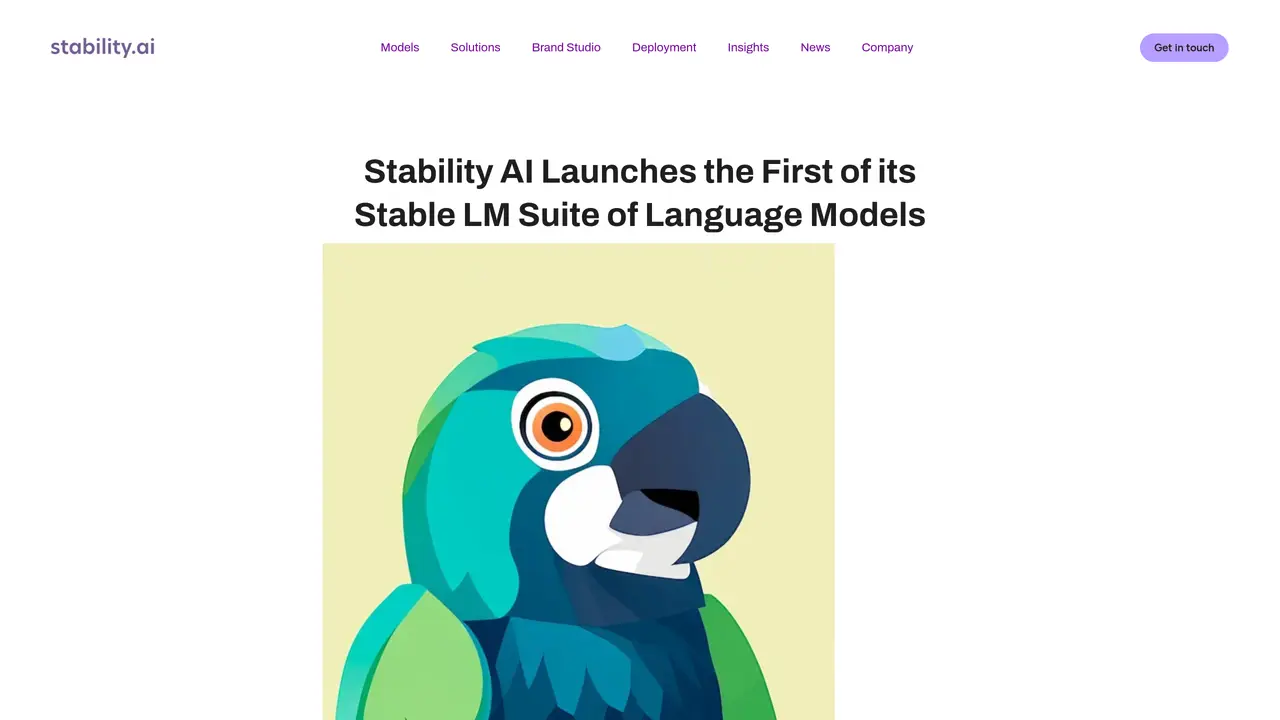
About StableLM
StableLM is a suite of language models developed by Stability.AI that helps organizations create more accurate and reliable natural language processing (NLP) systems. With StableLM, organizations can better understand customer questions, accurately classify documents, and quickly respond to customer inquiries. StableLM leverages advanced machine learning algorithms to quickly and accurately process natural language data. It offers organizations enhanced data security, improved accuracy, and greater scalability. The suite also provides a wide range of features designed to simplify the development and deployment of NLP systems, including tools to customize model architecture, optimize hyperparameters, and evaluate performance. The benefits of StableLM are far-reaching. The suite enables organizations to create more accurate and reliable systems that can quickly process customer inquiries and documents. It also provides enhanced security, scalability, and performance, allowing organizations to quickly deploy and scale their NLP systems.
Stability AI
London, United Kingdom · Founded 2019
- Founders
- Emad Mostaque, Cyrus Hodes
- Founded
- 2019
- Headquarters
- London, United Kingdom
- Legal status
- Private
Key features
- Create accurate customer question classification systems
- Automate customer inquiries with NLP processing
- Deploy scalable NLP systems
- Customize model architecture
- Optimize hyperparameters
- Evaluate performance
Use cases
- Classifying customer questions for improved support
- Automating customer inquiries for increased efficiency
- Deploying scalable NLP systems for business growth
Pros
- Open-source models with transparent architecture for public inspection and customization
- Available in multiple parameter sizes (3B, 7B, 15B–65B) to suit different use cases
- Trained on a large experimental dataset (1.5 trillion tokens) for improved performance in conversational and coding tasks
- Supports both commercial and research use under permissive licenses (CC BY-SA-4.0 for base models)
- Designed for edge deployment, enabling local and independent application development without reliance on proprietary services
Cons
- Alpha version models may lack full stability or optimization for production environments
- Fine-tuned instruction models are initially restricted to noncommercial research use (CC BY-NC-SA 4.0)
- Smaller parameter models (3B–7B) may underperform compared to larger proprietary models in complex tasks
Frequently asked questions about StableLM
What is StableLM and what does it do?
StableLM is an open-source suite of language models developed by Stability AI, designed to generate text and code for various applications. It includes base models and fine-tuned instruction models optimized for conversational and coding tasks.
Who should use StableLM?
StableLM is intended for developers, researchers, and organizations seeking transparent, accessible, and customizable language models for commercial or research purposes. It supports both technical and non-technical users.
How can I access and use StableLM?
StableLM models are available on Stability AI’s GitHub repository under open-source licenses. Users can inspect, adapt, and deploy the models locally or in their applications, subject to the specified license terms.
What are the licensing terms for StableLM?
The base StableLM models are released under the CC BY-SA-4.0 license, allowing commercial and research use with attribution. Fine-tuned instruction models are released under a noncommercial CC BY-NC-SA 4.0 license.
Does StableLM support fine-tuning or customization?
Yes, StableLM is designed for customization. Users can fine-tune the models for specific applications, optimize performance, and adapt them to their unique requirements without sharing sensitive data.
What hardware is required to run StableLM?
StableLM is designed to run on widely available hardware, including local devices, making it accessible for edge deployment. The models are optimized for efficiency, supporting deployment on standard computing environments.