
Scales efficient language processing with open-source accessibility.
357M visits/mo+1%#2 Coding & Development

Vector database with deterministic state and graph support for auditable AI systems
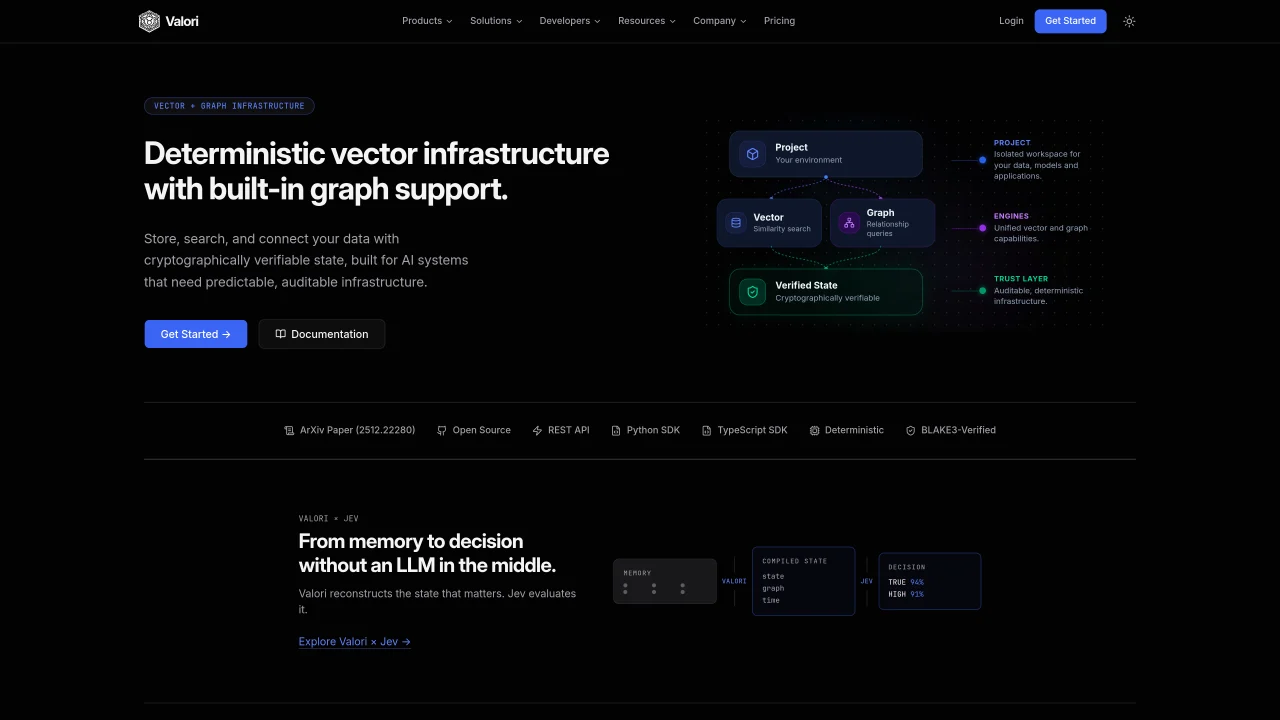
Valori provides a vector database designed for reproducible state in AI applications. It stores, indexes, and searches vector data through a REST API, ensuring that the same inputs produce identical outputs across different machines. The system uses fixed-point (Q16.16) computation instead of floating point to guarantee deterministic results. Every write operation commits to a BLAKE3-chained log and returns a receipt containing pre- and post-write state roots, enabling verifiable and replayable state recovery. The platform also supports graph relationships alongside vector similarity search, allowing users to query both data types within a single system. Valori is accessed primarily via a REST API with official Python and TypeScript SDKs, requiring no local infrastructure to begin use. It is positioned for applications where knowing the exact state behind a result is critical, such as retrieval-augmented generation, recommendation systems, and AI agent memory. The product emphasizes auditable, cryptographically verifiable infrastructure for AI workloads that demand predictability and compliance.
Valori is a deterministic vector infrastructure with built-in graph support designed for AI applications that require reproducible and auditable state. It stores, indexes, and searches vector data through a REST API, ensuring the same inputs produce identical outputs across different machines using fixed-point computation.
Valori is positioned for applications where knowing the exact state behind a result is critical, such as retrieval-augmented generation, recommendation systems, AI agent memory, and data analysis. It suits industries like ecommerce, legal, finance, healthcare, and high-frequency trading where verifiable vector search matters.
Valori uses fixed-point (Q16.16) computation instead of floating point to guarantee identical outputs on any machine. Every write operation commits to a BLAKE3-chained log and returns a receipt containing pre- and post-write state roots, enabling verifiable and replayable state recovery.
Valori provides a REST API and official Python and TypeScript SDKs for easy integration. It requires no local infrastructure to begin use, allowing users to authenticate and search vectors directly via HTTPS requests or SDKs.
Valori is currently in public beta, with Pro and Enterprise tiers in private preview, which may limit immediate access to advanced features. The system is designed for deterministic and verifiable state, which may introduce performance trade-offs compared to traditional floating-point vector databases.
To get started, create a project on Valori Cloud, obtain an API key, and begin storing vectors or running searches via the REST API or official SDKs. The platform offers documentation and an API reference to guide users through the process.
We use essential cookies to run Aitoolnavio, and optional cookies to analyze traffic and measure our marketing. You choose what we use — optional cookies stay off unless you turn them on. See our Privacy Policy.
One short email a week: fresh tools worth trying, honest takes and the updates that actually matter. No spam, unsubscribe any time.
Scales efficient language processing with open-source accessibility.
Collaboration and version control platform for software development and AI model hosting.
xAI builds Grok frontier AI models for reasoning, coding, voice, images, video, enterprise workflows, and developer APIs.
Unified platform to access and switch between hundreds of AI models like ChatGPT, Claude, and Gemini via a single API.
Meta AI enhances machine learning, NLP, and computer vision capabilities.
Crowdsourced platform for blind, side-by-side AI model comparisons with a public leaderboard.
Customize, deploy, and control AI models securely.
AI-first electronic design automation for ICs, advanced packaging, and systems with hardware-assisted acceleration and elastic cloud delivery.
AI models that return typed decisions with calibrated confidence for software automation
Chat, build, and explore with open AI models.
Multimodal AI models for text, video, speech, music, and coding
Develop, run data jobs, transform datasets, leverage ML algorithms for actionable insights.
Matched on what this tool does — grouped by the job you would be replacing.
matches Vector similarity search · Graph relationship queries · Cryptographically verifiable state
Open-source graph-native engine that unifies enterprise knowledge, grounds AI responses in verified facts, and exports auditable decision lineage for regulated domains.
AI-native search engine and document database for enterprise teams, combining vector search, keyword matching, and faceting in one query with sub-10ms latency.
Hosted knowledge graph platform that prepares enterprise data for AI use
matches Cryptographically verifiable state · State receipts for pre- and post-write verification · Runtime enforcement layer for governing AI agents and generating compliance proofs
Runtime enforcement layer for governing AI agents and generating compliance proofs
Verifies service-level agreements for APIs and AI agents by producing portable cryptographic receipts
MCP server for AI compliance and trust verification